01Facts
Respondent No. 2 alleged that his company and the petitioners’ company entered into an arrangement for sourcing materials and manufacturing garments for Benetton (UCB).
pp. 3–4, 8–9The complaint alleged that payments were to be credited to an escrow account, but petitioner No. 2 instead received the payment in her separate account and used it for her personal benefit.
pp. 3–4, 8–9On the complaint, police registered Crime No. 327/2022 for offences under Sections 406 and 420 read with Section 34 of the IPC.
pp. 2, 4–6The petitioners sought quashing under Section 482 of the CrPC, contending that the dispute was civil and the complaint did not disclose the alleged offences.
pp. 2, 4–602Issues
i.1. Whether the complaint and material on record prima facie disclosed offences under Sections 406 and 420 read with Section 34 of the IPC
pp. 8–10ii.2. Whether the FIR should be quashed under Section 482 of the CrPC because the dispute arose from a commercial transaction and was, in the petitioners’ submission, civil in nature
pp. 5–7, 9–1003Law Applied
The petition invoked Section 482 of the CrPC, which empowers the High Court to prevent abuse of process and secure the ends of justice.
The alleged offences were under Sections 406 and 420 read with Section 34 of the IPC.
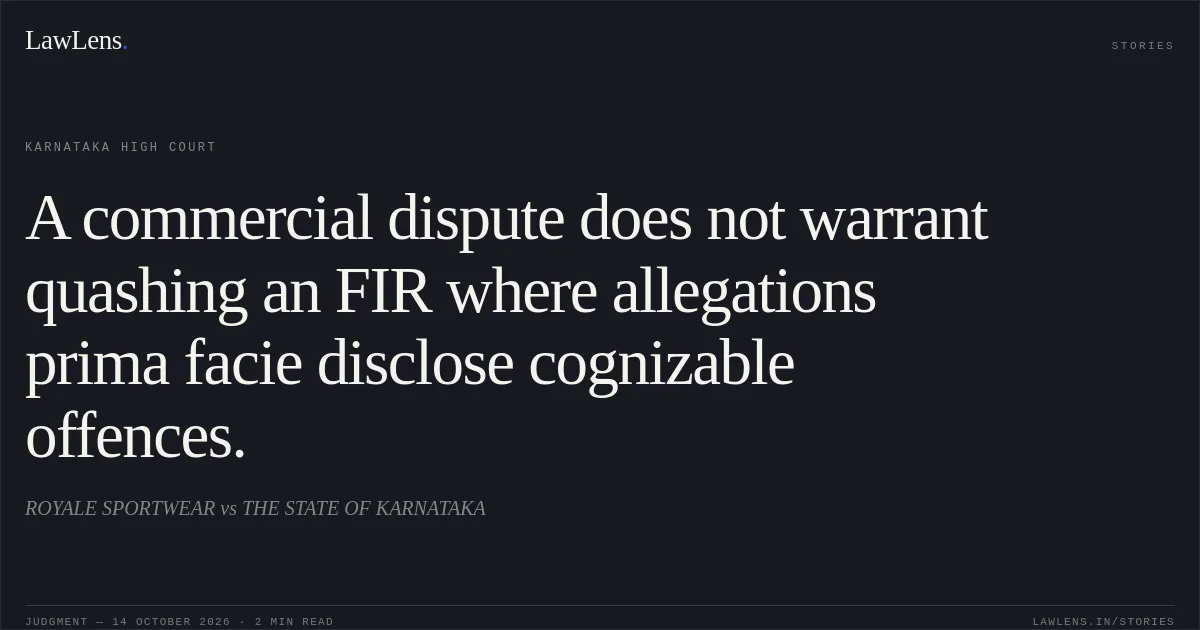
The Court applied the principle that a commercial character does not, by itself, warrant quashing where the complaint and available material prima facie disclose cognizable offences; nor should a matter be terminated at the threshold on the basis of an unsubstantiated defence while investigation remains at an early stage.
pp. 9–10The petitioners cited Deepak Gaba v. State of Uttar Pradesh, Salib @ Shalu @ Salim v. State of Uttar Pradesh and Lalit Chaturvedi v. State of Uttar Pradesh; the order does not set out or separately apply propositions from those decisions.
p. 6Provisions in the judgment · 4 · Linked ones open on LawLens
Code of Criminal Procedure, 1973 Section 482
Indian Penal Code, 1860 Section 34Section 406Section 420
04Reasoning
The Court considered the purchase order, the parties’ correspondence and the petitioners’ admission that an escrow account had been opened for receiving Benetton’s payment.
pp. 8–9It found that these materials prima facie supported the allegation that payment was received in petitioner No. 2’s separate account rather than the escrow account, contrary to the parties’ arrangement.
pp. 8–9On that basis, the Court held that the allegations prima facie disclosed cheating under Section 420 IPC and that the serious allegations concerning the funds required investigation.
pp. 9–10It declined to resolve the petitioners’ competing account of the transaction or assess their defence at the quashing stage.
pp. 9–1005Holding
The Court held that the FIR did not warrant interference at the nascent stage of investigation
p. 10dismissed the criminal petition for lack of merit.
p. 10Original Court PDF
ROYALE SPORTWEARvsTHE STATE OF KARNATAKA
Click to open original judgment
Original judgment, available to read, download and summarize on LawLens.in