Facts
The petitioner applied pursuant to Advertisement No. 1/2016 for recruitment as a Male Constable in the Punjab Police. Clause 6(C) required candidates to possess 10+2 or an equivalent qualification, with the qualification attained on or before the date of publication of the advertisement. The petitioner submitted a CBSE 10+2 certificate dated 21 May 2016, but the certificate recorded his result as “Compartment”.
Source reference: paras. 2–3; pp. 2–3He was nevertheless enrolled as a provisional constable on 17 December 2016 and allotted a regimental number on 21 December 2016.
Source reference: para. 3; p. 3The department subsequently initiated disciplinary proceedings on the ground that the petitioner did not possess the requisite qualification on the relevant cut-off date. During the inquiry, the petitioner remained absent from 21 March 2022 to 15 June 2022, and ex parte proceedings were conducted. The inquiry officer found the charge proved, following which the petitioner was dismissed from service on 16 August 2022.
Source reference: para. 3; pp. 3–4His statutory appeals and subsequent representations were rejected between 9 January 2023 and 15 April 2025.
Source reference: para. 3; p. 4The petitioner relied on a second 10+2 certificate issued by the Rural Institute of Open Schooling, Delhi, dated 26 December 2016, and contended that his subsequent qualification and more than five years of service justified continuation in employment.
Source reference: para. 4; p. 5The State argued that the later certificate was issued after the cut-off date and could not cure the petitioner’s ineligibility at the time of recruitment.
Source reference: para. 5; p. 5Issues
1. Whether the petitioner possessed the essential educational qualification prescribed under Clause 6(C) of the recruitment advertisement on the relevant cut-off date, despite the CBSE certificate recording his result as “Compartment”?
Source reference: paras. 7, 13; pp. 6, 152. Whether the departmental inquiry, ex parte proceedings, dismissal order, and subsequent appellate orders suffered from procedural illegality, violation of natural justice, perversity, or findings based on no evidence so as to warrant interference under Article 226 of the Constitution?
Source reference: paras. 8–11, 13; pp. 6–153. Whether the petitioner’s subsequent 10+2 certificate and length of service warranted relief against dismissal under the principle relied upon from Dr. M.S. Mudhol?
Source reference: paras. 4, 14; pp. 5, 15–16Law Applied
Under State of Andhra Pradesh v. S. Sree Rama Rao, State of Andhra Pradesh v. Chitra Venkata Rao, and Union of India v. P. Gunasekaran, the High Court is not an appellate court and cannot reappreciate evidence; interference is permissible where the inquiry was conducted by an incompetent authority, prescribed procedure or natural justice was violated, findings are based on no evidence, or the conclusion is perverse, arbitrary, or one that no reasonable person could reach.
Source reference: paras. 8–9; pp. 6–11State of Haryana v. Rattan Singh establishes that strict rules of evidence do not apply to departmental inquiries, provided the material has a reasonable nexus with the charge and the process remains fair.
Source reference: para. 9; pp. 11–12The Court also relied on CISF v. Abrar Ali, State Bank of Bikaner and Jaipur v. Nemi Chand Nalwaiya, B.C. Chaturvedi v. Union of India, and Deputy General Manager v. Ajai Kumar Srivastava, which reaffirm that judicial review concerns the decision-making process and not the correctness of the disciplinary authority’s factual conclusion.
Source reference: paras. 10–12; pp. 12–16Under Clause 6(C) of the advertisement, the candidate was required to possess the prescribed 10+2 qualification on or before the date of publication of the advertisement.
Source reference: para. 2; pp. 2–3Reasoning
The Court found that the petitioner’s own CBSE certificate, submitted with his application, showed his result as “Compartment.” Accordingly, he did not satisfy the essential 10+2 qualification under Clause 6(C) on the relevant date.
Source reference: paras. 5, 7, 13; pp. 5–6, 15The later certificate dated 26 December 2016 was issued after the recruitment cut-off date and therefore could not retrospectively establish eligibility.
Source reference: paras. 5, 7, 13; pp. 5–6, 15The departmental authorities had conducted an inquiry, afforded the prescribed process, and relied on documentary evidence establishing the petitioner’s ineligibility.
Source reference: paras. 7–13; pp. 6–15The petitioner failed to demonstrate violation of natural justice, procedural irregularity, consideration of extraneous matters, perversity, or absence of evidence.
Source reference: paras. 7–13; pp. 6–15The Court therefore declined to reassess the evidence or substitute its view for that of the disciplinary authorities.
Source reference: paras. 8–12; pp. 6–16Dr. M.S. Mudhol was distinguished because that case involved substantially longer and unblemished service, whereas the petitioner had rendered only approximately five years of service and had a blemished service record, including previous punishments.
Source reference: para. 14; pp. 15–16Holding
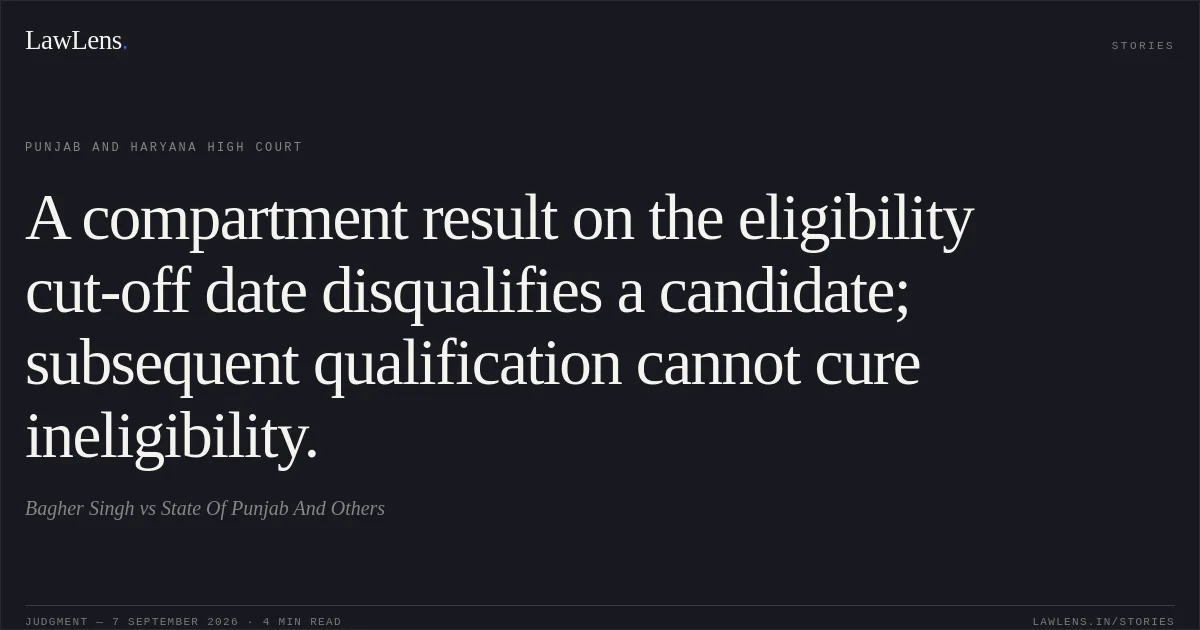
The Court held that the petitioner was ineligible for appointment because he did not possess the requisite 10+2 qualification on the prescribed cut-off date; his later certificate could not cure that defect.
It further held that the inquiry findings and the dismissal order were supported by evidence and were not vitiated by procedural irregularity, violation of natural justice, or perversity.
Source reference: paras. 13, 15; pp. 15–16The writ petition was accordingly dismissed, and no relief of reinstatement, continuity of service, or back wages was granted.
Source reference: para. 15; p. 16Original Court PDF
Bagher SinghvsState Of Punjab And Others
Click to open original judgment
Original judgment, available to read, download and summarize on LawLens.in