Facts
M/s Madhya Pradesh Audyogik Kendra Vikas Nigam Ltd. (“MPAKVNL”), a State Government-owned company engaged in developing industrial areas in Madhya Pradesh, leased industrial plots, shops and other premises and collected lease rent and, in some cases, one-time premium or salami.
Source reference: para. 1, 6The Department treated the activity as “renting of immovable property” taxable under the Finance Act, 1994, and alleged that MPAKVNL had received ₹55,89,93,145 during the period from 1 June 2007 to 31 March 2014 without paying service tax.
Source reference: para. 2Four show-cause notices proposed recovery of service tax aggregating to ₹6,40,23,593, along with interest and penalties.
Source reference: para. 2The Principal Commissioner dropped a substantial portion of the demand on limitation grounds but confirmed ₹23,92,191 for the period 1 October 2010 to 31 August 2011 and ₹2,89,56,215 for the subsequent period.
Source reference: para. 2The Department appealed against the portion of the demand that had been dropped, contending that MPAKVNL had suppressed material facts and that the extended limitation period and penalties were justified.
Source reference: para. 4–5Issues
Whether the leasing or renting of vacant industrial land by MPAKVNL was liable to service tax before 1 July 2010 and thereafter under the applicable provisions of the Finance Act, 1994?
Source reference: para. 6, 8–10Whether one-time premium or salami received under long-term leases constituted taxable consideration for renting of immovable property?
Source reference: para. 7–10Whether the Department was entitled to invoke the extended period of limitation on the allegation that MPAKVNL had suppressed the taxable receipts or failed to disclose the relevant information?
Source reference: para. 4, 11–13Whether penalties under the Finance Act, 1994 were imposable on MPAKVNL for non-registration and non-payment of service tax?
Source reference: para. 4, 12–13Law Applied
The Tribunal applied Sections 65(90a), 65(105)(zzzz), 65(41), 65B(44), 66B, 66D and 66E of the Finance Act, 1994, holding that renting includes leasing and similar arrangements of immovable property and that renting of vacant land became taxable with effect from 1 July 2010.
Source reference: para. 8–9Section 105 of the Transfer of Property Act, 1882 distinguishes between “premium”—the price paid for creation of the leasehold interest—and “rent”—periodic consideration for continued enjoyment; however, both may form part of the consideration for a lease.
Source reference: para. 8Relying on Panbari Tea Co. Ltd., the Tribunal held that lease premium is consideration for transfer of the right to enjoy the property.
Source reference: para. 8It also followed the Larger Bench decision in RII Rajasthan State Industrial Development & Investment Corporation Ltd. v. Commissioner of Central Excise & Service Tax, 2025 (33) Centax 73 (Tri.-Del.), which held that one-time premium or salami is taxable under renting of immovable property.
Source reference: para. 10For limitation, Cosmic Dye Chemical v. CCE, 1995 (75) E.L.T. 721 (S.C.), and Gopal Zarda Udyog v. CCE, 2005 (188) E.L.T. 251 (S.C.), establish that the extended period requires a positive, conscious and deliberate act of suppression or misstatement with intent to evade tax, and cannot be based merely on inaction or failure.
Source reference: para. 11–13Applying Hindustan Steel Ltd. v. State of Orissa, 1978 E.L.T. (J 159) (S.C.), the Tribunal held that penalties are not ordinarily warranted for a technical or venial breach or where the assessee acted under a bona fide belief regarding its liability.
Source reference: para. 12Reasoning
The Tribunal held that renting of vacant land was not taxable before 1 July 2010 because the statutory framework then excluded such land from the taxable service; therefore, the demand for the earlier period was correctly dropped.
Source reference: para. 9From 1 July 2010, however, leasing or renting vacant industrial land was covered by the taxable service provisions.
Source reference: para. 8–9The Tribunal rejected MPAKVNL’s contention that one-time premium or salami was outside the taxable value, reasoning that a lease comprises both the transfer of the right to enjoy the property and the consideration paid for that right; consequently, premium was taxable along with periodic rent.
Source reference: para. 8, 10Nevertheless, the Department could not sustain the demand for the extended period.
Source reference: para. 11–13MPAKVNL was a governmental authority, and the record contained no positive evidence of a deliberate intention to evade service tax.
Source reference: para. 11–13Its failure to obtain registration or disclose the receipts, in the circumstances and in light of the prevailing legal uncertainty regarding the taxability of vacant land, amounted at most to inaction or a bona fide belief, not wilful suppression.
Source reference: para. 11–13Since the extended period was unavailable, the corresponding penalties also could not be sustained.
Source reference: para. 12–13Holding
The Tribunal answered the taxability issues in favour of the Department to the extent that leasing of vacant land became taxable from 1 July 2010 and one-time lease premium was taxable as consideration for renting of immovable property.
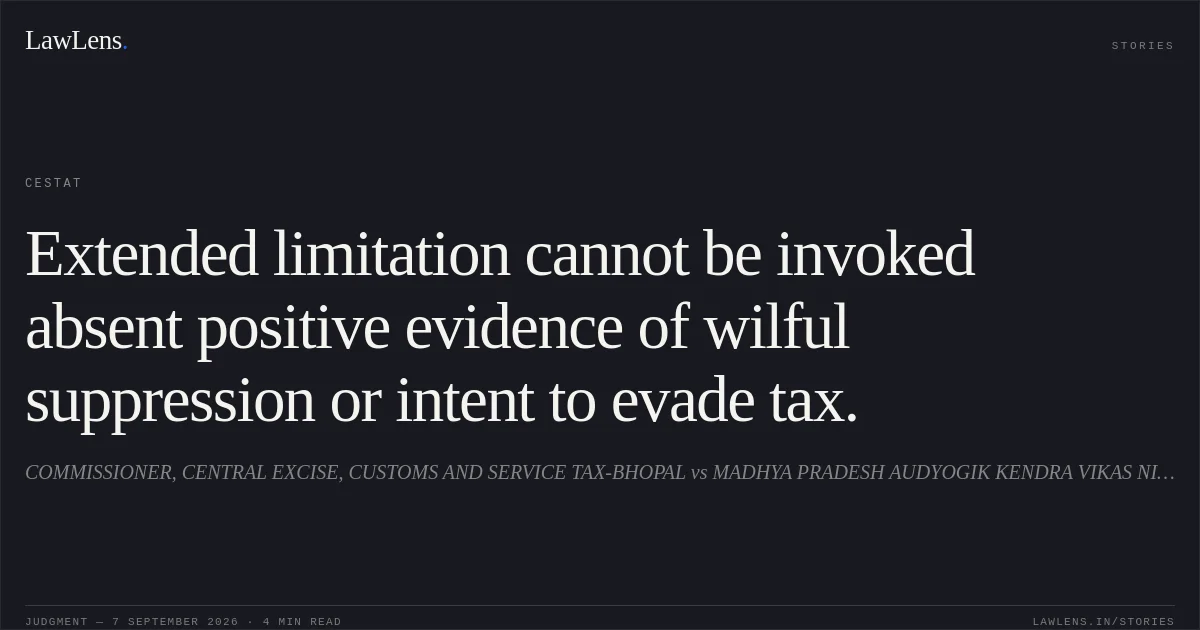
However, it held that the extended period of limitation was not invocable because the Department had failed to establish wilful suppression or intent to evade tax by MPAKVNL.
Source reference: para. 11–13The dropping of the demand for the extended period from 1 June 2007 to 30 September 2010 was therefore upheld, the Department’s appeal was dismissed, and the order under challenge was affirmed.
Source reference: para. 14Acts & Sections Cited
2 provisions across 1 statute referred to in this judgment. Linked provisions open on LawLens.
Companies Act, 19562
Original Court PDF
COMMISSIONER, CENTRAL EXCISE, CUSTOMS AND SERVICE TAX-BHOPALvsMADHYA PRADESH AUDYOGIK KENDRA VIKAS NIGAM LTD
Click to open original judgment
Original judgment, available to read, download and summarize on LawLens.in