Facts
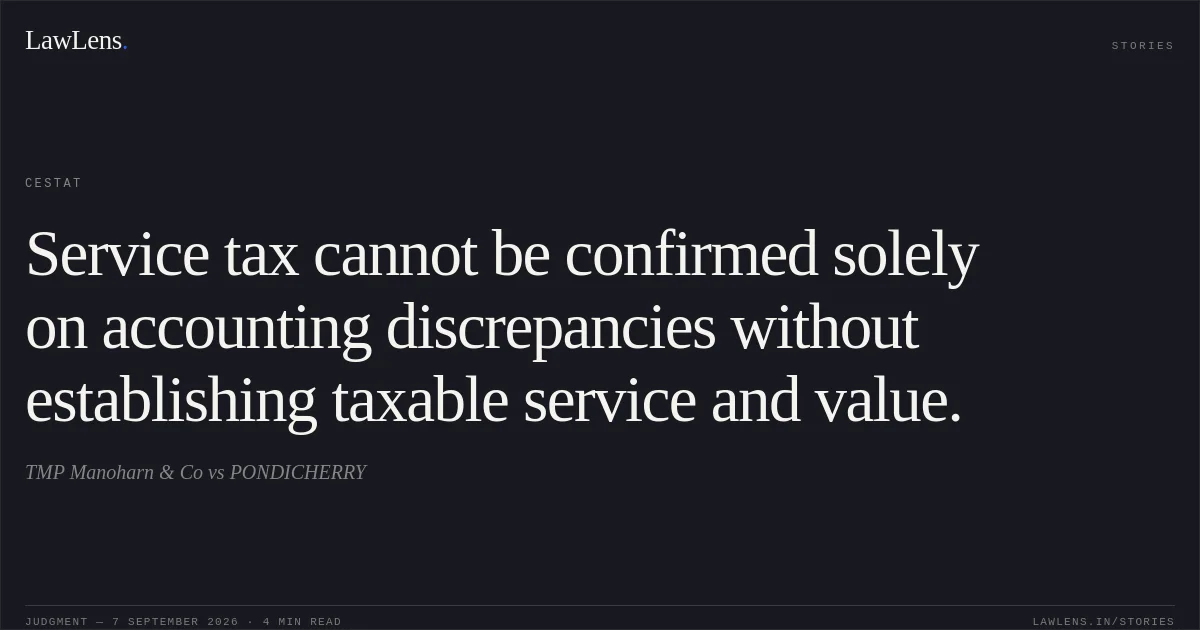
The appellant, registered for Manpower Recruitment or Supply Agency Service, Maintenance or Repair Service, and Commercial or Industrial Construction Service, challenged Order-in-Original No. 32/2016 (C)(ST), which confirmed service tax of ₹24,48,370, including an admitted liability of ₹8,96,535, for April 2012 to March 2013, together with interest, late fee, and penalties under the Finance Act, 1994.
Source reference: para. 1The demand arose from comparisons between the appellant’s balance sheet, ST-3 returns, and income-tax records.
Source reference: para. 1The Department alleged that the appellant had provided Erection, Commissioning and Installation Service without registration, wrongly claimed abatement for Maintenance or Repair Service, and short-paid service tax.
Source reference: para. 1The appellant contended that the work performed for Graphite India was only Manpower Supply Service, that no work had been performed for Siemens during the relevant period, and that the demand was based principally on unreconciled accounting differences without establishing the taxable service or taxable value.
Source reference: paras. 2–3The Department supported the demand on the basis of audit discrepancies, non-filing of ST-3 returns for April–June 2012, non-registration for Erection, Commissioning and Installation Service, and wrongful availment of abatement.
Source reference: para. 4Issues
1. Whether the service-tax demand confirmed in the impugned order was sustainable on merits, including whether the Department had properly identified and classified the taxable services and determined the taxable value?
Source reference: para. 5(i)2. Whether invocation of the extended period of limitation and the consequential interest, late fee, and penalties were sustainable?
Source reference: para. 5(ii)Law Applied
Service tax could be levied only after the Department established that the receipts represented consideration for a taxable service, classified the service under the appropriate charging provision, and determined the taxable value in accordance with Section 67 of the Finance Act, 1994.
Source reference: para. 10A demand could not be sustained merely on differences between balance-sheet figures, income-tax records, and ST-3 returns; the Department had to correlate the receipts with identifiable taxable services and examine the underlying contracts, invoices, work orders, and other evidence.
Source reference: paras. 10–14Under the proviso to Section 73(1), the extended limitation period required proof of fraud, collusion, wilful misstatement, suppression of facts, or contravention with intent to evade service tax; the burden of establishing these ingredients rested on the Department.
Source reference: para. 18The Tribunal followed its earlier decision in the appellant’s own case, T.M.P. Manoharan & Co. v. Commissioner of Central Excise, Puducherry, 2023 (11) TMI 15 (CESTAT-Chennai), and relied on CCE & ST, Pondicherry v. A.M. Manickam, 2017 (6) TMI 57, CST v. Purni Ads Pvt. Ltd., 2010 (19) S.T.R. 242, Firm Foundations & Housing Pvt. Ltd. v. Principal Commissioner of Service Tax, 2018 (16) G.S.T.L. 209 (Mad.), and Balajee Machinery v. Commissioner of CGST & Central Excise, 2022 (66) G.S.T.L. 440, for the requirement of a specific and properly quantified demand.
Source reference: paras. 8–14For limitation, it applied Chemphar Drugs & Liniments v. CCE, 1989 (40) E.L.T. 276 (S.C.), Pushpam Pharmaceuticals Co. v. CCE, 1995 (78) E.L.T. 401 (S.C.), and Nizam Sugar Factory v. CCE, 2006 (197) E.L.T. 465 (S.C.), which hold that mere omission, accounting discrepancies, or interpretational differences do not establish suppression with intent to evade tax.
Source reference: paras. 18–21Reasoning
The Tribunal found that the present proceedings were founded substantially on the same comparison of statutory and financial records considered in the appellant’s earlier case, and that the Revenue had not demonstrated any material factual distinction warranting a different conclusion.
Source reference: paras. 8–9, 19The show-cause notice did not adequately identify the taxable service, apply the relevant charging provision, or correlate the disputed receipts with taxable services and taxable value.
Source reference: paras. 10–15The appellant had produced agreements, invoices, and reconciliation statements, including explanations regarding the Graphite India and Siemens transactions, but these had not been objectively examined by the adjudicating authority.
Source reference: paras. 10–15Accordingly, the disputed portion of the demand failed on merits.
Source reference: para. 16However, the Tribunal treated ₹8,96,535 as an admitted liability because that admission was recorded in the adjudication order and sustained that amount.
Source reference: para. 16As the demand was based on the appellant’s disclosed statutory records, and there was no independent evidence of deliberate concealment, fraud, or wilful misstatement, the statutory conditions for invoking the extended period were not established.
Source reference: paras. 17–20The same reasoning also negated the penalty under Section 78; neither the admitted liability nor delayed filing of returns, by itself, established suppression with intent to evade service tax.
Source reference: para. 23Holding
The appeal was partly allowed.
The Tribunal sustained service-tax liability of ₹8,96,535, together with applicable interest under Section 75, subject to adjustment of amounts already paid.
Source reference: paras. 16, 22, 24The balance of the disputed service-tax demand was set aside because the Department had not established the taxable nature, classification, and taxable value of the relevant receipts.
Source reference: paras. 16, 24The penalty under Section 78 was set aside, as the ingredients necessary for invoking the extended period and imposing the penalty were not proved.
Source reference: paras. 20, 23–24Acts & Sections Cited
5 provisions across 1 statute referred to in this judgment. Linked provisions open on LawLens.
Finance Act, 19945
Original Court PDF
TMP Manoharn & CovsPONDICHERRY
Click to open original judgment
Original judgment, available to read, download and summarize on LawLens.in