Facts
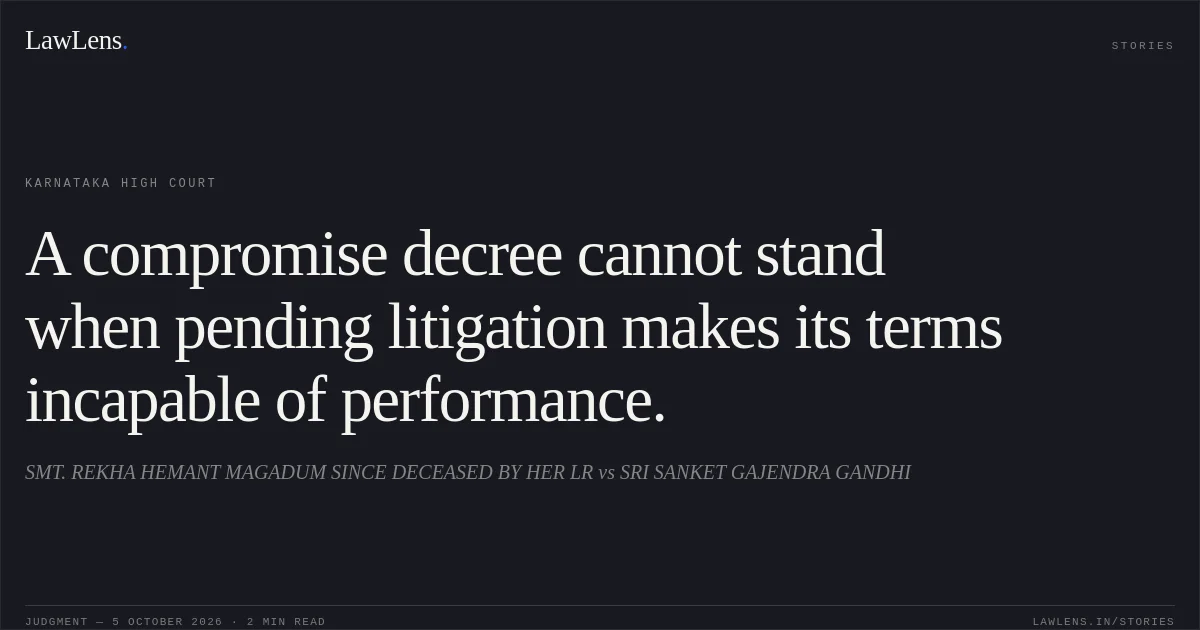
Smt. Rekha Hemant Magadum, since deceased and represented by her daughter, challenged a compromise decree dated 12 December 2011 in O.S. No. 150/2011, a suit for specific performance, recorded before a Mega Lok Adalat.
Source reference: paras. 1–2, p. 4The petitioner contended that the conciliator had not signed the compromise or decree and that her mother’s signature on the compromise petition was forged.
Source reference: para. 3, pp. 4–5; para. 13, p. 8The compromise itself referred to pending litigation concerning the property and stated that execution of the sale deed was not then possible.
Source reference: para. 3, p. 5; para. 11, p. 8Respondents 1 and 2 fairly accepted that, in light of that clause, the compromise could not have been entered into.
Source reference: para. 4, p. 5Issues
1. Whether the compromise decree could stand where the compromise acknowledged pending litigation over the property and the parties’ inability to execute the sale deed.
Source reference: paras. 3, 6, 11, pp. 5, 82. Whether the compromise decree was sustainable when the conciliator had not signed the compromise.
Source reference: paras. 3, 12, pp. 4, 8Law Applied
Order XXIII Rule 3 of the Code of Civil Procedure, 1908 requires the court, before recording a compromise, to be satisfied that the suit has been adjusted by a lawful agreement or compromise in writing and signed by the parties; the court must then record it and pass a decree in accordance with it.
Source reference: para. 7, pp. 6–7The Rule’s Explanation provides that an agreement or compromise void or voidable under the Indian Contract Act, 1872 is not lawful for this purpose.
Source reference: para. 7, p. 7The court stated that the trial court must examine the compromise terms and be satisfied that they are lawful and capable of being acted upon.
Source reference: paras. 8–10, pp. 7–8It also treated the conciliator’s failure to sign the compromise as a ground on which the decree could not be sustained.
Source reference: para. 12, p. 8Reasoning
The compromise expressly recognised pending litigation concerning the same property and stated that the sale deed could not then be executed. The trial court therefore ought to have examined whether the compromise was lawful and capable of performance before recording it; instead, it accepted the compromise despite those terms.
Source reference: paras. 6, 10–11, pp. 5, 8The respondents’ concession reinforced the conclusion that the compromise should not have been entered into.
Source reference: para. 4, p. 5The court also relied on the conciliator’s failure to sign the compromise and noted the petitioner’s allegation that her mother’s signature had been forged.
Source reference: paras. 12–14, p. 8Holding
The High Court allowed the writ petition and quashed the compromise decree in O.S. No. 150/2011.
It restored the suit to the trial court’s file for disposal in accordance with law.
Source reference: paras. 15–16, p. 9Original Court PDF
SMT. REKHA HEMANT MAGADUM SINCE DECEASED BY HER LRvsSRI SANKET GAJENDRA GANDHI
Click to open original judgment
Original judgment, available to read, download and summarize on LawLens.in