Facts
The landowners entered into an agreement for sale dated 19.11.2012 with respondent no. 2 and another prospective buyer, acting through the petitioner as their GPA holder.
Source reference: paras. 2–4, pp. 2–3The prospective buyers did not pay the balance consideration or seek execution of a sale deed within the agreed seven months or thereafter.
Source reference: paras. 2–4, pp. 2–3In February 2016, the landowners sold the property to a third party. Respondent no. 2 then filed a civil suit for specific performance and lodged an FIR under Sections 420, 423, 120-B read with Section 34 of the Indian Penal Code, 1860 (IPC), naming the petitioner and the landowners as accused.
Source reference: paras. 2–4, pp. 2–3The High Court quashed the FIR against the landowners but dismissed the petitioner’s separate quashing petition, distinguishing the petitioner on the basis of, among other things, receipt of the consideration and execution of the agreement as GPA holder.
Source reference: paras. 5–6, 13, pp. 3, 5–6The petitioner challenged that dismissal before the Supreme Court.
Source reference: para. 7, p. 3Issues
Whether the allegations disclosed the foundational ingredients of cheating or any other alleged IPC offence, or instead concerned a civil dispute over the sale agreement
Source reference: paras. 11–12, 17, pp. 4–5, 7–8Whether the petitioner could properly be denied the benefit of the order quashing the same FIR against the landowners, on the grounds relied on by the High Court
Source reference: paras. 13–18, pp. 5–8Law Applied
The Court considered the alleged offences under Sections 420, 423, 120-B and 34 IPC.
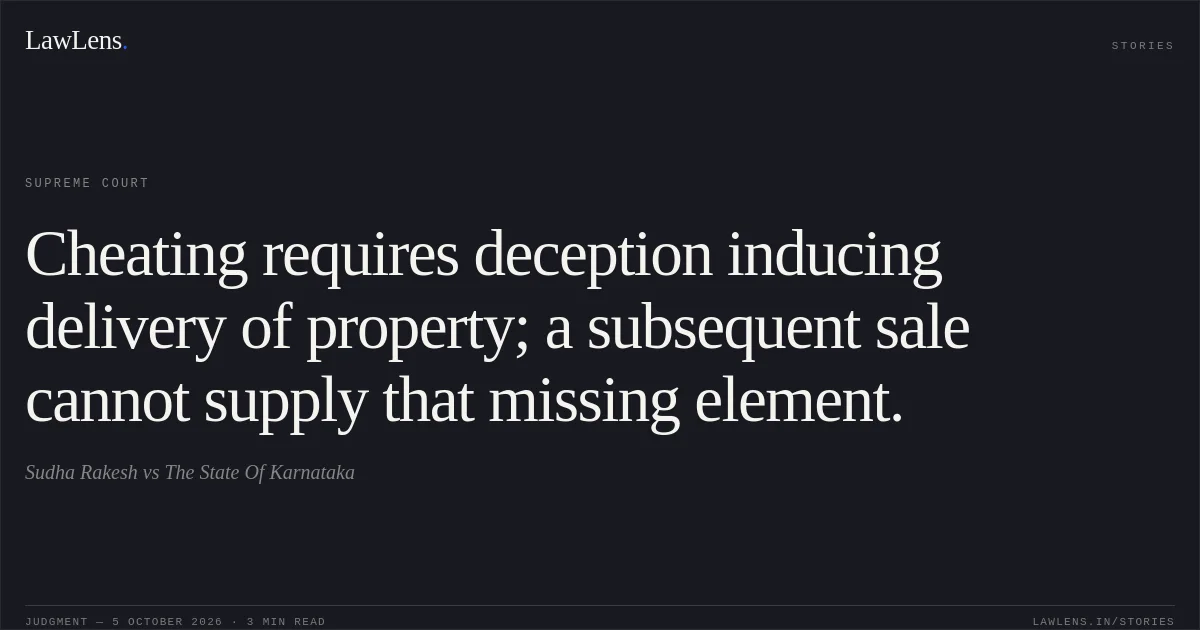
Source reference: para. 17, pp. 7–8Cheating under Section 420 requires a deceptive act that induces the delivery of property or money; Section 423 requires a false statement as to consideration in an instrument of transfer.
Source reference: para. 17, pp. 7–8The Court also applied the principles that criminal proceedings should not be used to give a criminal colour to a purely civil dispute and that a court assessing a quashing petition should not distinguish an accused on hypothetical matters outside the allegations.
Source reference: paras. 1, 16–18, pp. 1, 7–8It further invoked judicial consistency and propriety where similarly situated accused had already obtained quashing of the same FIR.
Source reference: para. 18, p. 8Reasoning
The Court found that the money paid under the 2012 agreement was not obtained by deception: at the time of payment, the property could legitimately have been transferred to respondent no. 2, while the later sale occurred nearly four years afterwards.
Source reference: para. 17, pp. 7–8The allegations therefore lacked the foundational ingredient of cheating.
Source reference: para. 17, pp. 7–8The Court also found no false statement as to consideration in the agreement or sale deed sufficient to attract Section 423 IPC.
Source reference: para. 17, p. 8The petitioner’s execution of the agreement as GPA holder and physical receipt of the consideration did not establish an aggravated or independent role; the agreement was executed on behalf of the landowners, and no allegation suggested that the petitioner acted beyond authority or concealed the transaction from them.
Source reference: para. 14, pp. 6–7Nor could the High Court rely on a hypothetical question about whether the petitioner transferred the consideration to the landowners, since they had made no allegation of misappropriation.
Source reference: para. 16, p. 7The alleged lower sale price was likewise speculative and could not distinguish the petitioner from the landowners, who were also parties to the sale.
Source reference: para. 15, p. 7Holding
The Supreme Court held that the FIR did not disclose the requisite ingredients of the alleged offences and that the petitioner’s culpability could not be distinguished from that of the landowners, against whom the same FIR had been quashed.
The High Court had erred in denying the petitioner equivalent relief.
Source reference: paras. 17–18, pp. 7–8The petition was allowed, the High Court’s order dated 19.09.2022 was set aside, and FIR/Crime No. 121/2016 and all consequential proceedings were quashed.
Source reference: para. 19, p. 9Acts & Sections Cited
3 provisions across 1 statute referred to in this judgment. Each provision opens on LawLens.
Indian Penal Code, 18603
Original Court PDF
Sudha RakeshvsThe State Of Karnataka
Click to open original judgment
Original judgment, available to read, download and summarize on LawLens.in