Facts
Ram Pratap Singh instituted Title Suit No. 185 of 1997 concerning correction of the Survey Khatiyan in respect of the scheduled land.
Source reference: p. 2; para. 4A compromise petition dated 10 August 1998 was allegedly filed on behalf of the defendant, Samsher Jang Bahadur Singh, and the suit was disposed of on its basis by judgment dated 10 August 1998 and decree dated 20 August 1998.
Source reference: p. 2; para. 5Samsher Jang Bahadur Singh subsequently challenged the compromise decree by filing Misc. Case No. 2 of 2011 under Section 151 of the Code of Civil Procedure, alleging that the compromise, vakalatnama and appearance had been procured through fraud and collusion.
Source reference: p. 4; para. 4The learned Sub Judge-I, Dumraon, found that the compromise was not lawful and set aside the compromise order and decree by order dated 14 October 2019.
Source reference: p. 2; para. 6Issues
Whether the court below was justified in exercising jurisdiction under Section 151 CPC to set aside the judgment and decree passed on the basis of the alleged compromise?
Source reference: p. 2; para. 1Whether the compromise petition dated 10 August 1998 was genuine, lawful and duly authorised by Samsher Jang Bahadur Singh?
Source reference: p. 4; para. 5Whether the petitioner discharged the burden of establishing the genuineness of the disputed signature, vakalatnama and authority of the alleged pairvikar?
Source reference: p. 7; para. 7Law Applied
The Court applied Section 151 of the Code of Civil Procedure, which preserves the inherent power of the civil court to make orders necessary to secure the ends of justice and prevent abuse of process.
Source reference: p. 2; para. 1It also relied on Section 44 of the Indian Evidence Act, 1872, under which a party may impeach a judgment, order or decree by showing that it was obtained by fraud or collusion.
Source reference: p. 8–9; para. 7Section 33 of the Evidence Act was referred to in relation to the evidentiary value of the uncontroverted testimony of Samsher Jang Bahadur Singh.
Source reference: p. 6–7; para. 6The Court further applied Section 114(g) of the Evidence Act, permitting an adverse inference where evidence that could have been produced is withheld; accordingly, the non-production of the alleged pairvikar and advocate justified an inference adverse to the petitioner.
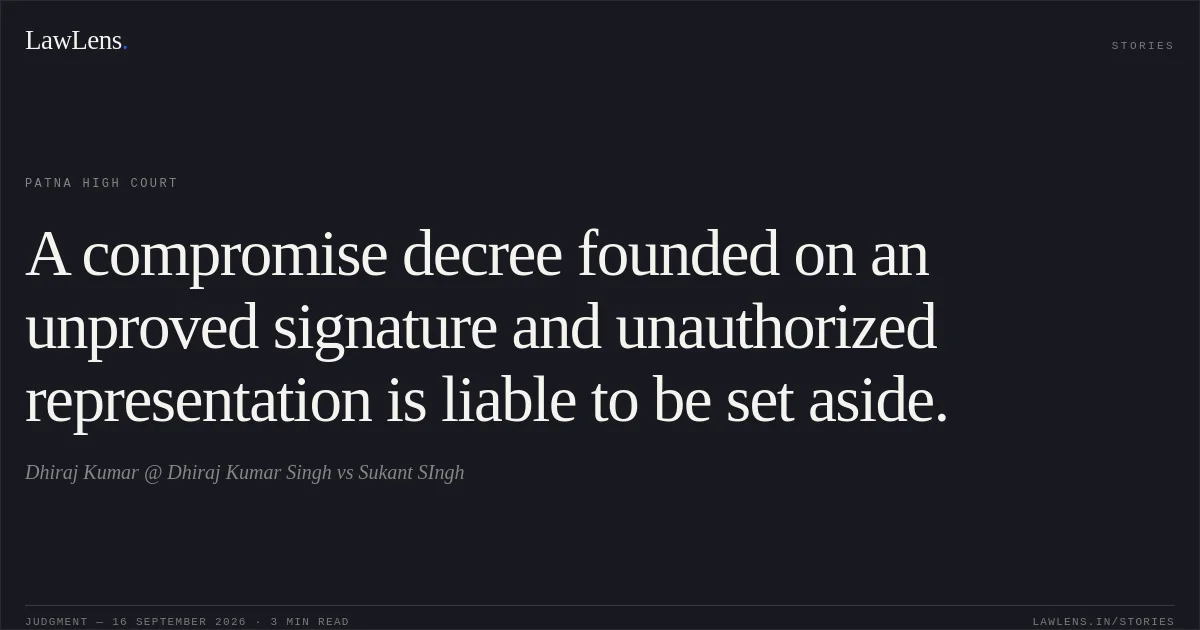
Source reference: p. 10–11; paras. 9–10A compromise decree must be founded on a genuine, lawful and duly authorised compromise; where the alleged consent or authority of a party is disproved or not established, the decree cannot be sustained.
Source reference: p. 7–10; paras. 6–9Reasoning
The High Court found that the order-sheet in the original title suit did not show valid service of summons upon Samsher Jang Bahadur Singh, although a vakalatnama and compromise petition were subsequently shown as having been filed on his behalf.
Source reference: p. 4–5, 11; paras. 5, 11Samsher specifically denied his signature on the compromise petition and denied authorising either Purushottam Singh or Advocate Om Prakash Sah.
Source reference: p. 7–10; paras. 7–9The petitioner did not produce either of them as witnesses, did not seek expert examination of the disputed signature, and did not otherwise prove the alleged authority or genuineness of the compromise.
Source reference: p. 7–10; paras. 7–9The Court treated the denial of signature and authority as a material challenge under Section 44 of the Evidence Act.
Source reference: p. 8–11; paras. 7–10Since the persons best placed to establish the execution and filing of the compromise were withheld, Section 114(g) permitted an adverse inference against the petitioner.
Source reference: p. 8–11; paras. 7–10The absence of proper verification of the compromise petition and the lack of proof that the defendant had authorised the alleged pairvikar further undermined the compromise.
Source reference: p. 9–12; paras. 8–13On these facts, the High Court concluded that the compromise was not fair, bona fide or legally valid and that the trial court had properly exercised its jurisdiction to set aside the compromise decree.
Source reference: p. 9–12; paras. 8–13Holding
The High Court dismissed Civil Miscellaneous No. 180 of 2020 and upheld the order dated 14 October 2019 setting aside the compromise order dated 10 August 1998 and decree dated 20 August 1998 in Title Suit No. 185 of 1997.
It held that the disputed compromise was not proved to bear the genuine signature of Samsher Jang Bahadur Singh and was unsupported by valid authority or lawful consent.
Source reference: p. 10–12; paras. 11–13The petitioner was, however, granted liberty to contest Title Suit No. 185 of 1997 on its merits without relying on the alleged compromise, with a direction that the trial court decide the suit independently on the merits.
Source reference: p. 12; para. 14Acts & Sections Cited
1 provisions across 1 statute referred to in this judgment. Each provision opens on LawLens.
Code of Civil Procedure, 19081
Original Court PDF
Dhiraj Kumar @ Dhiraj Kumar SinghvsSukant SIngh
Click to open original judgment
Original judgment, available to read, download and summarize on LawLens.in