Facts
The parties married on 21.06.2007 according to Hindu rites and ceremonies and had two children.
Source reference: paras. 2–5The husband alleged that the wife subjected him and his family to verbal abuse, frequently left the matrimonial home, threatened to implicate them in false dowry cases, and ultimately left the matrimonial home in September 2019 without returning or maintaining contact with him or the children.
Source reference: paras. 2–5The wife denied the allegations and alleged dowry harassment, physical abuse, and verbal mistreatment by the husband.
Source reference: paras. 6, 9Earlier proceedings under the Protection of Women from Domestic Violence Act were compromised, pursuant to which the parties resided separately in rented accommodation for some time.
Source reference: paras. 4, 6The Principal Judge, Family Court, Kangra, allowed the husband’s petition under Section 13(1)(i-a) of the Hindu Marriage Act, 1955, and granted divorce on the ground of cruelty by judgment and decree dated 18.06.2025.
Source reference: paras. 1, 8In appeal, the High Court noted that the husband’s testimony and that of his mother remained unchallenged because the wife did not cross-examine them, while the wife’s allegations of dowry harassment and beatings were unsupported by medical or other reliable evidence.
Source reference: paras. 13–17Mediation during the appeal failed owing to a deadlock between the parties.
Source reference: para. 12Issues
Whether the wife had deserted the husband by separating from him since September 2019 with the intention of permanently bringing cohabitation to an end, and without reasonable cause?
Source reference: paras. 19–27Whether the wife’s conduct, including leaving the matrimonial home, allegedly abusing and threatening the husband and his family, and ceasing communication with the children, amounted to mental cruelty under Section 13(1)(i-a) of the Hindu Marriage Act, 1955?
Source reference: paras. 28–31Whether the findings of the Family Court granting divorce were based on proper appreciation of the evidence and warranted interference in appeal?
Source reference: paras. 8–10, 31–32Law Applied
The Court applied Section 13(1)(i-a) of the Hindu Marriage Act, 1955, under which a marriage may be dissolved where one spouse has treated the other with cruelty.
Source reference: no citationIt also examined the principles governing desertion, namely, the factum of separation and the intention to permanently end cohabitation (*animus deserendi*) on the part of the deserting spouse, together with absence of consent and absence of conduct by the other spouse giving reasonable cause for separation.
Source reference: paras. 20–24Relying on *Adhyatma Bhattar Alwar v. Adhyatma Bhattar Sri Devi*, (2002) 1 SCC 308, the Court held that desertion must continue throughout the statutory period and may include wilful neglect; the burden lies on the petitioner to establish the relevant elements.
Source reference: para. 24The Court further relied on *Bhikam Ram v. Satya Devi*, 2011 (2) Shim. L.C. 342, for the principle that unjustified refusal to cohabit for a prolonged period may constitute cruelty.
Source reference: para. 28The Court further relied on *Durga Prasanna Tripathy v. Arundhati Tripathy*, AIR 2005 SC 3297, concerning the relevance of irretrievable breakdown and prolonged separation in bringing matrimonial litigation to an end.
Source reference: para. 30Reasoning
The Court found that the parties had admittedly lived separately since September 2019 and had not resumed cohabitation.
Source reference: paras. 15–17, 26–27The wife failed to provide a credible explanation for the separation, while her allegations of beatings and dowry harassment were not supported by specific particulars, medical evidence, or reliable corroboration; her own witnesses made material admissions regarding her leaving the matrimonial home and the husband’s attempts to bring her back.
Source reference: paras. 15–17, 26–27The Court therefore inferred both the factum of separation and *animus deserendi*.
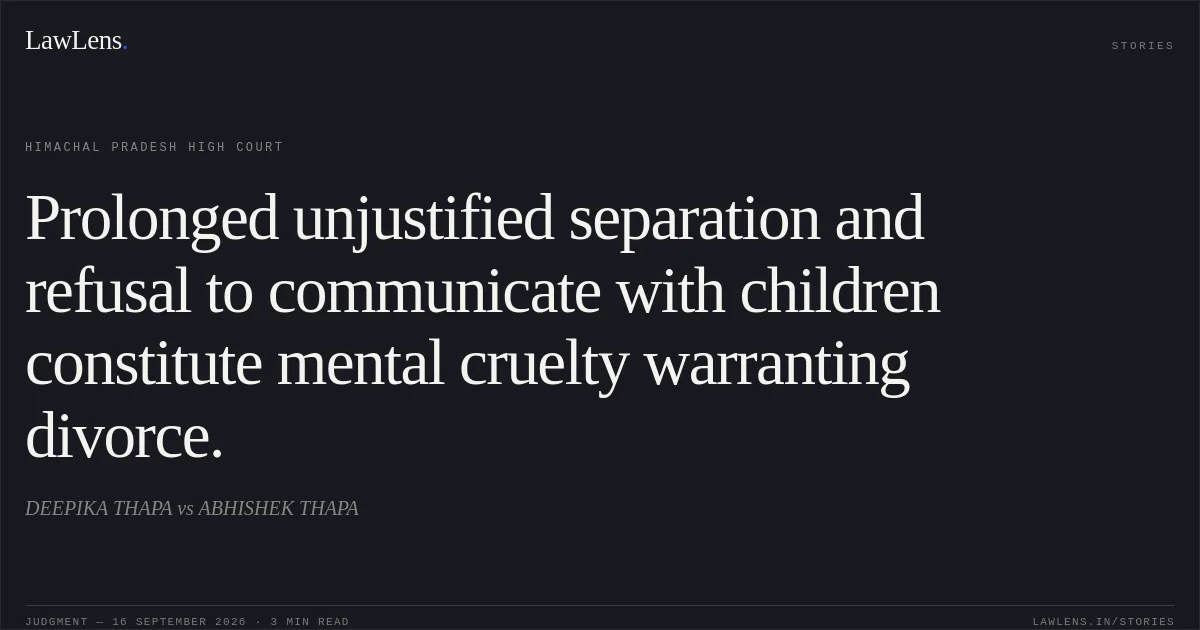
Source reference: paras. 26–27It further held that the wife’s prolonged and unjustified refusal to cohabit, failure to communicate with the children, alleged abusive conduct, and threats of false criminal proceedings constituted mental cruelty.
Source reference: paras. 28, 31The husband’s testimony regarding these allegations remained unchallenged due to the wife’s failure to cross-examine him and his witness, strengthening the evidentiary basis for the finding of cruelty.
Source reference: paras. 13–14, 28, 31The prolonged separation and failed mediation also demonstrated that the marital relationship had irretrievably broken down and that reconciliation was unlikely.
Source reference: paras. 12, 29–30Holding
The High Court held that the wife had deserted the husband without justifiable cause and that her conduct amounted to mental cruelty within the meaning of Section 13(1)(i-a) of the Hindu Marriage Act, 1955.
Finding no merit in the appeal, the Court dismissed it and upheld the judgment and decree dated 18.06.2025 granting dissolution of the marriage.
Source reference: para. 32Any pending applications were also disposed of.
Source reference: para. 32Acts & Sections Cited
1 provisions across 1 statute referred to in this judgment. Each provision opens on LawLens.
Hindu Marriage Act, 19551
Original Court PDF
DEEPIKA THAPAvsABHISHEK THAPA
Click to open original judgment
Original judgment, available to read, download and summarize on LawLens.in