Facts
Sandeep Kaila, aged 37 years, died in a motor accident occurring on the intervening night of 12–13 April 2015.
Source reference: p.1His wife, son, mother and father instituted a claim before the Motor Accident Claims Tribunal.
Source reference: p.1The Tribunal awarded total compensation of ₹70,89,212 with interest at 9% per annum, assessing the deceased’s monthly income at ₹52,000, applying a one-third deduction towards personal expenses, and denying future prospects.
Source reference: p.1The deceased was a highly qualified professional employed as Head of Production Planning and Control with M/s Aero Club Ltd. His appointment letter, salary statements, TDS certificate and employment details were proved through the company’s accountant. His last drawn salary was ₹1,45,000 per month, and he had completed his probation period.
Source reference: pp.2–3The claimants appealed seeking enhancement on the grounds of incorrect assessment of income, excessive deduction towards personal expenses, and denial of future prospects.
Source reference: p.2Issues
1. Whether the deceased’s allowances, apart from transport allowance, were liable to be included in determining his monthly income for computation of loss of dependency.
Source reference: pp.2–42. Whether the deduction towards the deceased’s personal and living expenses ought to be one-fourth, having regard to the number and status of the dependants.
Source reference: pp.2, 43. Whether the claimants were entitled to an addition towards future prospects despite the Tribunal’s finding that confirmation of employment had not been proved.
Source reference: pp.2, 54. Whether the compensation under conventional heads, including consortium, loss of estate, funeral expenses and loss of care and guidance, required modification.
Source reference: pp.5–6Law Applied
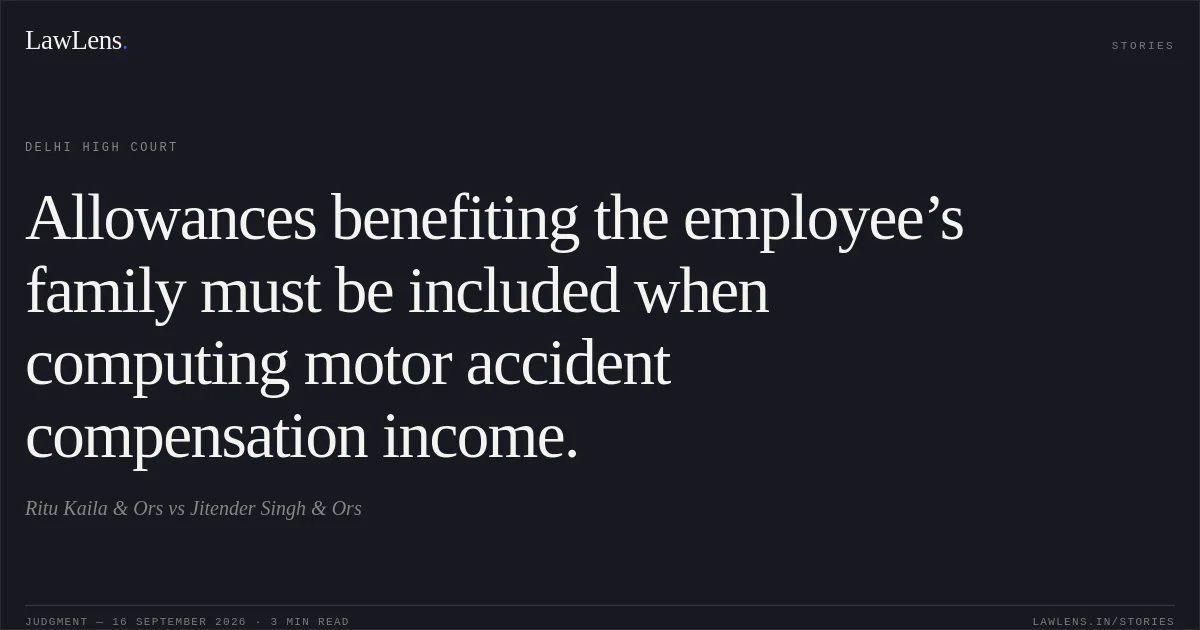
The Court applied the principle that salary-related allowances which accrue for the benefit of the employee and his family must ordinarily be included in assessing income for motor accident compensation, except allowances demonstrably intended solely to reimburse employment-related expenses.
Source reference: pp.4–5It relied on Manorma Sinha v. The Divisional Manager, Oriental Insurance Co. Ltd., 2025 INSC 1237; Kavita Devi v. Sunil Kumar, 2025 INSC 938; Meenakshi v. Oriental Insurance Co. Ltd., 2024 SCC OnLine SC 1872; National Insurance Co. Ltd. v. Indira Srivastava, (2008) 2 SCC 763; and E. Neeta Devi v. Ashwani Kumar, 2026:DHC:5184.
Source reference: pp.4–5The Court applied the rule that future prospects are to be added based on the deceased’s age and employment circumstances, granting 40% for a deceased aged 37 years.
Source reference: p.5It further applied the principles in Pranay Sethi for conventional heads and United India Insurance Co. Ltd. v. Satinder Kaur, (2021) 11 SCC 780, under which compensation for loss of care and guidance was not awardable in the circumstances.
Source reference: p.5A deduction of one-fourth was applied towards personal expenses because there were four dependants, including the deceased’s 68-year-old father.
Source reference: p.5Reasoning
The Court found that the deceased’s employment and salary were established through the employer’s accountant, the appointment letter, salary statements and TDS certificate.
Source reference: pp.2–3It held that HRA, children’s education allowance and special allowance constituted income benefiting the family and were therefore includible.
Source reference: p.4However, the transport allowance of ₹3,000 per month was excluded because it was intended to meet the deceased’s commuting expenses.
Source reference: p.4The resulting monthly income was fixed at ₹1,42,000, after which annual income of ₹17,04,000 and income-tax deduction of ₹2,67,491 were taken into account.
Source reference: pp.4–5Since the deceased was 37 years old, 40% future prospects were added.
Source reference: p.5The Court also treated the 68-year-old father as a dependant and consequently reduced the deduction for personal expenses from one-third to one-fourth.
Source reference: p.5Applying a multiplier of 15, the loss of dependency was recalculated at ₹2,26,25,025.
Source reference: p.5The Court further awarded consortium of ₹1,60,000 for four claimants, ₹15,000 for loss of estate, and ₹15,000 towards funeral expenses, while setting compensation for loss of care and guidance at nil.
Source reference: pp.5–6Holding
The appeal was allowed and the total compensation was enhanced from ₹70,89,212 to ₹2,39,03,232.
The enhanced amount was ₹1,68,14,020, carrying interest at 9% per annum from the date of filing of the claim petition.
Source reference: pp.5–6The insurer was directed to deposit the enhanced amount before the MACT within four weeks.
Source reference: p.6A lump sum of ₹10,00,000 was directed to be released to the claimants within two weeks thereafter, while the balance, together with accrued interest, was to be placed in staggered fixed deposits of ₹1,00,000 each for successive periods.
Source reference: p.6The appeal was accordingly disposed of, and pending applications were rendered infructuous.
Source reference: p.6Original Court PDF
Ritu Kaila & OrsvsJitender Singh & Ors
Click to open original judgment
Original judgment, available to read, download and summarize on LawLens.in