Facts
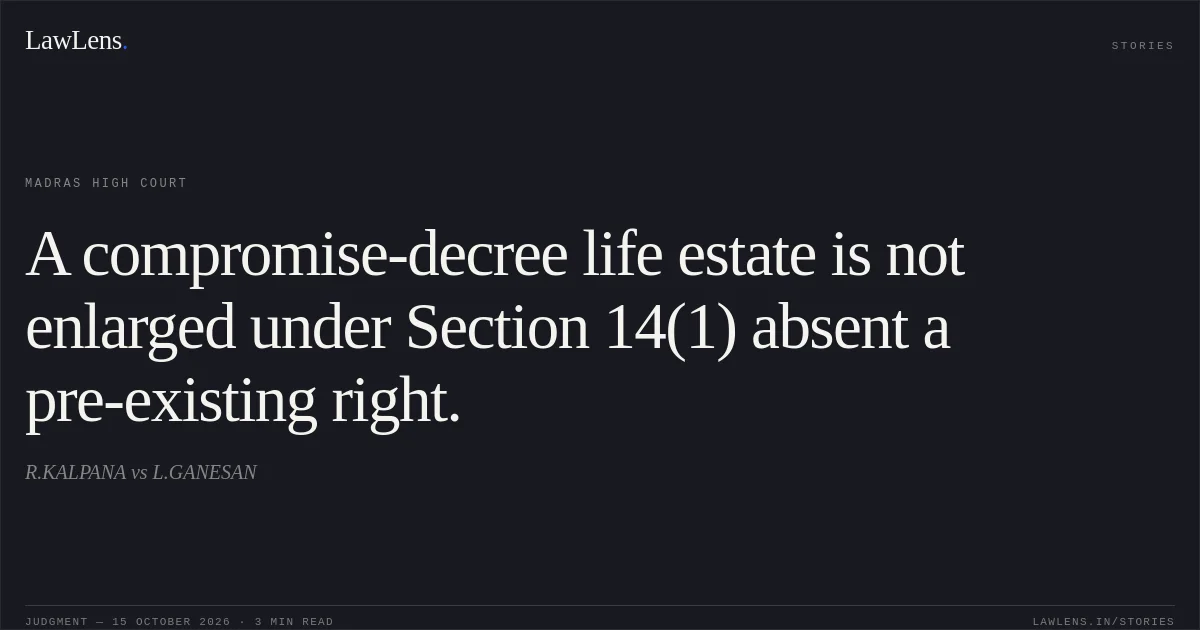
The suit property was purchased by C.K. Duraisamy at a court auction and was dealt with under his probated Will. A compromise decree in C.S. No. 3 of 1940 granted C.K. Krishnasamy and his wife, Logambal, life estates, with the property to vest in their sons or, absent male issue, revert to Duraisamy’s estate; the decree also restricted alienation and encumbrance.
Source reference: p. 12–15After Krishnasamy’s death, Logambal unsuccessfully challenged the compromise decree. A later suit by her daughter, Nallatchi, was also dismissed, with findings concerning the estate and its devolution reaching finality.
Source reference: p. 15–17Logambal sold portions of the property to the respondents. Following her death in 1994, the appellants, claiming through the Will’s beneficiaries, sued for possession. The Single Judge dismissed the suit, holding that Logambal’s life estate had enlarged under Section 14(1) of the Hindu Succession Act, 1956, and that the suit was time-barred. The appellants appealed.
Source reference: p. 6–7, 22–23Issues
1. Whether the life estate granted to Logambal under the compromise decree enlarged into an absolute estate under Section 14(1) of the Hindu Succession Act, 1956
Source reference: p. 12, 17–222. Whether the suit for recovery of possession was barred by limitation
Source reference: p. 12, 22–27Law Applied
Section 14(1) of the Hindu Succession Act enlarges a female Hindu’s limited interest where the property is possessed by her in recognition of a pre-existing right; Section 14(2), however, preserves a restricted estate created for the first time under a decree or other instrument.
Source reference: p. 17–18, 21–22V. Tulasamma v. Sesha Reddy recognises a Hindu woman’s pre-existing right to maintenance, while Jupudy Pardha Sarathy v. Pentapati Rama Krishna confirms that such a right may be enforced against property.
Source reference: p. 18–21Under the rule applied from Gopalakrishna v. Narayanagowda, a reversioner’s limitation period for possession from an alienee of a limited owner runs from the limited owner’s death; an unauthorised alienation does not, by itself, start the period.
Source reference: p. 23–25Sadhu Singh v. Gurdwara Sahib Narike supports the principle that an alienee can acquire no greater title than the limited owner possessed and cannot defeat the ultimate beneficiary’s right to possession upon cessation of the life estate.
Source reference: p. 26Reasoning
The Court held that the compromise decree itself created Logambal’s restricted life estate, expressly barred encumbrances, and directed reversion of the property in the absence of male issue.
Source reference: p. 14–16, 19–22It found no basis to treat that grant as recognition of a pre-existing maintenance right: Logambal had not asserted such a basis, her maintenance application had been dismissed, and earlier proceedings had determined relevant rights and findings that had become final. Section 14(2), therefore, applied, and Section 14(1) did not enlarge her interest.
Source reference: p. 14–16, 19–22Because Logambal held only a life estate, her transfers could not bind the appellants beyond that interest. The right to recover possession accrued on her death in 1994, and the suit was filed within 12 years; prior notice asserting the purchasers’ title did not make the suit time-barred.
Source reference: p. 22–27Holding
The Court answered both issues in the appellants’ favour: Logambal’s life estate did not become absolute under Section 14(1), and the possession suit was within limitation.
It set aside the Single Judge’s judgment and decree, decreed the suit for possession as prayed, allowed the appeal, and made no order as to costs.
Source reference: p. 27Acts & Sections Cited
1 provisions across 1 statute referred to in this judgment. Each provision opens on LawLens.
Hindu Succession Act, 19561
Original Court PDF
R.KALPANAvsL.GANESAN
Click to open original judgment
Original judgment, available to read, download and summarize on LawLens.in