Facts
The appellant/prosecutrix, a widow residing in Shajapur, alleged that respondent No. 2, Madanlal, with whom she had worked since 2020, induced her to engage in sexual intercourse on the false promise of marriage.
Source reference: paras. 5–8The alleged incidents commenced on 12 December 2020 and continued on several occasions; on 15 June 2025, he allegedly forcibly had sexual intercourse with her, refused to marry her, and threatened to kill her and her children.
Source reference: paras. 5–8The FIR was registered on 21 June 2025 at Police Station Kotwali, Shajapur, for offences under Sections 69 and 351(3) of the Bharatiya Nyaya Sanhita, 2023 (“BNS”).
Source reference: paras. 5–8The Sessions Court, Shajapur, acquitted respondent No. 2 by judgment dated 10 March 2026 in Sessions Trial No. 155/2025.
Source reference: paras. 1–4The appellant challenged the acquittal under Section 413 of the Bharatiya Nagarik Suraksha Sanhita, 2023, after obtaining condonation of a 73-day delay.
Source reference: paras. 1–4Issues
Whether the appellant established that respondent No. 2 committed an offence under Section 69 of the BNS by obtaining sexual intercourse through a false promise of marriage made without the intention of fulfilling it.
Source reference: paras. 9–11, 15–18Whether the evidence established criminal intimidation under Section 351(3) of the BNS through threats to kill the prosecutrix and her children.
Source reference: para. 19Whether the trial court’s acquittal was so perverse or illegal as to warrant interference in an appeal against acquittal.
Source reference: paras. 13–14, 21–22Law Applied
The Court applied Section 413 of the Bharatiya Nagarik Suraksha Sanhita, 2023, governing an appeal against acquittal, and Sections 69 and 351(3) of the BNS, 2023, concerning sexual intercourse obtained by deceitful means, including a false promise of marriage, and criminal intimidation, respectively.
Source reference: paras. 2–4The Court also considered Section 63 of the BNS, which defines rape, and reiterated that the testimony of a prosecutrix, if wholly reliable and inspiring confidence, can by itself sustain a conviction; however, such testimony must be carefully scrutinised.
Source reference: paras. 16–18In an appeal against acquittal, interference is not warranted where the trial court’s view is a possible view based on a proper appreciation of the evidence.
Source reference: para. 21Reasoning
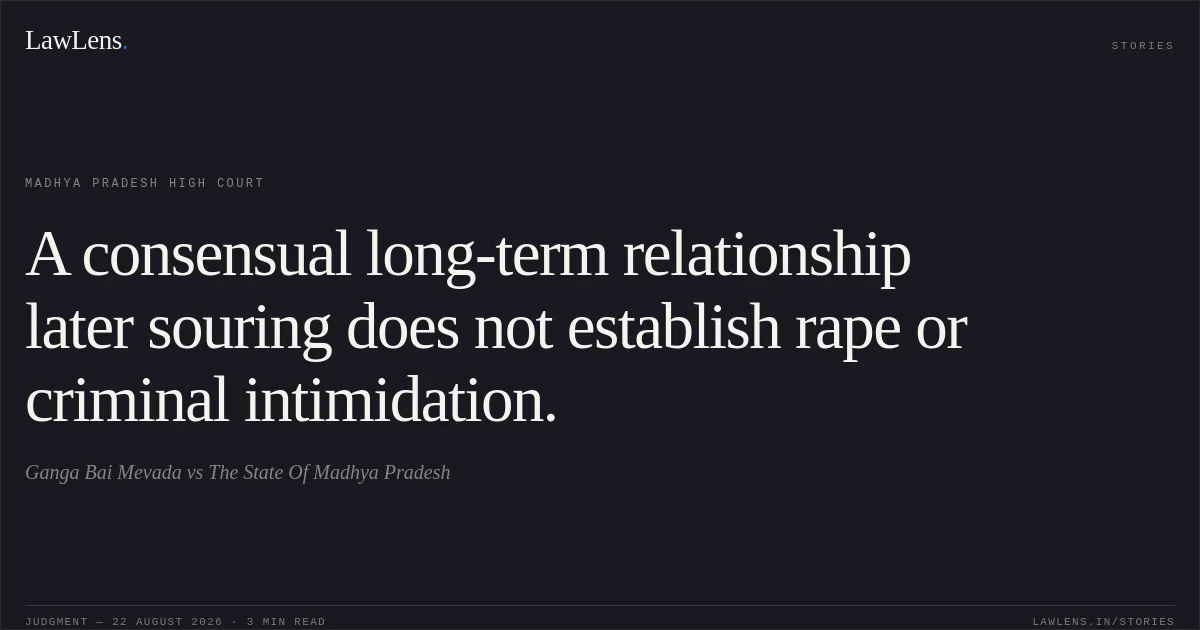
The Court found that the trial court had correctly assessed the parties’ relationship as a consensual relationship extending over approximately five years, rather than one founded on a false promise of marriage.
Source reference: para. 15The prosecutrix was aware that respondent No. 2 was married and had five children, and the evidence did not establish that the alleged promise was false from its inception or that the essential ingredients of Section 69 were satisfied.
Source reference: para. 16Although corroboration is not legally indispensable where the prosecutrix’s testimony is trustworthy, the Court, after examining her evidence and the surrounding material, agreed with the trial court that she was a consenting party.
Source reference: para. 18The prosecution also failed to prove the alleged threats with the requisite intention to cause fear, or to establish the other circumstances relied upon to support the alleged offences.
Source reference: paras. 17, 19–20Since the trial court’s conclusions were based on a proper appreciation of the evidence and constituted at least a possible view, no perversity or illegality justified appellate interference.
Source reference: para. 21Holding
The Court answered the issues against the appellant.
It held that the prosecution failed to prove either the Section 69 offence or criminal intimidation under Section 351(3) of the BNS beyond the required standard, and that the acquittal was neither perverse nor illegal.
Source reference: paras. 19–21The application seeking leave to appeal, I.A. No. 9967/2026, was rejected; consequently, the criminal appeal was dismissed.
Source reference: paras. 1–2, 22–23The delay-condonation application was allowed, and the trial court record was directed to be returned for information and compliance.
Source reference: paras. 1–2, 22–23Acts & Sections Cited
5 provisions across 3 statutes referred to in this judgment. Each provision opens on LawLens.
Limitation Act, 19631
Bharatiya Nagarik Suraksha Sanhita, 20231
Bharatiya Nyaya Sanhita, 20233
Original Court PDF
Ganga Bai MevadavsThe State Of Madhya Pradesh
Click to open original judgment
Original judgment, available to read, download and summarize on LawLens.in