Facts
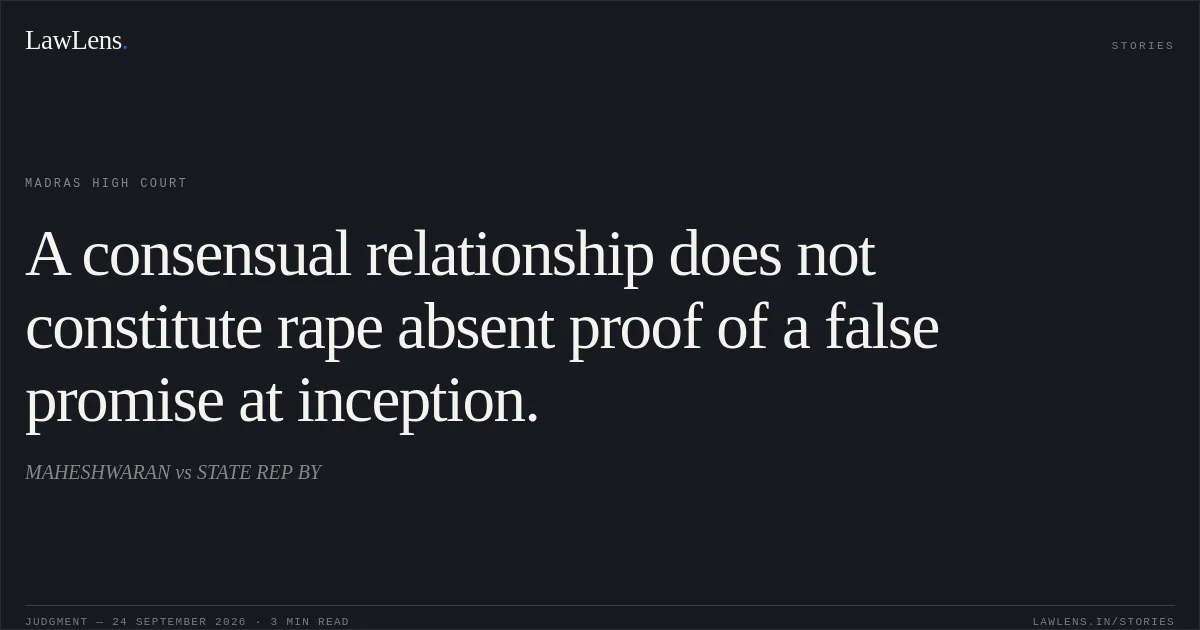
The appellant and PW1, both adults, had been in a romantic relationship for approximately four years and had a continuing physical relationship.
Source reference: pp.2–5; paras 2.1–2.6PW1 alleged that in October 2017 the appellant had sexual intercourse with her by forcibly making a false promise of marriage and subsequently continued the relationship on the same assurance.
Source reference: pp.2–5; paras 2.1–2.6When the appellant’s family arranged his marriage elsewhere, PW1 alleged that he declined to marry her, following which she consumed rat poison on 29.03.2018 and lodged a complaint on 03.04.2018.
Source reference: pp.2–5; paras 2.1–2.6The FIR was registered on 16.04.2018 under Sections 417 and 376 IPC.
Source reference: pp.2–5; paras 2.1–2.6The Sessions Court convicted the appellant under Section 376 read with Section 90 IPC and Section 417 IPC, sentencing him to seven years’ rigorous imprisonment and a fine of ₹25,000 for the offence under Section 376 IPC.
Source reference: p.2; para 1No separate sentence was imposed under Section 417 IPC.
Source reference: p.2; para 1Issues
Whether the sexual relationship between the appellant and PW1 was without her consent or was procured through a misconception of fact so as to constitute rape under Sections 375 and 376 read with Section 90 IPC?
Source reference: p.7; para 7Whether the appellant had made a false promise of marriage, with dishonest intention from the inception, thereby attracting Section 417 IPC and vitiating PW1’s consent under Section 90 IPC?
Source reference: p.7; para 7; pp.17–20, paras 26–29Law Applied
The Court applied Sections 375 and 376 IPC concerning rape and its punishment, Section 90 IPC concerning consent given under fear or misconception of fact, and Section 417 IPC concerning punishment for cheating.
Source reference: pp.7–8; paras 6–7It held that for consent to be invalidated under Section 90 IPC, the prosecution must establish both the relevant fear or misconception and the accused’s knowledge that the consent was given because of that fear or misconception.
Source reference: p.19; para 27Relying on Deepak Gulati v. State of Haryana, (2013) 7 SCC 675, and Deelip Singh v. State of Bihar, (2005) 1 SCC 88, the Court reiterated that a distinction exists between a false promise made with no intention to marry from the outset and a subsequent breach of a genuine promise.
Source reference: pp.17–19, paras 26–27It also relied on Prashant v. State of NCT of Delhi, (2025) 5 SCC 764, for the principle that a prolonged consensual relationship between adults does not become criminal merely because it does not culminate in marriage.
Source reference: p.19; para 28Reasoning
The Court found that PW1’s complaint and evidence established a four-year love affair and continuing physical intimacy, rather than a solitary sexual act obtained through force or deception.
Source reference: pp.14–16, paras 21–24The original complaint did not allege forcible intercourse; the date, time and particulars of the alleged occurrence were subsequently inserted, while allegations of pulling her hair, assault and forcible intercourse emerged only in a later statement recorded several months afterward.
Source reference: pp.8–9, 14–16, paras 8, 20, 22–25PW10’s medical evidence recorded that PW1 had described the intercourse as consensual, and the old scars noted by the doctor could not be attributed to the appellant or to any particular cause.
Source reference: p.13; para 19The Court further considered PW1’s conduct: she continued to meet and have sexual relations with the appellant in January 2018 even after his family’s opposition to the marriage had become known, which was inconsistent with the claim that her consent had been obtained solely through a promise known by the appellant to be false.
Source reference: pp.15–16, 20–21, paras 24, 30The evidence instead indicated that the appellant had been willing to marry PW1 but that the marriage failed due to opposition from his family.
Source reference: pp.20–22, paras 29–33Accordingly, neither absence of consent nor dishonest intention at the inception was proved beyond reasonable doubt.
Source reference: pp.20–22, paras 29–33Holding
The Court answered both issues in favour of the appellant.
It held that the prosecution failed to prove forcible intercourse, consent vitiated by misconception of fact, or a false promise of marriage made with dishonest intention from the beginning.
Source reference: pp.20–22, paras 30–33The convictions under Sections 376 read with 90 IPC and 417 IPC were therefore unsustainable.
Source reference: pp.20–22, paras 30–33The criminal appeal was allowed; the Sessions Court judgment dated 22.06.2022 was set aside; the appellant was acquitted of all charges; his bail bond, if any, was cancelled; and any fine paid was directed to be refunded.
Source reference: p.23; final orderActs & Sections Cited
9 provisions across 2 statutes referred to in this judgment. Each provision opens on LawLens.
Code of Criminal Procedure, 19735
Indian Penal Code, 18604
Original Court PDF
MAHESHWARANvsSTATE REP BY
Click to open original judgment
Original judgment, available to read, download and summarize on LawLens.in