Facts
The petitioner filed Complaint Case No. 6791 of 2022 alleging that he had entered into an agreement for sale of immovable property with Opposite Party No. 2 after receiving an advance of ₹8,50,000. Although the agreement stipulated six months for payment of the balance consideration, Opposite Party No. 2 allegedly failed to pay within that period.
Source reference: paras. 3–4The petitioner claimed that, after he attempted to return the advance, Opposite Party No. 2 sent the amount back to his bank account and subsequently visited his house, misbehaved with him, and threatened him with dire consequences if he did not execute the sale deed.
Source reference: paras. 3–4The Judicial Magistrate dismissed the complaint under Section 203 CrPC for want of sufficient material to issue process.
Source reference: paras. 4–5The petitioner’s criminal revision was dismissed by the Additional Judicial Commissioner, who noted that Opposite Party No. 2 had already instituted Original Suit No. 27 of 2022 seeking specific performance of the agreement.
Source reference: para. 6The petitioner thereafter invoked Section 482 CrPC before the High Court.
Source reference: para. 3Issues
Whether the allegations in the complaint, taken at their face value, disclosed the offence of criminal intimidation punishable under Section 506 IPC.
Source reference: paras. 10–11Whether the allegations disclosed the offence of cheating punishable under Section 420 IPC.
Source reference: para. 12Whether the High Court should exercise its inherent jurisdiction under Section 482 CrPC to interfere with the orders dismissing the complaint and criminal revision.
Source reference: paras. 3, 13Law Applied
The Court applied Section 203 CrPC, under which a Magistrate may dismiss a complaint where, after considering the complainant’s examination and the material on record, there is insufficient ground for proceeding.
Source reference: paras. 3–5It considered the inherent jurisdiction under Section 482 CrPC and the principle that criminal process must not be used as an instrument of oppression, harassment, or vendetta, relying on Punjab National Bank v. Surendra Prasad Sinha, AIR 1992 SC 1815.
Source reference: para. 6Relying on Mahmood Ali v. State of Uttar Pradesh, (2023) 15 SCC 488, the Court held that, in frivolous or vexatious proceedings, it may look beyond the formal allegations and examine the surrounding circumstances by reading between the lines.
Source reference: para. 9For Section 506 IPC, the Court relied on Vikram Johar v. State of Uttar Pradesh, (2019) 14 SCC 207, which requires proof of a threat of injury intended either to cause alarm or to compel the victim to act or refrain from acting in a legally permissible manner.
Source reference: para. 10Section 420 IPC requires deception and inducement resulting in the dishonest delivery or parting with property; a mere contractual dispute or subsequent failure to perform an agreement does not, without the requisite fraudulent intention and inducement, constitute cheating.
Source reference: para. 12Reasoning
The Court treated the dispute as essentially arising from an agreement for sale: the petitioner sought to withdraw from the transaction by returning the advance, whereas Opposite Party No. 2 sought specific performance through a civil suit.
Source reference: paras. 6, 10Although the complaint alleged threats, it did not allege facts showing that the threats were made with the intention of causing alarm, an essential element of Section 506 IPC under Vikram Johar.
Source reference: paras. 10–11Section 420 IPC was also not attracted because there was no allegation that Opposite Party No. 2 had deceived the petitioner and thereby induced him to part with property; the allegations instead concerned non-payment of the balance consideration and enforcement of the contractual arrangement.
Source reference: para. 12Considering the surrounding civil litigation and the absence of the essential ingredients of any alleged offence, the Court found no basis to exercise its inherent jurisdiction under Section 482 CrPC.
Source reference: paras. 9–13Holding
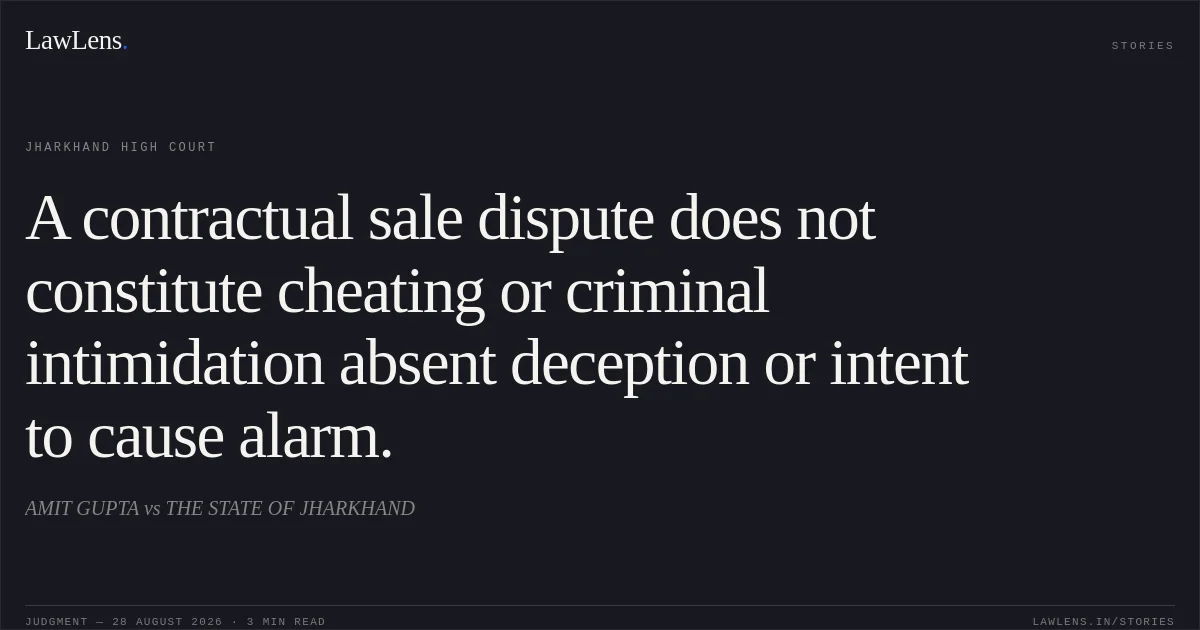
The High Court held that, even if the complaint allegations were accepted in their entirety, the offences under Sections 506 and 420 IPC, or any other offence, were not made out against Opposite Party No. 2.
It therefore declined to interfere with the Magistrate’s order dated 11 November 2022 dismissing the complaint under Section 203 CrPC and the revisional order dated 26 April 2023.
Source reference: para. 13The Criminal Miscellaneous Petition was dismissed as meritless.
Source reference: para. 14Acts & Sections Cited
4 provisions across 2 statutes referred to in this judgment. Each provision opens on LawLens.
Code of Criminal Procedure, 19732
Indian Penal Code, 18602
Original Court PDF
AMIT GUPTAvsTHE STATE OF JHARKHAND
Click to open original judgment
Original judgment, available to read, download and summarize on LawLens.in
![Courts will not interfere with transfers absent mala fides or violation of statutory rules.. M Ramya vs EMPLOYEES STATE INSURANCE CORPORATION (ESIC). CAT - ['Chennai']. LawLens](/stories/thumbnails/courts-will-not-interfere-with-transfers-absent-mala-fides-or-violation-of-statutory-rules-a6845e9ca6f548fca284c51c8351957f.webp)
![Courts cannot direct one-time recruitment age relaxation absent authority in the governing rules or advertisement.. UT OF PUDUCHERRY vs M ANDAL. CAT - ['Chennai']. LawLens](/stories/thumbnails/courts-cannot-direct-one-time-recruitment-age-relaxation-absent-authority-in-the-governing-895d78fde47143e2a8ed0207c4b6a44f.webp)
![A review cannot correct an allegedly erroneous decision absent an error apparent on the record.. Ajit Kumar Jha vs RAILWAY BOARD. CAT - ['Delhi']. LawLens](/stories/thumbnails/a-review-cannot-correct-an-allegedly-erroneous-decision-absent-an-error-apparent-on-the-re-8ac952fd4eba470c92f7da20af72a220.webp)