Facts
The petitioner’s father, an employee of Ajmer Vidyut Vitran Nigam Ltd. (AVVNL), died in service.
Source reference: para. 2–3The petitioner was appointed as a Helper-II probationer trainee on compassionate grounds.
Source reference: para. 2–3AVVNL later received a police verification report showing that the petitioner had been convicted in a case under the Rajasthan Excise Act, but released on probation under Section 4 of the Probation of Offenders Act, 1958.
Source reference: para. 5–6It terminated his services on 20 January 2016, citing alleged non-disclosure of the conviction in an affidavit.
Source reference: para. 5–6The petitioner challenged the termination, contending, among other things, that he was a minor when the relevant events occurred, that Section 12 of the 1958 Act protected him from conviction-based disqualification, and that the hearing notice had not disclosed the allegation.
Source reference: para. 6–10AVVNL maintained that the non-disclosure justified termination.
Source reference: para. 11Issues
Whether the termination was invalid because the petitioner was not given effective notice of the specific allegation of suppression before the decision was made.
Source reference: para. 14Whether the petitioner’s conviction, followed by release on probation under Section 4 of the Probation of Offenders Act, 1958, could lawfully support termination for alleged non-disclosure, in light of Section 12 and the circumstances of the case.
Source reference: para. 15–17, 22–24Law Applied
Section 4 of the Probation of Offenders Act, 1958 permits release on probation of good conduct instead of immediate punishment; Section 12 provides that a person dealt with under Sections 3 or 4 shall not suffer a disqualification attaching to conviction under any law.
Source reference: para. 15–16Under Avtar Singh v. Union of India, assessment of criminal-antecedent disclosure must be contextual and non-mechanical, taking account of the offence, the post, applicable rules and surrounding circumstances.
Source reference: para. 17The Court also relied on Commissioner of Police v. Sandeep Kumar, Ram Kumar v. State of Uttar Pradesh and Pawan Kumar v. Union of India for the principle that non-disclosure does not automatically warrant cancellation or termination; suitability must be assessed objectively.
Source reference: para. 18–20A hearing must provide a real and effective opportunity to answer the allegation relied upon.
Source reference: para. 14Reasoning
The Court found that the petitioner was a minor when the criminal case was registered and decided and when he made the declaration, and that the record did not establish that he understood the legal distinction between an ordinary conviction and one followed by probation.
Source reference: para. 13The hearing notice did not identify the alleged suppression, so the petitioner had no effective opportunity to respond to the ground ultimately used for termination.
Source reference: para. 14The Court further reasoned that Section 12 meant the probation-related conviction could not, absent a legally sustainable applicable exception, operate as a disqualification from appointment or continued service; on that reasoning, disclosure would not itself have rendered the petitioner ineligible, weakening the claim that its omission was material suppression.
Source reference: para. 15–16Applying Avtar Singh and the related precedents, it held that AVVNL had acted mechanically by relying on non-disclosure without adequately considering the petitioner’s age, the probation order, the nature of the case and the relevance of the information to suitability.
Source reference: para. 17–23It distinguished State of Rajasthan v. Chetan Jeff on its facts, including the other FIRs and the constable post involved there.
Source reference: para. 21Holding
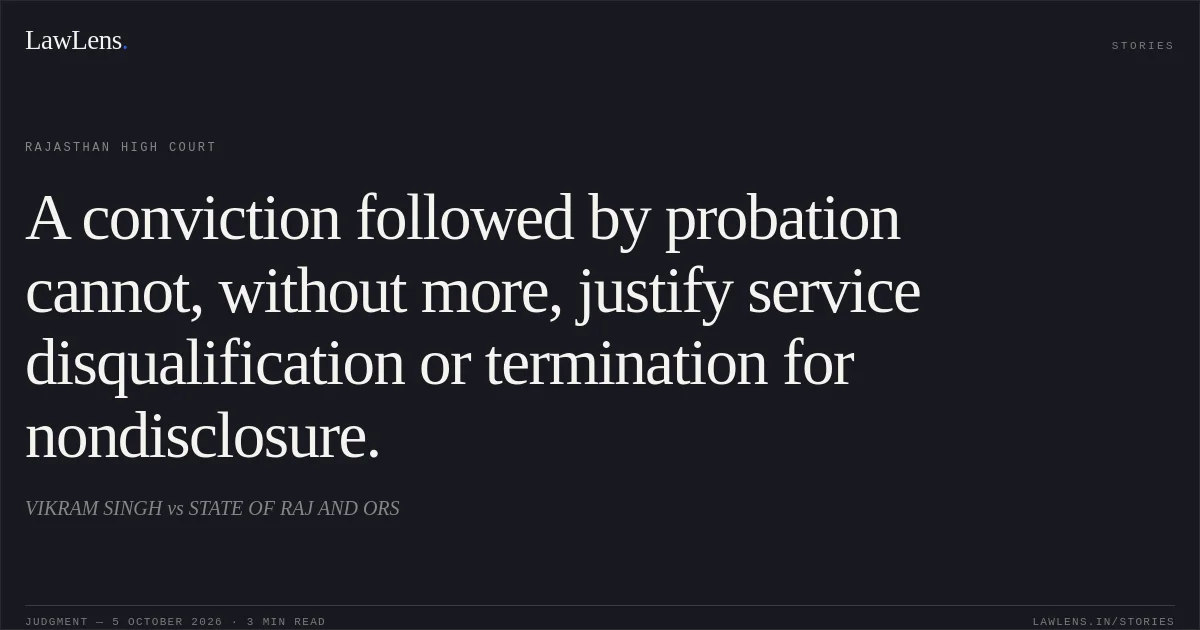
The Court held that the termination was unsustainable for violation of natural justice, failure to consider Section 12 of the Probation of Offenders Act, 1958, and non-application of mind to the relevant circumstances.
It allowed the writ petition, quashed the termination order dated 20 January 2016, and directed AVVNL to reinstate the petitioner with continuity of service and consequential benefits.
Source reference: para. 26The petitioner was granted notional benefits for the period from termination to judgment and actual benefits from the date of judgment.
Source reference: para. 26Acts & Sections Cited
7 provisions across 3 statutes referred to in this judgment. Each provision opens on LawLens.
rajasthan excise act, 19502
Probation of Offenders Act, 19583
Indian Penal Code, 18602
Original Court PDF
VIKRAM SINGHvsSTATE OF RAJ AND ORS
Click to open original judgment
Original judgment, available to read, download and summarize on LawLens.in