Facts
The petitioner’s 6 MW mini-hydel project was allotted before 1 October 2009.
Source reference: paras. 2–6, 14After the project’s allotment was restored and time to complete it extended, the State later demanded an extension fee.
Source reference: paras. 2–6, 14The petitioner challenged the demand, relying on the Government Order dated 13 October 2009, which stated that the revised fees would apply to allotments made on or after 1 October 2009.
Source reference: paras. 2–6, 14The State relied on a corrigendum dated 21 December 2015, which stated that extension fees applied to all projects seeking an extension, irrespective of allotment date.
Source reference: paras. 2–6, 14The petitioner had paid Rs.35,39,340 towards the fee and sought its refund.
Source reference: paras. 2–6, 14It also challenged an order dated 17 June 2015 concerning Rs.66,32,627 payable to respondent No. 2.
Source reference: paras. 2–6, 14Issues
1. Whether the 2009 Government Order confined the extension-fee regime to projects allotted on or after 1 October 2009, excluding the petitioner’s project.
Source reference: para. 14(i)2. Whether the 2015 corrigendum could extend the fee to projects allotted before 1 October 2009.
Source reference: para. 14(ii)3. Whether the State’s 2012 extension order, which required a performance guarantee but did not stipulate an extension fee, affected the later demand.
Source reference: para. 14(iii)4. Whether the petitioner’s acknowledgment and payment of the fee precluded it from challenging the levy.
Source reference: para. 14(iv)Law Applied
A subsequent instrument may be treated as clarificatory where the earlier instrument is ambiguous, but it cannot be so treated if it changes the earlier instrument’s scope, enlarges the class subject to an obligation, or imposes a new financial burden.
Source reference: paras. 22–23The Court relied on Sree Sankaracharya University of Sanskrit v. Dr. Manu, which states that a clarification cannot expand or alter an unambiguous provision.
Source reference: para. 22The Court relied on CIT v. Vatika Township (P) Ltd., which recognises the general presumption against retrospectively imposing a new burden or affecting substantive rights.
Source reference: para. 23It also relied on Kusumam Hotels (P) Ltd. v. Kerala State Electricity Board for the principle that an executive decision ordinarily cannot operate retrospectively to impose an additional burden.
Source reference: para. 25The Court further held that estoppel cannot validate a levy lacking authority under the governing instrument.
Source reference: paras. 31, 35, 39The petition was brought under Articles 226 and 227 of the Constitution.
Source reference: p. 2Reasoning
The 2009 Government Order expressly made the revised fee regime applicable to allotments made on or after 1 October 2009; the petitioner’s earlier allotment therefore fell outside its scope.
Source reference: paras. 19–29By making the fee applicable irrespective of allotment date, the 2015 corrigendum changed the criterion for liability and imposed a burden on projects excluded by the original order.
Source reference: paras. 19–29It was thus substantive, not merely clarificatory, and could not retrospectively apply to the petitioner.
Source reference: paras. 19–29The 2012 extension order reinforced this conclusion because its operative conditions required a performance guarantee but did not impose an extension fee.
Source reference: paras. 19–29The petitioner’s acknowledgment and payment did not cure the absence of authority for the levy or bar review of its legality.
Source reference: paras. 31–35Holding
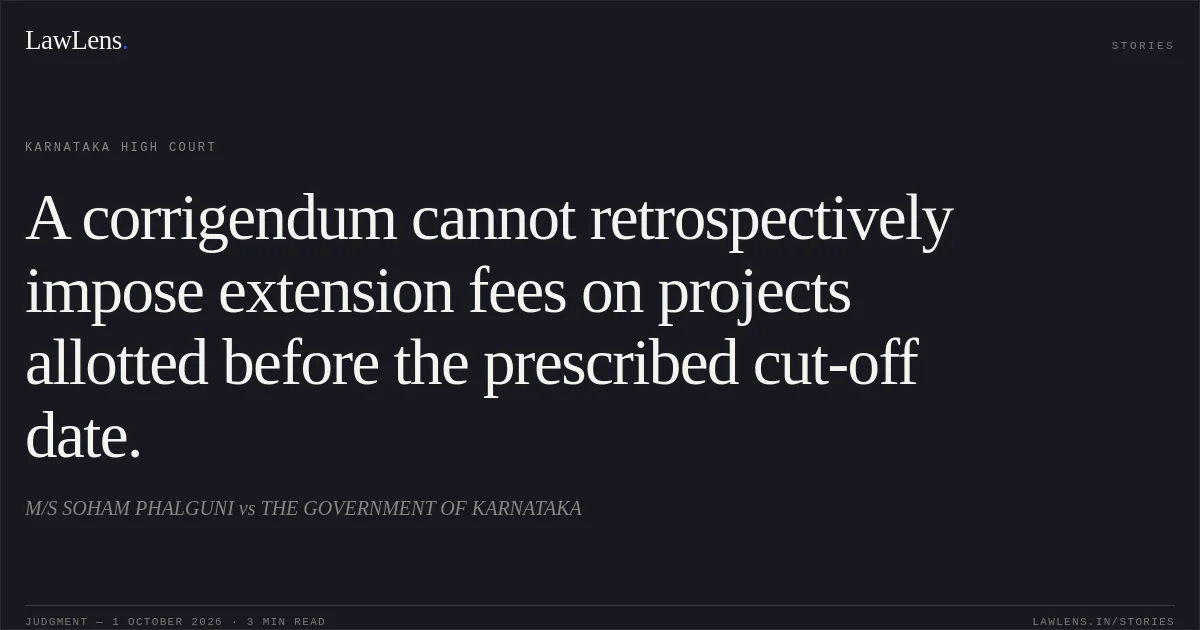
The Court held that the petitioner’s pre-1 October 2009 project was outside the extension-fee regime under the 2009 Government Order and that the 2015 corrigendum could not retrospectively bring it within the levy.
The writ petition was allowed in part: the corrigendum was held inapplicable to the petitioner’s project to that extent, and respondents 1 and 2 were directed to refund Rs.35,39,340 within three months of receiving a certified copy of the order.
Source reference: paras. 36–41The challenge concerning the direction for payment of Rs.66,32,627 to respondent No. 2 was stated to be governed by the Court’s findings and consequential directions.
Source reference: paras. 36–41Original Court PDF
M/S SOHAM PHALGUNIvsTHE GOVERNMENT OF KARNATAKA
Click to open original judgment
Original judgment, available to read, download and summarize on LawLens.in