Facts
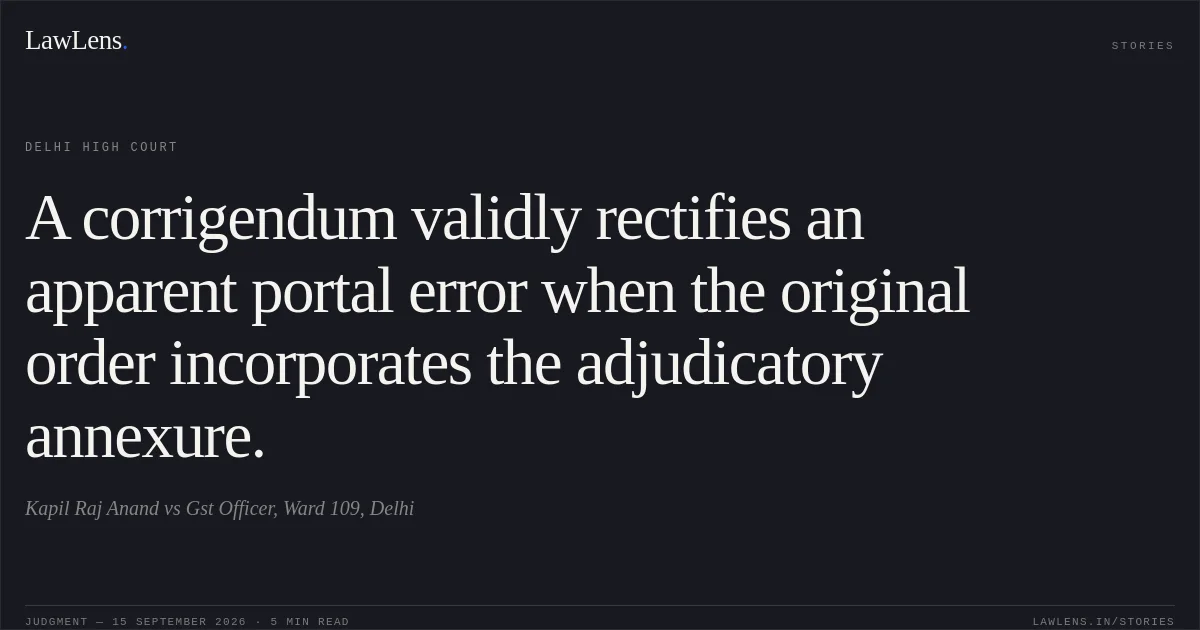
The Petitioner challenged the Respondent’s failure to give effect to an order dated 13 April 2024, generated on the GST portal, which stated that proceedings under Section 73 of the Central Goods and Services Tax Act, 2017 (“CGST Act”) for Financial Year 2018–19 had been dropped.
Source reference: p.1, para.1The order expressly incorporated an Annexure. While the portal-generated operative portion recorded that the proceedings were dropped, the Annexure rejected the Petitioner’s explanation on one of four issues—Input Tax Credit relating to M/s Sai Traders and M/s Jain Cement Udyog—and quantified tax, interest and penalty aggregating to ₹71,42,956.
Source reference: pp.2–3, paras.6–7The Respondent attributed the inconsistency to an incorrect option selected while generating the portal order and issued a Corrigendum dated 28 May 2024, clarifying that relief had been granted on three issues but the demand on the fourth issue had been confirmed.
Source reference: p.3, para.9The Petitioner contended that the digitally signed portal order prevailed over the allegedly unsigned Annexure, that the demand could not be sustained through a Corrigendum, and that the demand was also unenforceable in the absence of FORM GST DRC-07.
Source reference: pp.4–5, paras.10–13Issues
1. Whether the portal-generated order dated 13 April 2024, read together with its Annexure, conclusively dropped the proceedings on all four issues, or whether the demand on the fourth issue formed part of the original adjudication?
Source reference: pp.7–8, paras.20–232. Whether the Annexure was unenforceable merely because it did not bear a separate physical or digital signature?
Source reference: pp.8–9, paras.23–243. Whether the Corrigendum dated 28 May 2024 was a valid rectification under Section 161 of the CGST Act, or impermissibly created a fresh demand after the adjudication period had expired?
Source reference: pp.9–10, paras.25–294. Whether issuance or availability of FORM GST DRC-07 and, consequentially, FORM GST DRC-08 was necessary for enforcement of the demand and appellate remedy?
Source reference: pp.11–12, paras.31–325. Whether the Petitioner’s limitation objection, including the challenge to Notification No. 56/2023-Central Tax, could be adjudicated in the writ proceedings?
Source reference: p.10, para.30; pp.12–13, paras.33–39Law Applied
Section 73(9) of the CGST Act requires determination of the amount payable and issuance of an adjudication order, while Section 75(6) requires the order to state the relevant facts and basis of decision.
Source reference: p.6, para.17Rule 142(5) of the CGST Rules requires the summary of the adjudication order to be uploaded in FORM GST DRC-07, and Rule 142(7) requires FORM GST DRC-08 where an order is rectified under Section 161 or withdrawn.
Source reference: pp.6–7, para.19Section 161 permits rectification of an error apparent on the face of the record, subject to statutory time limits and, where the rectification adversely affects a person, compliance with natural justice. Section 160 does not dispense with the requirements governing rectification under Section 161.
Source reference: p.6, para.18The Court relied on Marg ERP Limited v. Commissioner of Delhi Goods and Services Tax, (2023) 112 GSTR 153, for the principle that an admittedly unsigned adjudication order cannot ordinarily be sustained, but distinguished it where a digitally authenticated order expressly incorporates the relevant Annexure.
Source reference: pp.4, 8–9, paras.11, 23–24It also relied on Rishi Enterprises v. Additional Commissioner, Central Tax, Delhi North, W.P.(C) 4374/2025, decided on 20 August 2025, for the principle that FORM GST DRC-07 is a summary of the adjudication order and that, although its later uploading does not necessarily invalidate a timely order, it should accompany the order or be uploaded within a reasonable time because its absence may prevent appeal and enforcement.
Source reference: p.11, para.31Under Section 107(11), the Appellate Authority may confirm, modify or annul the order under appeal.
Source reference: p.12, para.34Reasoning
The Court treated the portal order and Annexure as a composite document because the portal order expressly incorporated the Annexure and the Respondent stated on affidavit that both had been uploaded together on 13 April 2024.
Source reference: p.7, paras.20–22Although the operative portal recital stated that the proceedings were dropped, the Annexure gave detailed reasons for rejecting the Petitioner’s case on the fourth issue, upheld the demand, quantified the liability and directed payment. The documents therefore disclosed an internal contradiction rather than an unequivocal dropping of the entire proceedings.
Source reference: p.7, paras.21–22The Court held that the Annexure was not a standalone unsigned order: it was incorporated into and adopted by the digitally authenticated portal order, and its concluding “Sd/-” endorsement further supported that conclusion.
Source reference: p.8, para.23The Corrigendum did not reconsider the merits, add reasons, or enlarge the demand; it merely corrected the inconsistent portal recital so that the order reflected the determination already recorded in the Annexure. The error was apparent on the face of the record and therefore fell within Section 161.
Source reference: pp.9–10, paras.25–27Since the original composite order had already rejected the fourth issue and quantified the liability, the Corrigendum did not adversely alter the Petitioner’s position and did not require a further hearing under the third proviso to Section 161.
Source reference: p.10, para.28It was also issued within six months of the original order, so the expiry of the period for completing the original adjudication did not invalidate the rectification.
Source reference: p.10, para.29The Court did not conclusively determine whether DRC-07 had in fact been made available, but directed compliance with Rule 142 and the uploading of DRC-07 and DRC-08 if not already available.
Source reference: pp.11–12, para.32The merits of the fourth-issue demand and any surviving limitation objection were left to the statutory appellate authority. The challenge to Notification No. 56/2023-Central Tax was not examined because it had been raised only in rejoinder and was not part of the original writ proceedings.
Source reference: p.10, para.30Holding
The Court held that the order dated 13 April 2024, read as a whole with its incorporated Annexure, did not drop the demand on all four issues. The demand relating to the fourth issue was part of the original adjudication, and the absence of a separate signature on the Annexure did not invalidate it.
The Corrigendum dated 28 May 2024 was upheld as a valid rectification under Section 161 because it corrected an apparent inconsistency without creating a fresh demand or changing the adjudication on merits.
Source reference: pp.9–10, paras.25–29The Respondent was directed to furnish certified copies of the original order, Annexure and Corrigendum, and to upload or make available FORM GST DRC-07 and FORM GST DRC-08, if not already available, within two weeks.
Source reference: pp.12–13, paras.36–37The Petitioner was granted four weeks from the later of receipt of the documents or availability of the statutory summaries to file an appeal under Section 107, with the appeal not to be rejected on limitation grounds if filed within that period with the requisite pre-deposit.
Source reference: p.13, para.38Recovery was stayed until expiry of that period, and thereafter would be governed by Section 107(7) if an appeal was filed.
Source reference: p.14, para.41Subject to these directions, the writ petition was dismissed, while the merits of the demand and any legally maintainable limitation objection were left open before the Appellate Authority.
Source reference: pp.13–14, paras.39–42Acts & Sections Cited
8 provisions across 1 statute referred to in this judgment. Each provision opens on LawLens.
Central Goods and Services Tax Act, 20178
Original Court PDF
Kapil Raj AnandvsGst Officer, Ward 109, Delhi
Click to open original judgment
Original judgment, available to read, download and summarize on LawLens.in