Facts
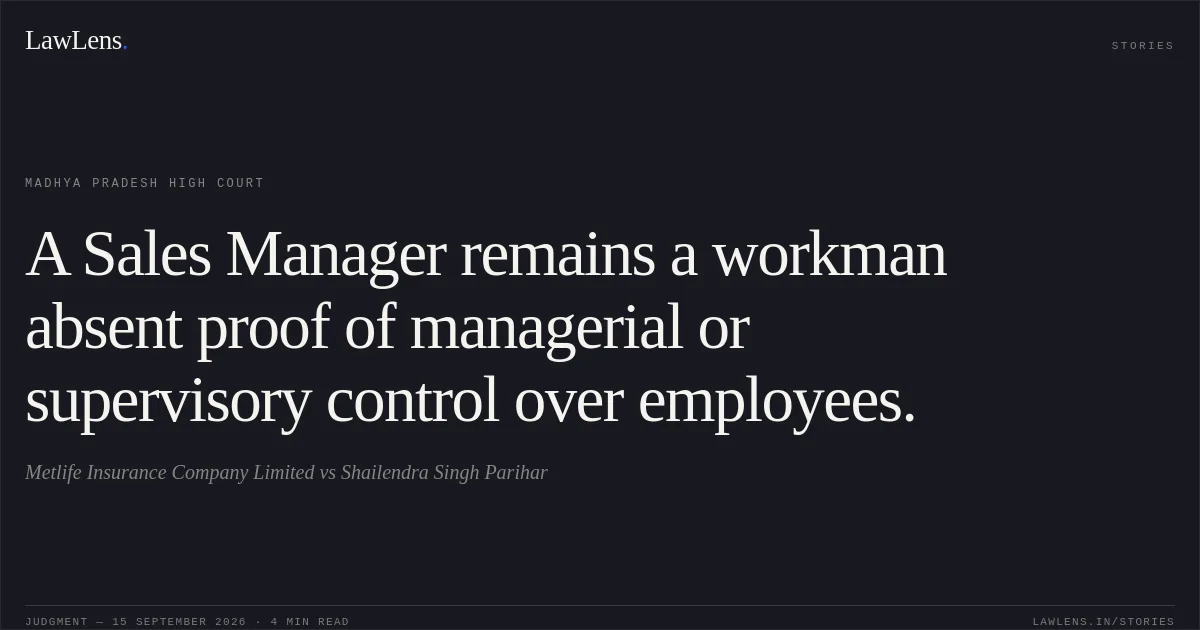
The connected petitions arose from identical awards dated 6 February 2025 passed by the Central Government Industrial Tribunal-cum-Labour Court (“CGIT”), concerning the termination of Manish Kumar Shrivastava and Shailendra Singh Parihar by MetLife Insurance Company Limited.
Source reference: [paras. 13–15]Shrivastava was appointed on 22 February 2011 and Parihar on 18 October 2010; both were terminated on 13 June 2012 after allegations of misbehaviour and use of abusive language against a senior manager.
Source reference: [paras. 13–15]The employees denied using abusive language. Their emails acknowledged that their voices had been raised in a tense conversation but denied the alleged foul or abusive language. No domestic enquiry was conducted before termination.
Source reference: [para. 16]The CGIT held the termination illegal and directed reinstatement with full back wages and consequential benefits.
Source reference: [para. 2]The employer challenged the awards, contending that the employees were not “workmen” under Section 2(s) of the Industrial Disputes Act, 1947 (“ID Act”), and that no formal enquiry was necessary because the emails amounted to an admission of guilt.
Source reference: [paras. 3–8]Issues
1. Whether the employees’ emails amounted to an admission of misconduct so as to dispense with a domestic enquiry before termination.
Source reference: [para. 16]2. Whether the employees, despite being designated “Sales Managers”, were sales-promotion employees or were employed mainly in managerial, administrative, or supervisory capacities and were therefore excluded from the definition of “workman” under Section 2(s) of the ID Act.
Source reference: [paras. 17–20, 25–27]3. Whether the CGIT was justified in directing reinstatement and full back wages when no domestic enquiry had been held and the employer had not sought to prove the alleged misconduct before the Tribunal.
Source reference: [paras. 28–29]4. Whether the grant of 100% back wages required modification in view of the employees’ relatively short periods of service.
Source reference: [paras. 30–33]Law Applied
Section 2(s) of the ID Act includes persons employed in manual, skilled, technical, operational, clerical, or supervisory work, but excludes persons employed mainly in managerial or administrative capacities and supervisory employees drawing wages exceeding the statutory limit or exercising mainly managerial functions.
Source reference: [para. 20]The Court applied the principle that the actual nature of duties, rather than the employee’s designation, determines whether the employee is a “workman” or a sales-promotion employee.
Source reference: [paras. 17–18]It considered *H.R. Adyanthaya v. Sandoz (India) Ltd.*, (1994) 5 SCC 737, and *Novartis India Ltd. v. Vipin Srivastava*, W.A. No. 75 of 2017, on sales-promotion employees.
Source reference: [para. 7]On supervisory and managerial functions, the Court relied on *Ved Prakash Gupta v. Delton Cable India (P) Ltd.*, (1984) 2 SCC 569; *S.K. Maini v. Carona Sahu Co. Ltd.*, (1994) 3 SCC 510; and *Bharti Airtel Ltd. v. A.S. Raghavendra*, (2024) 6 SCC 418, holding that absence of power to appoint, dismiss, or initiate disciplinary proceedings is relevant but not by itself conclusive; the overall nature of duties and actual supervisory control must be examined.
Source reference: [paras. 22–24]Regarding termination for misconduct without enquiry, the Court applied *Workmen v. Firestone Tyre & Rubber Co.*, (1973) 1 SCC 813, and *Workmen v. Motipur Sugar Factory*, AIR 1965 SC 1803, under which an employer may seek to prove the alleged misconduct before the Labour Court after a defective or absent enquiry, but must actually request and lead such evidence.
Source reference: [para. 28]Reasoning
The Court held that the emails did not admit the alleged misconduct. The employees denied using abusive language and merely acknowledged that their voices had been raised during a tense exchange; therefore, the allegations remained disputed and could not justify termination without a domestic enquiry.
Source reference: [para. 16]The Court further found that the employees’ work consisted of identifying prospective financial advisers and referring them to the Branch Manager, who alone conducted interviews and made the final decision regarding engagement.
Source reference: [paras. 17–18, 25–27]The financial advisers were not regular employees under the employees’ control, and the employer produced no evidence that the employees supervised, appointed, dismissed, or exercised managerial authority over any workmen.
Source reference: [paras. 17–18, 25–27]Their designation as Sales Managers was consequently not determinative, and they were held to be “workmen” under Section 2(s).
Source reference: [paras. 17–18, 25–27]Although the absence of a domestic enquiry entitled the employer to seek permission to prove misconduct before the CGIT, the employer did not make such a request or lead evidence to establish the charges; hence, the Court declined to remand the matter and upheld the finding that the termination was illegal.
Source reference: [paras. 28–29]However, considering that Shrivastava had served for approximately sixteen months and Parihar for approximately twenty months, the Court found 100% back wages disproportionate, while also recognising that the prolonged litigation was not attributable to the employees.
Source reference: [paras. 30–32]Holding
The High Court partly allowed both petitions.
It upheld the CGIT’s findings that the employees were “workmen” under Section 2(s) of the ID Act, that their termination without a domestic enquiry was illegal, and that they were entitled to reinstatement.
Source reference: [paras. 27–29, 33]However, it modified the monetary relief by reducing back wages from 100% to 30% for the period up to 6 February 2025.
Source reference: [paras. 32–33]The employees were directed to receive 100% salary thereafter until they were taken back into service.
Source reference: [paras. 32–33]Acts & Sections Cited
2 provisions across 2 statutes referred to in this judgment. Linked provisions open on LawLens.
Industrial Disputes Act, 19471
Industrial Disputes (Amendment) Act, 19821
Original Court PDF
Metlife Insurance Company LimitedvsShailendra Singh Parihar
Click to open original judgment
Original judgment, available to read, download and summarize on LawLens.in
![Post-superannuation challenge to dismissal fails; retiral benefits may be pursued only upon acquittal.. Manohar Prasad vs D/o Posts. CAT - ['Kolkata']. LawLens](/stories/thumbnails/post-superannuation-challenge-to-dismissal-fails-retiral-benefits-may-be-pursued-only-upon-952bb65805134b3eb584dc223c8196a7.webp)