Facts
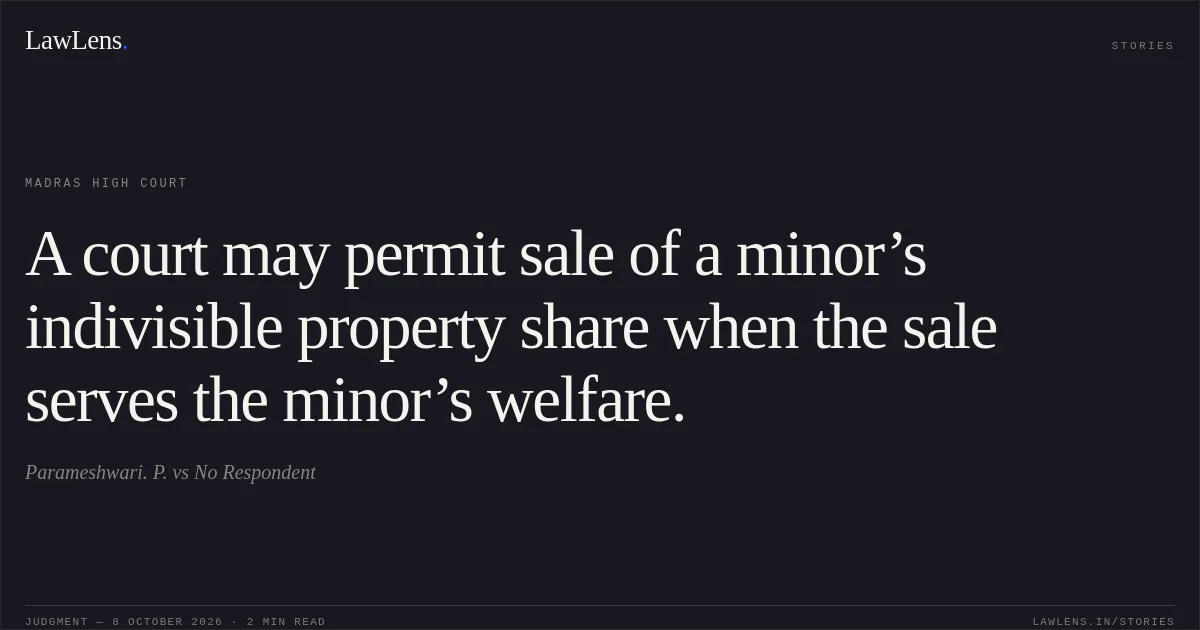
The petitioner, the mother and natural guardian of minor P. Yogeshwari, sought permission to sell the minor’s 1/10th share in jointly held property.
Source reference: p. 2–6The petitioner said the property was not income-generating, the building was in poor condition, and the co-owners had agreed to sell it to R. Ajith for a total consideration of ₹1,18,80,000. The minor’s share was valued at ₹11,88,000.
Source reference: p. 2–6The petitioner also relied on her financial difficulties and the need to meet the minor’s expenses.
Source reference: p. 2–6The co-owners had executed an agreement of sale and provided consent affidavits; the petitioner gave oral and documentary evidence before the learned Master.
Source reference: p. 2–6The petition was brought under Section 8(2)(a) of the Hindu Minority and Guardianship Act, 1956, read with Order XXI Rules 2 and 3 of the Original Side Rules.
Source reference: p. 1Issues
Whether permission should be granted to the petitioner to sell the minor’s 1/10th share in the property.
Source reference: p. 6–7Whether the proposed sale proceeds should be protected through conditions governing deposit, investment, and withdrawal.
Source reference: p. 5, 7–8Law Applied
The Court considered Section 8(2)(a) of the Hindu Minority and Guardianship Act, 1956, which was invoked as the basis for seeking permission to transfer the minor’s immovable property, and Order XXI Rules 2 and 3 of the Original Side Rules, under which the petition was filed.
Source reference: p. 1The Court’s stated governing consideration was whether the proposed sale was in the minor’s best interest; it cited no precedents.
Source reference: p. 5–7Reasoning
The Court found that the minor’s share could not be divided and dealt with independently, and that joining the other co-owners in the sale was in the minor’s best interest.
Source reference: p. 6It considered the agreed sale price, the petitioner’s evidence, the co-owners’ consent, and the condition of the property in reaching that conclusion.
Source reference: p. 4–6To safeguard the minor’s entitlement, the Court required the minor’s share of the proceeds to be deposited and placed in a fixed deposit, while permitting the mother to withdraw interest quarterly for the minor’s upkeep and maintenance.
Source reference: p. 7–8Holding
The Court allowed the petition and authorized the sale of the minor’s 1/10th share.
The ₹11,88,000 share of the consideration, less any applicable TDS, must be deposited in a nationalised bank before execution and registration of the sale deed, which must occur by 31 January 2027.
Source reference: p. 7–8The sum must be invested in a fixed deposit, initially for two years and then renewed for a further two years; the mother may withdraw interest quarterly for the minor’s upkeep and maintenance.
Source reference: p. 7–8The sale deed and fixed-deposit documents must be filed with the Registry within four weeks of registration.
Source reference: p. 7–8On attaining majority and maturity of the deposit, the minor may seek payment of the principal and accrued interest.
Source reference: p. 7–8Acts & Sections Cited
1 provisions across 1 statute referred to in this judgment. Each provision opens on LawLens.
Hindu Minority and Guardianship Act, 19561
Original Court PDF
Parameshwari. P.vsNo Respondent
Click to open original judgment
Original judgment, available to read, download and summarize on LawLens.in