Facts
The petitioner was allotted a stall on a 99-year lease and claimed to have paid Rs. 8,00,000.
Source reference: no citationThe Municipality cancelled the allotment in 2019 and provided for a refund of Rs. 6,00,000 after deducting 25% of the deposit.
Source reference: no citationThe petitioner later sought repayment of Rs. 8,00,000 with interest.
Source reference: no citationOn 24 September 2025, the Court disposed of the writ petition after recording that the petitioner would accept Rs. 6,00,000 in full and final satisfaction; the Municipality produced a cheque for that amount.
Source reference: paras. 3–6The petitioner then sought recall, alleging that his former advocate had agreed to the settlement without his authority.
Source reference: paras. 3–6He relied principally on a letter said to have been sent to his advocate on 10 October 2025 and maintained that the cheque had not been accepted or encashed.
Source reference: paras. 3–6The respondent disputed the alleged lack of authority, challenged the letter’s reliability, and opposed recall on grounds including delay and the petitioner’s retention of the cheque.
Source reference: paras. 11–14Issues
1. Whether the order disposing of the writ petition should be recalled because the petitioner’s advocate allegedly agreed to the Rs. 6,00,000 settlement without the petitioner’s instructions.
Source reference: paras. 16–172. Whether the petitioner’s delay, conduct concerning the letter and cheque, and failure to challenge the cancellation order precluded recall.
Source reference: paras. 18–25Law Applied
Under Himalayan Coop. Group Housing Society v. Balwan Singh, a lawyer must have specific authority to compromise a client’s claim; engagement alone does not confer implied authority to settle, although counsel may make statements that are proper steps in accomplishing the purpose of the engagement.
Source reference: paras. 8, 21A court’s record of what transpired at a hearing is ordinarily conclusive, and a party disputing that record must promptly bring the alleged error to the judge’s attention.
Source reference: para. 20Recall or review is not a substitute for a rehearing on the merits; finality may be disturbed where a patent mistake or glaring omission appears.
Source reference: para. 24The Court also applied the principles that discretionary relief under Article 226 may be denied to a litigant who does not approach the Court with clean hands, and that a party may not approbate and reprobate by retaining a benefit while challenging the order that conferred it.
Source reference: paras. 23, 25It considered K.D. Sharma v. Steel Authority of India Ltd., Prestige Lights Ltd. v. State Bank of India, and Jamal Molla v. State of West Bengal on candour, delay, and discretionary relief.
Source reference: paras. 19, 25Reasoning
The Court found the petitioner’s principal evidence unreliable: the letter relied on was undated, the accompanying courier and postal records did not establish what was sent or when, and the petitioner did not explain why the same letter appeared to have been sent twice.
Source reference: para. 18His subsequent conduct—including no demonstrated follow-up or complaint against the advocate, and no prompt application to correct the Court’s record—undermined the allegation of an unauthorised concession; the delay was also inadequately explained.
Source reference: paras. 19–20The settlement concerned the refund at issue, followed an adjournment for counsel to obtain instructions, and matched the Rs. 6,00,000 refund provided in the unchallenged cancellation order.
Source reference: paras. 21–22The Court therefore found no apparent mistake warranting recall.
Source reference: paras. 21–22It further relied on the petitioner’s failure to return the cheque and his lack of candour about it in declining discretionary relief.
Source reference: paras. 23, 25Holding
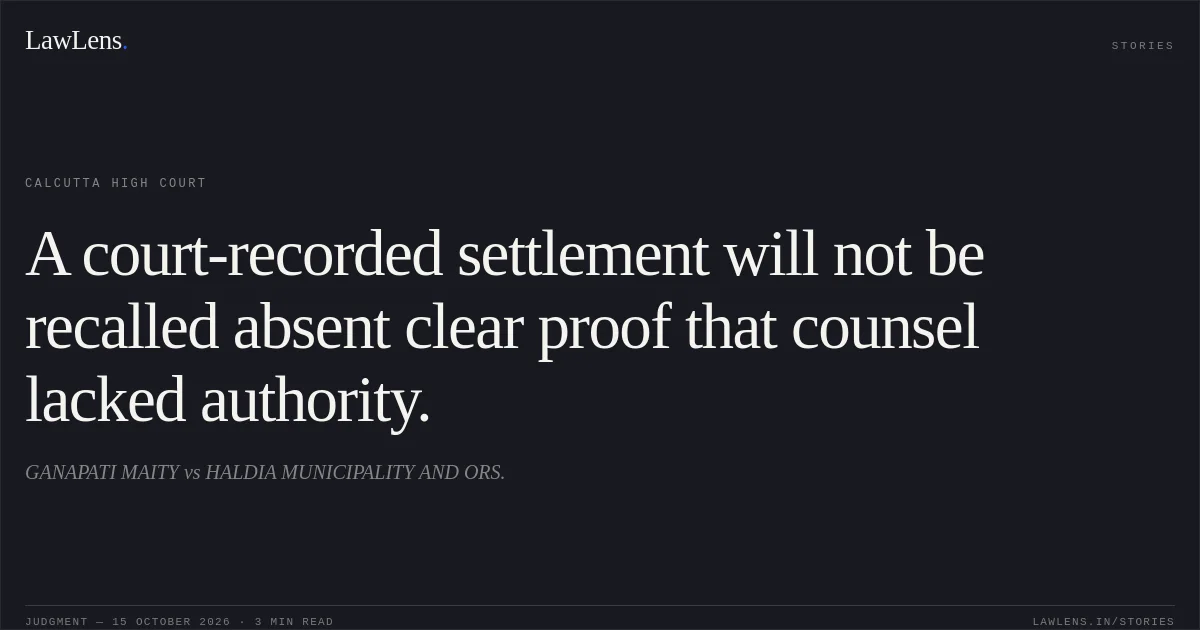
The Court held that no ground had been established to recall the order dated 24 September 2025.
The Court dismissed CAN 1 of 2026.
Source reference: paras. 26–27It directed that, if the cheque had become stale, the Municipality must issue a fresh cheque for Rs. 6,00,000 in favour of “Adarsha Hotel & Restaurant” within four weeks after the stale cheque is returned.
Source reference: para. 28Original Court PDF
GANAPATI MAITYvsHALDIA MUNICIPALITY AND ORS.
Click to open original judgment
Original judgment, available to read, download and summarize on LawLens.in