Facts
The respondent-plaintiff, Chand Babu, was the owner of House No. 201, Ground Floor, MIG Flats, Jahangir Puri, Delhi, as evidenced by the allotment letter and payment receipt.
Source reference: p.3, para. 12After the marriage of his son, Brij Raj, with Renu Raj on 28 January 2012, he permitted both appellants—his son and daughter-in-law—to reside in one room of the property out of love and affection.
Source reference: p.2, para. 3Alleging that their conduct subsequently became hostile and disrespectful and that they threatened to dispossess him, Chand Babu terminated their permissive occupation by legal notice dated 13 July 2015.
Source reference: p.2, paras. 4–5He thereafter instituted a suit for permanent and mandatory injunction seeking possession and occupation charges of ₹5,000 per month.
Source reference: p.2, para. 5The appellants claimed that Renu Raj had paid ₹2 lakhs towards purchase of the property and that Brij Raj had contributed substantially to its maintenance, thereby acquiring an ownership or co-sharer interest.
Source reference: p.3, para. 6They also claimed a right of residence in the property as a shared household.
Source reference: p.4, paras. 19–21The Trial Court decreed mandatory injunction directing delivery of vacant possession but denied damages; the First Appellate Court affirmed the decree.
Source reference: p.4, paras. 14–17The appellants preferred the present second appeal under Section 100 CPC.
Source reference: p.5, para. 18Issues
Whether the appellants had any legal or proprietary right to continue occupying the respondent’s property after termination of their permissive occupation?
Source reference: p.6, paras. 23–24Whether the daughter-in-law possessed an indefeasible right of residence in the property as a “shared household,” notwithstanding the respondent’s ownership and withdrawal of permission?
Source reference: p.5, paras. 19–20; p.6, para. 25Whether the second appeal raised any substantial question of law warranting interference under Section 100 CPC?
Source reference: p.6, para. 26Law Applied
The Court applied Section 100 CPC, under which a second appeal lies only where a substantial question of law arises.
Source reference: p.6, para. 26It applied the principle that a son and daughter-in-law permitted to reside in the property of the owner out of love and affection acquire no independent legal right to continue there once such permission is withdrawn, particularly where no ownership or co-ownership is proved.
Source reference: p.6, paras. 23–24Relying on Prabha Tyagi v. Kamlesh Devi, the Court recognized that a daughter-in-law may have a right to reside in a shared household even without title or ownership.
Source reference: p.6, para. 25However, relying on Satish Chander Ahuja v. Sneha Ahuja, (2021) 1 SCC 414, it held that such right is not indefeasible and that dispossession must be effected in accordance with law.
Source reference: p.6, para. 25The Court also applied the evidentiary principle that an assertion of contribution towards purchase or ownership, unsupported by evidence, cannot establish a proprietary interest.
Source reference: p.6, para. 24Reasoning
The respondent’s ownership was supported by the allotment letter and payment receipt, while the appellants led no evidence despite repeated opportunities to substantiate their alleged payment of ₹2 lakhs or contribution towards the property.
Source reference: p.3, para. 12; p.4, paras. 16–17Their occupation was therefore permissive and not founded on ownership, co-ownership, or any proved contractual right.
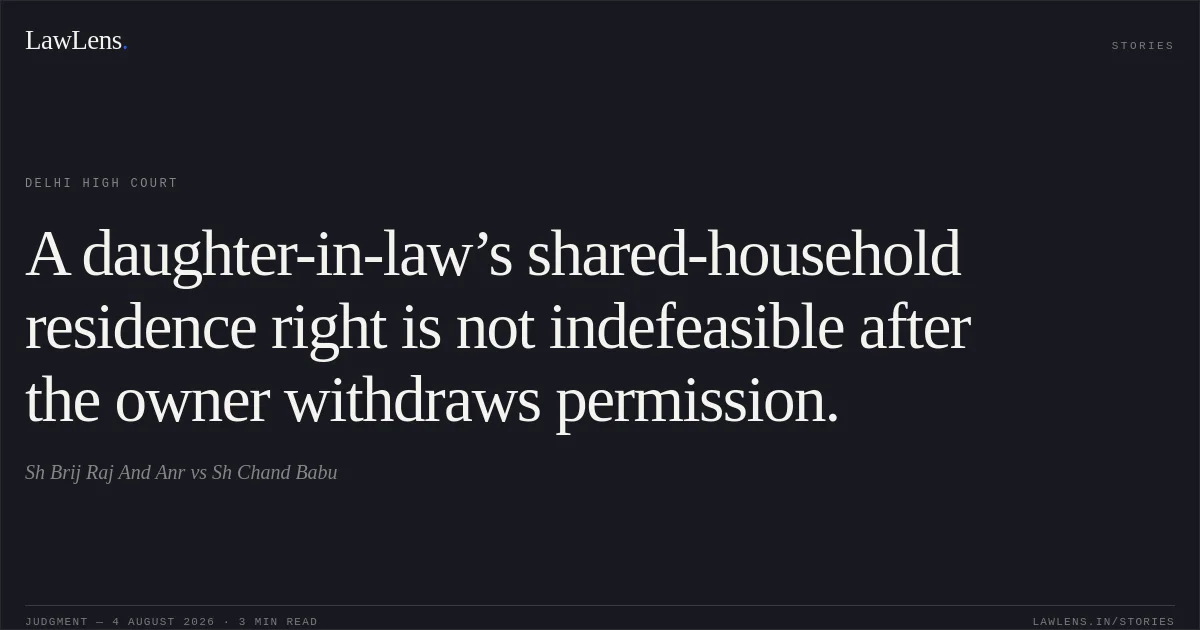
Source reference: p.6, paras. 23–24Although the Court acknowledged the daughter-in-law’s potential statutory right to reside in a shared household under the principles discussed in Prabha Tyagi and Satish Chander Ahuja, it clarified that the right was not indefeasible.
Source reference: p.6, para. 25In the present case, the owner had expressly withdrawn permission through the legal notice, and the concurrent findings of the Trial Court and First Appellate Court established that the appellants had no right to continue in possession.
Source reference: p.6, paras. 23–26The appellants’ challenge merely sought reconsideration of factual findings and did not disclose any substantial question of law under Section 100 CPC.
Source reference: p.6, para. 26Holding
The High Court held that the appellants had no legally enforceable right to remain in the respondent’s property after termination of their permissive occupation.
The daughter-in-law’s shared-household right was not treated as an indefeasible right overriding the owner’s entitlement to seek possession through lawful proceedings.
Source reference: p.6, para. 25Finding no substantial question of law, the Court dismissed RSA 185/2024 and upheld the decree directing the appellants to hand over peaceful vacant possession.
Source reference: p.6, para. 26The claim for occupation charges had already been rejected by the Trial Court, and the pending applications were disposed of accordingly.
Source reference: p.6, para. 26; p.7, para. 27Original Court PDF
Sh Brij Raj And AnrvsSh Chand Babu
Click to open original judgment
Original judgment, available to read, download and summarize on LawLens.in