Facts
The appellant’s father, D. Ramanujayam, was employed as a teacher in a Panchayat Union Primary School and died in service on 16 June 1992.
Source reference: p.2, para.2The appellant’s mother applied for compassionate appointment on 24 March 1997.
Source reference: p.2, para.2The application was subsequently rejected on 19 August 2008 on the grounds that the requisite documents had not been produced, the application had not been pursued, there was substantial delay, most of the children had married, and the eldest legal heir had not applied.
Source reference: p.2, para.2The rejection was challenged in W.P. No.30506 of 2002, but the writ petition was withdrawn.
Source reference: p.3, para.3After attaining majority, the appellant submitted a fresh application in 2022, followed by a representation dated 10 October 2022 seeking compassionate appointment.
Source reference: p.3, para.3As the representation was not considered, he filed W.P. No.6636 of 2023.
Source reference: p.3, para.3The writ petition was dismissed on 20 April 2023, leading to the present writ appeal.
Source reference: p.3, para.3Issues
Whether the appellant could maintain a second application for compassionate appointment submitted approximately 30 years after the death of the employee and after attaining majority?
Source reference: p.3, para.4; p.5, para.7Whether the appellant was entitled to a direction for consideration of his claim for compassionate appointment despite the earlier rejection of his mother’s application and the withdrawal of the earlier writ petition?
Source reference: p.3, para.4Whether compassionate appointment could be granted without establishing that the family continued to suffer penurious circumstances warranting relaxation of the ordinary constitutional recruitment process?
Source reference: pp.3–4, paras.5–6Law Applied
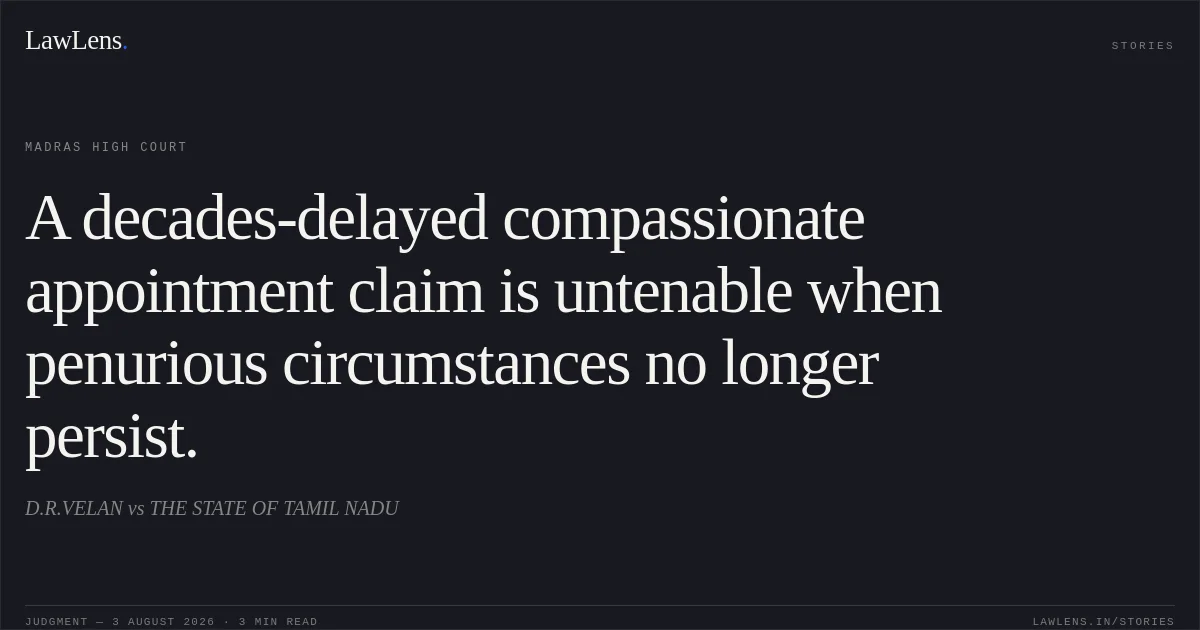
Compassionate appointment is a concession intended to mitigate the immediate financial hardship caused by the sudden death of a government employee; it is neither a vested right nor an alternative mode of public recruitment.
Source reference: pp.3–4, para.5Since public employment is governed by Articles 14 and 16 of the Constitution, compassionate appointment schemes—being an exception to the general rule of recruitment—must be applied strictly in accordance with their terms and conditions and only in deserving cases after verification of the family’s penurious circumstances.
Source reference: pp.3–4, paras.5–6The purpose of the scheme is not to provide employment to a legal heir irrespective of the passage of time or continuing financial need.
Source reference: p.3, para.5A prolonged delay in seeking appointment is relevant evidence that the immediate financial crisis, if any, no longer exists.
Source reference: p.5, para.7Reasoning
The Court held that the appellant’s 2022 application was submitted nearly 30 years after his father’s death and therefore could not be treated as a claim arising from the immediate hardship contemplated by the compassionate appointment scheme.
Source reference: p.3, para.4; p.5, para.7The mother’s earlier application had already been rejected in 2008, and the challenge to that rejection had been withdrawn; consequently, the appellant could not revive the claim through a second application after attaining majority.
Source reference: p.3, para.4The Court further reasoned that directing appointment merely on the basis of familial relationship or misplaced sympathy would undermine the constitutional requirement of equal opportunity in public employment and prejudice candidates seeking appointment through open competition.
Source reference: pp.3–4, paras.5–6The 30-year delay supported the factual inference that any penurious circumstances existing at the time of the employee’s death had ceased to exist.
Source reference: p.5, para.7Holding
The Court answered the issues against the appellant.
It held that the second application made after approximately 30 years was not maintainable, particularly in view of the earlier rejection of the mother’s application and the withdrawal of the prior writ petition.
Source reference: p.3, para.4The writ appeal was dismissed, the order dated 20 April 2023 in W.P. No.6636 of 2023 was confirmed, and no costs were awarded.
Source reference: p.5, para.7Original Court PDF
D.R.VELANvsTHE STATE OF TAMIL NADU
Click to open original judgment
Original judgment, available to read, download and summarize on LawLens.in