Facts
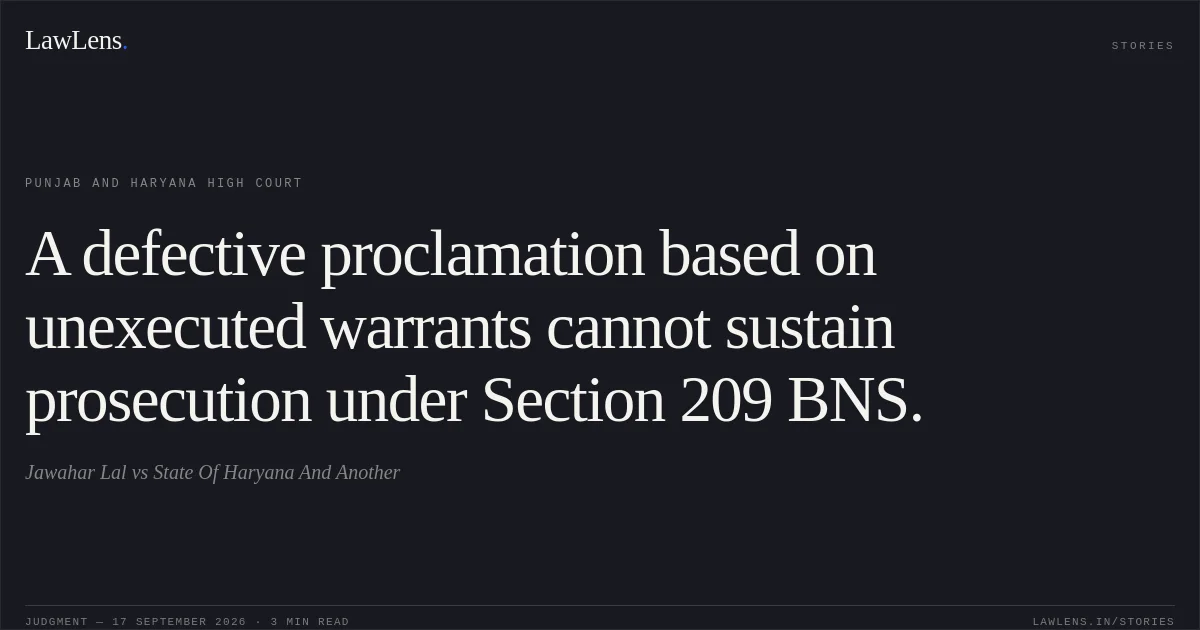
The petitioner sought quashing under Section 528 of the Bharatiya Nagarik Suraksha Sanhita, 2023 (“BNSS”), corresponding to Section 482 Cr.P.C., of FIR No. 369 dated 10 June 2026 registered under Section 209 of the Bharatiya Nyaya Sanhita, 2023 (“BNS”), corresponding to Section 174-A IPC, at Police Station Civil Lines, Karnal.
Source reference: p.1He also challenged the order dated 19 October 2024 by which the Judicial Magistrate First Class, Karnal, declared him a proclaimed person in a complaint under the Negotiable Instruments Act.
Source reference: p.1The petitioner asserted that he had never been served with summons, notices, or warrants and had no knowledge of the complaint proceedings.
Source reference: p.2He claimed that, after learning of the proceedings and FIR, he surrendered before the Trial Court on 13 July 2026, was granted regular bail, and thereafter appeared in the complaint case.
Source reference: p.2On examination of the record, the High Court found no reliable material showing valid service of summons or lawful execution of warrants against the petitioner; the Magistrate had recorded that the warrants were returned as “executed” through the petitioner’s son.
Source reference: pp.5–6Issues
1. Whether the order declaring the petitioner a proclaimed person was legally sustainable when the record did not establish due service of summons, valid execution of warrants, or the procedural prerequisites for proclamation under Section 82 Cr.P.C.
Source reference: pp.5–62. Whether the consequential prosecution under Section 209 BNS, corresponding to Section 174-A IPC, could continue when the proclamation proceedings forming its foundation suffered from substantive procedural defects and the petitioner had subsequently surrendered before the Trial Court.
Source reference: pp.4–6Law Applied
The Court exercised its inherent jurisdiction under Section 528 BNSS, corresponding to Section 482 Cr.P.C., to prevent abuse of process and secure the ends of justice.
Source reference: p.1It applied the procedural requirements of Section 82 Cr.P.C. governing proclamation proceedings, holding that issuance of a proclamation presupposes a warrant against the person concerned and a judicial satisfaction, based on relevant material, that the person has absconded or is concealing himself to evade execution of the warrant.
Source reference: p.5Relying on Daljit Singh v. State of Haryana and another, Criminal Appeal No. 4359 of 2024, decided on 2 January 2025, the Court reiterated that Section 174-A IPC is a standalone offence arising from failure to appear pursuant to a proclamation; however, prosecution under that provision cannot be initiated independently of a valid proclamation issued under Section 82 Cr.P.C.
Source reference: pp.3–4A warrant of arrest is personal in character and cannot be treated as executed merely because it was received by or served through a family member.
Source reference: p.5Reasoning
The Court found a fundamental defect in the genesis of the impugned proceedings because the record did not demonstrate that the petitioner had been duly served with summons or that any bailable or non-bailable warrant had been lawfully executed against him before issuance of the proclamation.
Source reference: p.5The Magistrate’s recital that the warrants were “executed” through the petitioner’s son could not amount to execution of warrants directed against the petitioner himself, since a warrant must be executed by securing or apprehending the person named in it.
Source reference: p.5The material also failed to establish conscious or deliberate evasion by the petitioner.
Source reference: no citationAlthough Daljit Singh recognises that Section 174-A IPC is independent of the continued existence of the proclamation after a valid initiation, the present prosecution had not been validly set in motion because the foundational proclamation proceedings were procedurally defective.
Source reference: pp.3–4, 5–6The petitioner’s subsequent surrender and appearance further demonstrated that the object of the proclamation mechanism—securing his presence—had been achieved, making continuation of the prosecution unjustified in the circumstances.
Source reference: p.6Holding
The High Court held that the proclamation order dated 19 October 2024 was unsustainable because the mandatory foundational safeguards preceding proclamation had not been established and the warrants had not been lawfully executed against the petitioner.
Consequently, the Court quashed and set aside the proclamation order, FIR No. 369 dated 10 June 2026 registered under Section 209 BNS, and all consequential proceedings arising therefrom, insofar as they concerned the petitioner.
Source reference: p.6The petition was accordingly allowed, and all pending miscellaneous applications were disposed of as infructuous.
Source reference: p.7Acts & Sections Cited
4 provisions across 3 statutes referred to in this judgment. Each provision opens on LawLens.
Bharatiya Nagarik Suraksha Sanhita, 20231
Code of Criminal Procedure, 19732
Bharatiya Nyaya Sanhita, 20231
Original Court PDF
Jawahar LalvsState Of Haryana And Another
Click to open original judgment
Original judgment, available to read, download and summarize on LawLens.in