Facts
The petitioners were teachers employed by respondent No. 5, Sant Ravidas Shiksha Prasar Samiti, which operated Sant Ravidas Prathmik Vidyalaya, Lahar. They had been appointed in 1993, and their appointments were stated to have been rectified under Rule 12(A) of the Grant-in-Aid Rules, 1985.
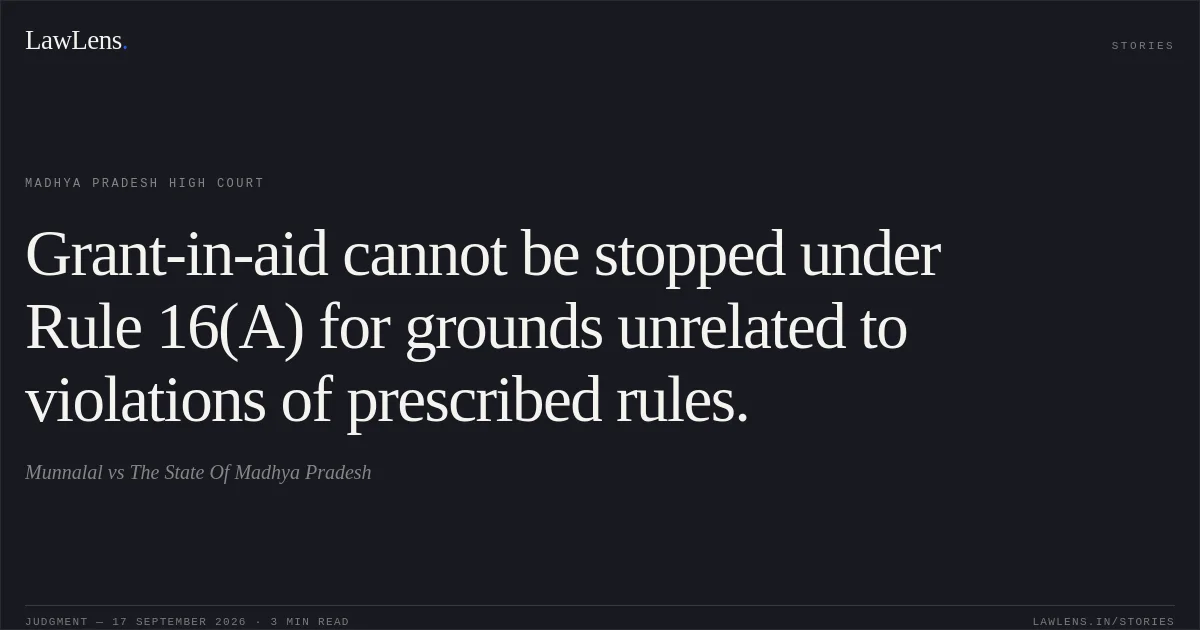
Source reference: paras. 2, 14The institution received State grant-in-aid from which the petitioners’ salaries, including benefits under the Fifth and Sixth Pay Commissions, were paid. The Collector issued notices to the Samiti concerning, inter alia, compliance with the reservation roster under Rule 15 and the existence of other primary schools nearby. By order dated 26 May 2025, the Collector stopped the grant-in-aid under Rule 16(A), principally on the ground that four primary schools were functioning within a radius of 1.5 kilometres.
Source reference: paras. 2–4The petitioners challenged the order, contending that the stated ground was not a violation contemplated by the 1985 Rules and that the Samiti had not been effectively served with the notices.
Source reference: paras. 5–8Issues
Whether the Collector could stop the grant-in-aid under Rule 16(A) of the Grant-in-Aid Rules, 1985 on the ground that other primary schools were functioning in the vicinity, when such circumstance did not constitute a specified violation of the Rules.
Source reference: paras. 15–18Whether the impugned order was legally sustainable when the notice dated 6 March 2025 did not specify any violation and the respondent-Samiti disputed receipt of the earlier notices, thereby raising an issue of compliance with natural justice.
Source reference: paras. 17–18Whether the petitioners, although not the direct recipients of the grant-in-aid, could invoke Article 226 to challenge the order stopping the grant.
Source reference: para. 19Law Applied
Rule 16(A) of the Grant-in-Aid Rules, 1985 permits the grant-sanctioning authority to stop, reduce, or recover grant only where a grant-aided institution fails to satisfy the authority regarding compliance with conditions prescribed under the Rules, and only after notice granting an opportunity to rectify the specified defect.
Source reference: paras. 15–16Rule 15 concerns compliance with the reservation roster, while Rule 12(A) governs the validity or approval of appointments.
Source reference: paras. 2, 9–10The Court also recognised the general principle that an administrative order having adverse civil consequences must be preceded by a proper notice and meaningful opportunity of hearing.
Source reference: paras. 17–20Under Article 226 of the Constitution, the High Court may exercise extraordinary judicial review to correct jurisdictional error, illegality, and violation of natural justice.
Source reference: paras. 15–20Reasoning
The Court held that although the notice dated 25 February 2025 referred to alleged non-compliance with Rule 15, the impugned order was not based on violation of the reservation roster. Instead, the grant was stopped because other primary schools existed within 1.5 kilometres of the respondent institution.
Source reference: paras. 17–18That circumstance did not constitute an irregularity or violation of a condition prescribed under the 1985 Rules so as to attract Rule 16(A).
Source reference: paras. 17–18Further, the subsequent notice dated 6 March 2025 merely required the Samiti to appear with documents and did not identify any specific violation requiring rectification.
Source reference: para. 17Consequently, the Collector could not rely on Rule 16(A) to stop the grant on a ground outside the statutory scheme.
Source reference: paras. 17–18Although the Court observed that the Samiti was the proper party to challenge the stoppage and that the petitioners could not ordinarily challenge it without authorisation, it exercised jurisdiction under Article 226 because the impugned order suffered from a patent legal infirmity.
Source reference: para. 19Holding
The High Court quashed the Collector’s order dated 26 May 2025 stopping the grant-in-aid.
The matter was remitted to the Collector with directions to issue a proper notice to respondent No. 5, call for its response and requisite documents, and pass a fresh order after granting it due opportunity of hearing.
Source reference: paras. 20–22The exercise was directed to be completed within two months from receipt of the certified copy of the judgment.
Source reference: paras. 20–22The petition was accordingly disposed of; the Court did not direct automatic or permanent release of the grant-in-aid.
Source reference: paras. 20–22Original Court PDF
MunnalalvsThe State Of Madhya Pradesh
Click to open original judgment
Original judgment, available to read, download and summarize on LawLens.in