Facts
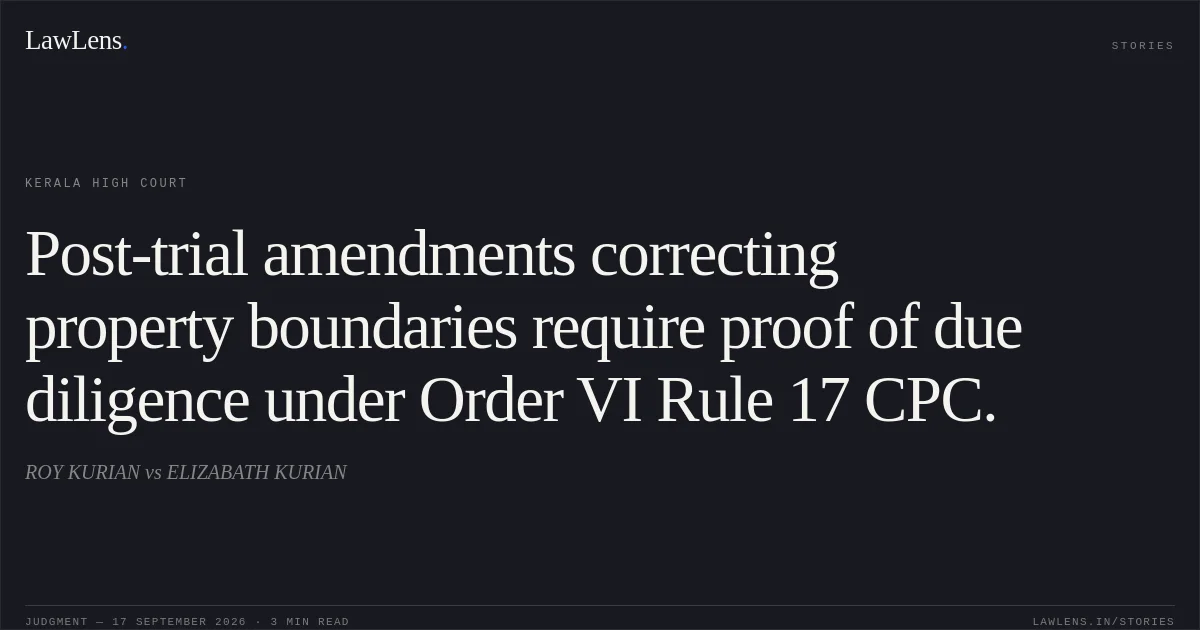
The petitioner, plaintiff in O.S. No. 257 of 2012 before the Munsiff Court, Changanacherry, instituted a suit against his sister for fixation of the western and northern boundaries of his property.
Source reference: para. 1In the original plaint, the northern boundary of plaint item No. 1 was incorrectly described as the defendant’s property.
Source reference: para. 1The defendant’s written statement, filed in 2013, specifically contended that the suit had been filed without clear knowledge of the property boundaries.
Source reference: para. 1After commencement of trial, during the petitioner’s cross-examination, the discrepancy in the boundary description was noticed.
Source reference: para. 1The petitioner thereafter filed I.A. No. 16 of 2023 seeking amendment of the plaint, contending that the error resulted from an incorrect translation of the property description from Malayalam into English and that the amendment would bring the plaint in conformity with his title deed.
Source reference: paras. 1, 3The Munsiff Court dismissed the amendment application by order dated 29 June 2024, holding that the petitioner had failed to establish the “due diligence” required under the proviso to Order VI Rule 17 of the Code of Civil Procedure, 1908 (“CPC”).
Source reference: para. 1The petitioner challenged that order before the High Court.
Source reference: para. 1Issues
Whether the petitioner established that, despite exercising due diligence, he could not have sought amendment of the plaint before commencement of trial, as required by the proviso to Order VI Rule 17 CPC?
Source reference: paras. 5–9Whether an amendment correcting the description of the property boundaries should nevertheless be permitted because it was necessary for effective adjudication and would not prejudice the defendant?
Source reference: paras. 3–4, 7–9Law Applied
The Court applied Order VI Rule 17 CPC, including its proviso, which restricts amendment of pleadings after commencement of trial unless the court is satisfied that, despite due diligence, the party could not have raised the matter earlier.
Source reference: paras. 5–6“Due diligence” means reasonable diligence, namely, the diligence that a prudent person would exercise in conducting his affairs; delay, laches, and the party’s constructive knowledge are relevant considerations, and the burden lies on the applicant seeking post-trial-commencement amendment.
Source reference: paras. 5–6The Court relied on Chander Kanta Bansal v. Rajinder Singh Anand, Vidyabai v. Padmalatha, Samuel J. v. Gattu Mahesh, and M. Revanna v. Anjanamma for these principles.
Source reference: paras. 5–6Although LIC v. Sanjeev Builders (P) Ltd. states that amendments necessary for determining the real controversy should ordinarily be allowed, the Court held that those general principles cannot override the specific statutory restriction contained in the proviso to Order VI Rule 17 when trial has commenced.
Source reference: paras. 6–7The Court also considered Basavaraj v. Indira, which held that mere oversight or negligence does not satisfy the due-diligence requirement.
Source reference: para. 8Reasoning
The Court accepted that correcting the boundary description could assist in the proper adjudication of the boundary-fixation suit and that the amendment might not independently cause substantial prejudice to the defendant.
Source reference: para. 3However, because the amendment was sought after commencement of trial, the petitioner first had to satisfy the statutory due-diligence requirement.
Source reference: paras. 5–7The alleged error was not a newly arising fact: the incorrect northern boundary appeared in the original plaint, and the defendant’s Malayalam written statement filed in 2013 had already pointed out the uncertainty regarding the plaintiff’s boundaries.
Source reference: paras. 1, 9Consequently, the petitioner and his counsel could, with reasonable diligence, have detected and corrected the mistake well before trial commenced.
Source reference: para. 9The petitioner’s lack of familiarity with English and reliance on counsel’s translation did not establish due diligence, particularly because the written statement was in Malayalam and had drawn attention to the boundary discrepancy.
Source reference: para. 9The Court therefore held that the mistake amounted to oversight or negligence, not an inability to raise the matter earlier despite due diligence.
Source reference: paras. 8–9Holding
The High Court answered the principal issue against the petitioner and held that the application was barred by the proviso to Order VI Rule 17 CPC.
Since the petitioner failed to demonstrate due diligence and the trial court had correctly dismissed I.A. No. 16 of 2023, the High Court declined to interfere with the impugned order.
Source reference: para. 9The original petition was accordingly dismissed.
Source reference: para. 9Original Court PDF
ROY KURIANvsELIZABATH KURIAN
Click to open original judgment
Original judgment, available to read, download and summarize on LawLens.in