Facts
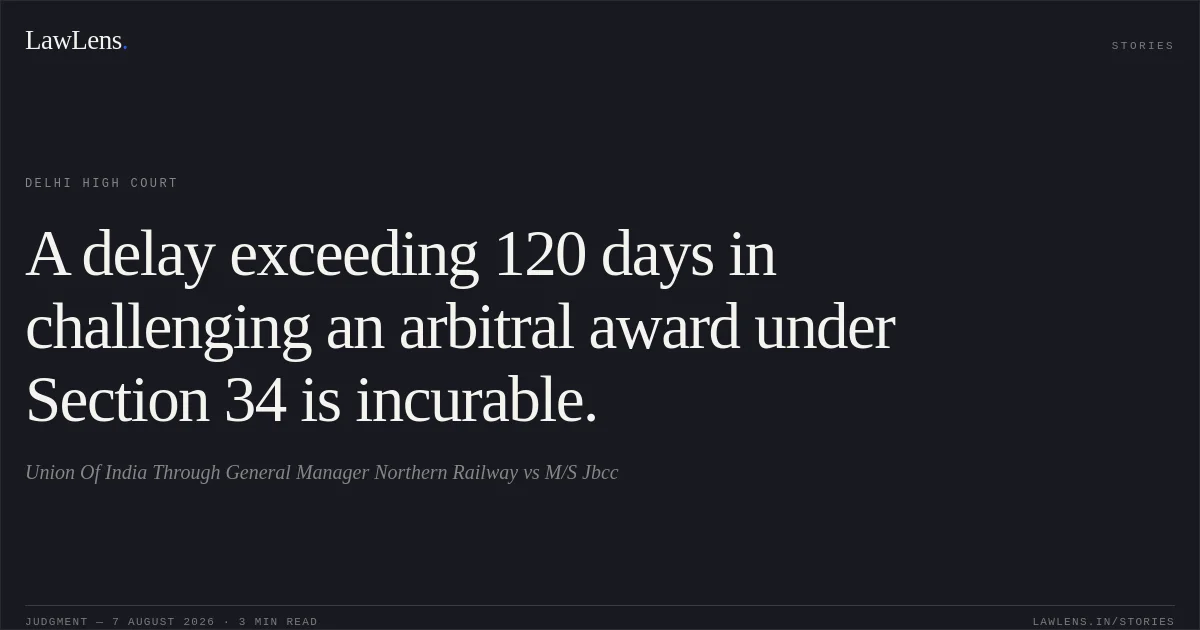
The appellant issued a tender for repair and maintenance of track in a yard on 6 September 2011, and the respondent was awarded the work, which was to be completed by 6 December 2012.
Source reference: para. 3Although the appellant stated that the respondent’s dues had been fully paid and a “no claim certificate” had been executed, the respondent invoked arbitration on 10 August 2017. An arbitral award was thereafter passed against the appellant on 26 April 2018.
Source reference: paras. 4–6The appellant challenged the award under Section 34 of the Arbitration and Conciliation Act, 1996, but the petition was dismissed in default on 31 January 2023 because no one appeared for the appellant.
Source reference: paras. 7–8, 19The appellant subsequently filed an application under Order IX Rule 9 CPC for restoration, claiming that the Railway’s advocates’ panel had been scrapped, the matter had been transferred to a new panel under the Ministry of Law and Justice, and the papers had not been collected by the newly appointed counsel.
Source reference: paras. 10–12, 23–25The restoration application was dismissed on 30 October 2025. The appellant challenged that order under Section 37(1)(c) of the Arbitration and Conciliation Act, 1996, read with Section 13 of the Commercial Courts Act, 2015.
Source reference: paras. 1, 8Issues
1. Whether the appellant established “sufficient cause” under Order IX Rule 9 CPC for restoring its Section 34 petition dismissed in default on 31 January 2023
Source reference: paras. 19–302. Whether the application for restoration, filed in February 2024, was barred by delay and whether the delay could be condoned on the basis that the dismissal order was allegedly discovered only on 2 February 2024
Source reference: paras. 27–313. Whether the Section 34 proceedings could be revived or entertained in view of the statutory limitation period of 90 days plus a further 30 days under the proviso to Section 34(3) of the Arbitration and Conciliation Act, 1996
Source reference: paras. 32–334. Whether the impugned orders warranted interference under Section 37 of the Arbitration and Conciliation Act, 1996, read with Section 13 of the Commercial Courts Act, 2015
Source reference: paras. 1, 34Law Applied
The Court applied Section 37(1)(c) of the Arbitration and Conciliation Act, 1996, which permits an appeal from specified orders under the Act, read with Section 13 of the Commercial Courts Act, 2015.
Source reference: para. 1It applied Order IX Rule 9 CPC, under which a proceeding dismissed for the plaintiff’s default may be restored only if the Court is satisfied that there was “sufficient cause” for the non-appearance.
Source reference: para. 20The Court further applied the proviso to Section 34(3) of the Arbitration and Conciliation Act, which permits a Section 34 challenge only within the prescribed period of 90 days and, upon sufficient cause, within a further maximum period of 30 days; the delay cannot be condoned beyond that statutory limit.
Source reference: paras. 32–33No judicial precedent was cited or relied upon in the judgment.
Source reference: no citationReasoning
The Court held that the appellant had already been granted an adjournment on 24 August 2022 because of the alleged change in the advocates’ panel, and the matter was listed for 3 November 2022 as a “last opportunity”.
Source reference: paras. 23–25Despite that accommodation, no one appeared for the appellant on the subsequent dates, including 31 January 2023, when the Section 34 petition was dismissed for want of prosecution.
Source reference: paras. 24–26The Court considered the administrative transition within the Railway’s legal representation to be an internal matter and found that the appellant had not pleaded the relevant dates concerning the scrapping of the old panel, constitution of the new panel, or entrustment of the case to new counsel.
Source reference: para. 31Filing the restoration application only in February 2024, more than one year after the dismissal, demonstrated unjustifiable negligence; the alleged date of knowledge, 2 February 2024, did not automatically postpone limitation.
Source reference: paras. 27–30In any event, revival of the Section 34 proceedings after such delay would be legally impermissible because the Court lacked power to condone delay beyond the 90-plus-30-day statutory period under Section 34(3).
Source reference: paras. 32–33Holding
The Court answered the issues against the appellant. It held that no sufficient cause was shown under Order IX Rule 9 CPC, the restoration application was substantially delayed, and the delay could not be condoned in a manner that would circumvent the mandatory limitation under Section 34(3) of the Arbitration and Conciliation Act, 1996.
Finding no ground for appellate interference under Section 37, the Court dismissed the appeal and disposed of all pending applications.
Source reference: paras. 34–35Acts & Sections Cited
3 provisions across 2 statutes referred to in this judgment. Each provision opens on LawLens.
Arbitration and Conciliation Act, 19962
Commercial Courts Act, 20151
Original Court PDF
Union Of India Through General Manager Northern RailwayvsM/S Jbcc
Click to open original judgment
Original judgment, available to read, download and summarize on LawLens.in