Facts
The prosecution alleged that, on 9 April 2006 at about 3:00 a.m., the accused—four brothers of the injured Tamilarasi and two of their wives—attacked her with sickles and sticks due to a dispute concerning cultivation and partition of agricultural land.
Source reference: paras. 2–7The injured was the wife of the appellant/defacto complainant, John Kennady. On the complaint of PW1, the police registered Crime No.264 of 2006 for offences under Sections 147, 148, 341, 323 and 307 IPC and conducted an investigation, including seizure of alleged weapons and blood-stained articles.
Source reference: paras. 2–7The Trial Court convicted Accused Nos.1 to 4 under Section 307 read with Section 34 IPC and sentenced them to seven years’ rigorous imprisonment with fine, while Accused Nos.5 and 6 were convicted under Section 323 read with Section 34 IPC and sentenced to fine.
Source reference: para. 11On appeal, the Additional District and Sessions Judge, Dindigul, reversed the convictions and acquitted all the accused.
Source reference: para. 12The defacto complainant challenged that acquittal before the High Court under Section 397 read with Section 401 Cr.P.C.
Source reference: paras. 1, 13Issues
Whether the judgment of acquittal rendered by the First Appellate Court was sustainable in view of the oral, medical and investigative evidence placed by the prosecution?
Source reference: para. 14Whether the prosecution had proved beyond reasonable doubt that the respondents participated in the alleged assault and committed the offences under Sections 307/323 read with Section 34 IPC?
Source reference: paras. 15, 33Whether the contradictions between the Accident Register and the FIR, the delay in forwarding the FIR, and the deficiencies in recovery and forensic evidence entitled the accused to the benefit of doubt?
Source reference: paras. 25–33Law Applied
The Court considered the offences alleged under Sections 147, 148, 307, 323 and 34 of the Indian Penal Code, and the revisional/appellate jurisdiction invoked under Section 397 read with Section 401 Cr.P.C.
Source reference: no citationIt applied the principle that the testimony of a related or interested witness is not to be discarded solely on that ground, but must be scrutinised with particular care where previous enmity exists.
Source reference: para. 18Relying on Ramji Surjya v. State of Maharashtra, 1983 Cri LJ 1105, the Court held that corroboration may be prudently sought where the solitary or principal eyewitness is closely related to both the deceased/injured and the accused.
Source reference: para. 18Relying on Balbir v. Vazir, (2014) 12 SCC 670, it reiterated that motive is a double-edged circumstance: it may explain the crime but may also support a possibility of false implication.
Source reference: para. 18The Court also applied the principle that where the prosecution evidence is inseparably mixed with truth and falsehood and the accused cannot be reliably identified as the perpetrators, the benefit of reasonable doubt must go to the accused.
Source reference: para. 33It further treated a fabricated or materially delayed FIR as undermining the prosecution case, referring to Sivagami v. State, 2009 (1) LW (Crl.).
Source reference: paras. 29–30Reasoning
The Court found that the prosecution case substantially rested on PW1, the injured PW2, and their children PW4 and PW5, while other alleged eyewitnesses had either turned hostile or were not examined.
Source reference: para. 16Since these witnesses were closely related to the injured and there was admitted prior enmity over the land, their evidence required careful scrutiny.
Source reference: paras. 17–19Their testimony was considered doubtful because they did not attribute clear and specific overt acts to each accused; the husband and children allegedly made no attempt to rescue the injured; and the evidence regarding the accused’s arrival, the duration of the occurrence and the presence of witnesses was inconsistent.
Source reference: paras. 20–24The injured witness also stated before the doctor that she had been attacked by four known persons, whereas the FIR alleged an attack by six persons.
Source reference: paras. 25–30The Court treated this discrepancy as material, particularly because the Accident Register preceded the FIR and the FIR was allegedly received several hours after the occurrence and reached the jurisdictional court after a further delay of approximately 26 hours.
Source reference: paras. 25–30The alleged weapons were not subjected to forensic examination, the recovery was not supported by independent witnesses, and the blood-stained soil was not sent for scientific analysis.
Source reference: para. 31The Court also found that the prosecution failed to establish that the alleged electric light was functioning and enabled identification of the assailants.
Source reference: para. 32In these circumstances, the evidence did not permit the Court to separate reliable evidence from possible exaggeration or false implication, and the prosecution failed to establish the accused’s guilt beyond reasonable doubt.
Source reference: para. 33Holding
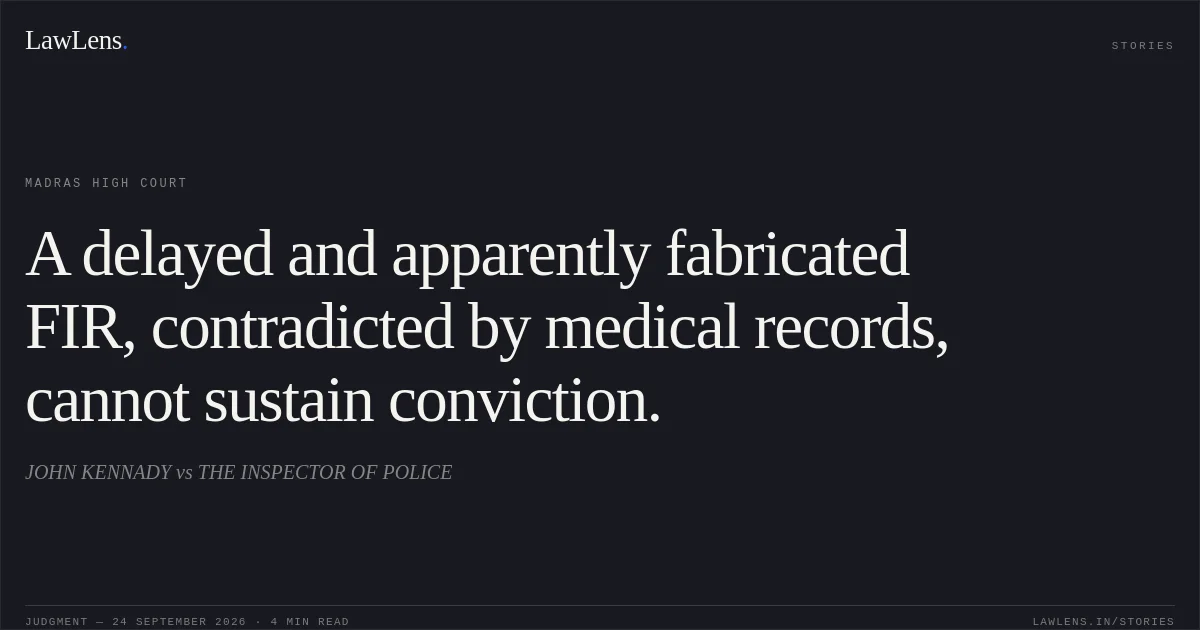
The High Court answered the principal issue against the appellant and held that the acquittal by the First Appellate Court was sustainable.
The contradictions between the medical record and FIR, unexplained delays, doubtful conduct of the alleged eyewitnesses, lack of specific overt acts, and inadequate forensic corroboration created reasonable doubt regarding the identity and participation of the accused.
Source reference: paras. 25–33Accordingly, the criminal appeal was dismissed, the judgment of acquittal dated 19 April 2012 in Crl.A. No.20 of 2012 was confirmed, and all respondents/accused were granted the benefit of doubt.
Source reference: para. 34Acts & Sections Cited
10 provisions across 2 statutes referred to in this judgment. Each provision opens on LawLens.
Code of Criminal Procedure, 19734
Indian Penal Code, 18606
Original Court PDF
JOHN KENNADYvsTHE INSPECTOR OF POLICE
Click to open original judgment
Original judgment, available to read, download and summarize on LawLens.in