Facts
The parties entered into a contract for the Balance of Plant package for the North Chennai Supercritical Thermal Power Project, Stage III.
Source reference: no citationDisputes arose concerning delay, project performance, payments, and invocation of a bank guarantee.
Source reference: no citationAfter proceedings under Section 9 of the Arbitration and Conciliation Act, 1996 (“the Act”) were closed with liberty to file afresh, BGR issued a notice under Section 21 and applied under Section 11(5), relying on Clause 94 of the Letter of Intent, headed “Settlement of Disputes”
Source reference: p. 3–5Clause 94 provided for written instructions or a decision by TANGEDCO or its representative, followed by an appeal to the Chief Engineer, who would hear the contractor and issue a decision.
Source reference: p. 8–9TANGEDCO opposed the application, contending that Clause 94 created only an internal departmental appeal and was not an arbitration agreement.
Source reference: p. 5–7Issues
1. Whether Clause 94 constitutes an arbitration agreement under Section 7 of the Act, permitting appointment of an arbitrator under Section 11(5).
Source reference: p. 9, 17, 20–222. Whether Section 16(1) requires the Court to appoint an arbitrator so that the tribunal may determine whether it has jurisdiction.
Source reference: p. 23–24Law Applied
Section 7 of the Act requires an agreement by the parties to submit present or future disputes, arising from a defined legal relationship, to arbitration; the existence of such an agreement is a condition precedent to appointment under Section 11.
Source reference: p. 17, 23Under K.K. Modi v. K.N. Modi, an arbitration agreement contemplates, among other attributes, a binding determination of substantive rights by a tribunal acting impartially and pursuant to an agreement enforceable in law.
Source reference: p. 9–11Jagdish Chander v. Ramesh Chander holds that the parties’ intention to refer disputes to a private tribunal and be bound by its decision must be evident; the tribunal must be empowered to act impartially and afford the parties an opportunity to present their cases.
Source reference: p. 12–17South Delhi Municipal Corporation v. SMS Ltd. identifies clear intent to arbitrate, a binding adjudicatory process, and compliance with arbitration norms as conjunctive requirements.
Source reference: p. 18–20Section 16 empowers an existing arbitral tribunal to rule on its jurisdiction; it does not itself create a tribunal where no arbitration agreement exists.
Source reference: p. 23Reasoning
Clause 94 did not refer disputes to arbitration or to an independent private tribunal, and it did not state that the Chief Engineer’s decision would be final or binding.
Source reference: p. 20–22Its scope was limited to a contractor’s challenge to instructions, decisions, or rulings made in the course of the work, with an appeal to the Chief Engineer—an internal departmental process rather than an agreement to arbitrate disputes under the contract.
Source reference: p. 20–22The provision for a hearing and evidence did not supply the missing intent to arbitrate, independence, or binding effect.
Source reference: p. 22Nor could Section 16 cure the absence of an arbitration agreement, as that provision presupposes an existing tribunal.
Source reference: p. 23Holding
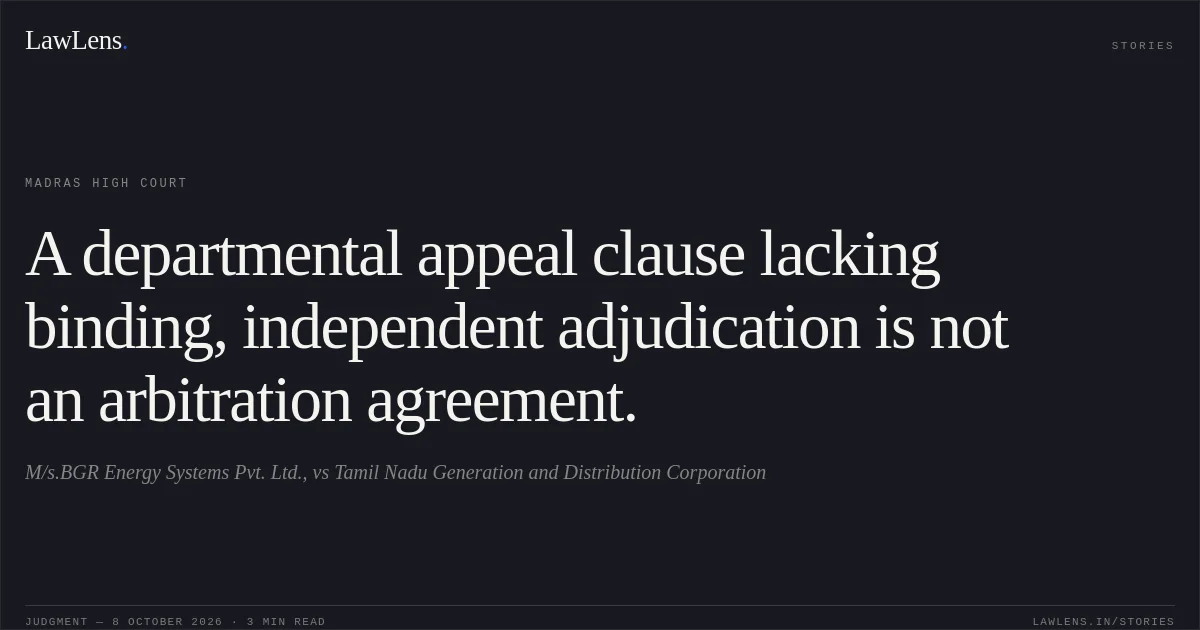
The Court held that Clause 94 was not an arbitration agreement within the meaning of Section 7 and that it therefore lacked power to appoint an arbitrator under Section 11(5).
The petition was dismissed, with liberty to the petitioner to pursue its claims before the competent court.
Source reference: p. 25Any claim to exclusion of time under Section 14 of the Limitation Act, 1963, was left to that court; the merits of the dispute and the pending writ petition were unaffected.
Source reference: p. 25Acts & Sections Cited
6 provisions across 2 statutes referred to in this judgment. Each provision opens on LawLens.
Arbitration and Conciliation Act, 19965
Limitation Act, 19631
Original Court PDF
M/s.BGR Energy Systems Pvt. Ltd.,vsTamil Nadu Generation and Distribution Corporation
Click to open original judgment
Original judgment, available to read, download and summarize on LawLens.in