Facts
The petitioner, a Patwari, was suspended by order dated 6 August 2025. A charge-sheet dated 19 September 2025 containing two charges was subsequently issued. After considering the petitioner’s reply and obtaining the opinion of the Sub-Divisional Officer (Revenue), Pohri, the Disciplinary Authority passed an order dated 2 June 2026 revoking the suspension, reinstating the petitioner, and imposing the penalty of withholding two annual increments without cumulative effect under the Madhya Pradesh Civil Services (Classification, Control and Appeal) Rules, 1966.
Source reference: para. 2; p. 1The petitioner challenged the punishment order under Article 226, contending that it was non-speaking and failed to deal with the grounds raised in his reply. The State supported the impugned order.
Source reference: para. 2; p. 1Issues
Whether the punishment order dated 2 June 2026 was invalid for being a non-speaking order that did not disclose proper consideration of the petitioner’s defence.
Source reference: paras. 2, 5–7; pp. 1–2Whether the Disciplinary Authority, while exercising quasi-judicial or administrative power affecting the petitioner’s service rights, was required to record cogent and intelligible reasons for imposing the penalty.
Source reference: paras. 6–10; pp. 2–5Law Applied
The High Court exercised jurisdiction under Article 226 of the Constitution of India. It applied the principle that a Disciplinary Authority exercising quasi-judicial power must consider the relevant facts and record reasons supporting its conclusion; an order affecting a person’s rights must be a speaking, reasoned, and self-contained order.
Source reference: paras. 7–9; pp. 2–4Relying on State of Punjab v. Bandip Singh, (2016) 1 SCC 724, the Court held that administrative or executive decisions must be composite and self-sustaining and must disclose the reasons that prevailed with the decision-maker; governmental discretion cannot be exercised capriciously or arbitrarily.
Source reference: paras. 7–9; pp. 2–4The Court also relied on Kranti Associates (P) Ltd. v. Masood Ahmed Khan, (2010) 9 SCC 496, which affirms that quasi-judicial authorities must record reasons, that reasons restrain arbitrary exercise of power, facilitate judicial review, and must be cogent, clear, and not merely “rubber-stamp reasons”.
Source reference: para. 10; pp. 4–6The penalty was imposed under the Madhya Pradesh Civil Services (Classification, Control and Appeal) Rules, 1966.
Source reference: para. 5; p. 2Reasoning
The Court examined the material portion of the punishment order and found that it merely recorded the suspension, issuance of the charge-sheet, submission of the petitioner’s reply, and the opinion of the Sub-Divisional Officer that Charge No. 1 was unsatisfactorily answered.
Source reference: paras. 5–10; pp. 2–6It did not independently analyse the charges, address the petitioner’s specific defence, or provide reasons explaining why the proposed penalty was warranted.
Source reference: paras. 5–10; pp. 2–6Since the Disciplinary Authority was exercising power affecting the petitioner’s service rights, the order was required to demonstrate application of mind and disclose valid, rational, and legally sustainable reasons.
Source reference: paras. 5–10; pp. 2–6The absence of such reasoning rendered the order non-speaking and inconsistent with the principles stated in Bandip Singh and Kranti Associates.
Source reference: paras. 5–10; pp. 2–6Holding
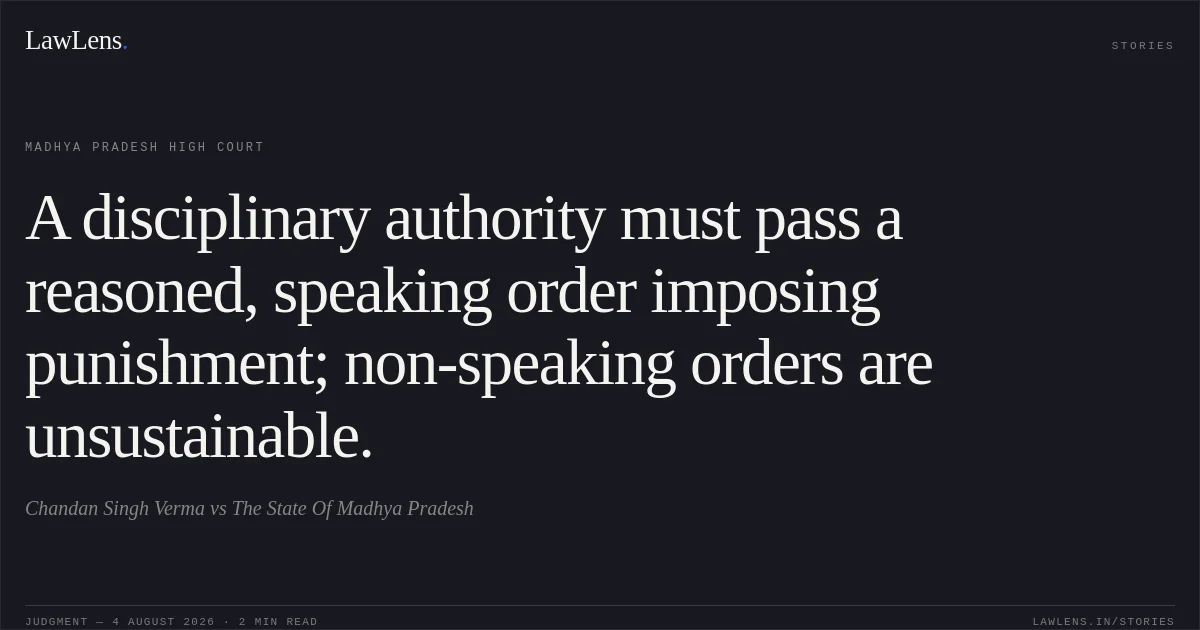
The Court held that the punishment order dated 2 June 2026 was non-speaking and therefore quashed it.
The respondents were granted liberty to issue a fresh show-cause notice, consider the petitioner’s reply, and pass a fresh order in accordance with law, if so advised.
Source reference: paras. 12–13; p. 6The Court clarified that it had expressed no opinion on the merits of the charges.
Source reference: paras. 12–13; p. 6The writ petition was accordingly disposed of.
Source reference: paras. 12–13; p. 6Original Court PDF
Chandan Singh VermavsThe State Of Madhya Pradesh
Click to open original judgment
Original judgment, available to read, download and summarize on LawLens.in