Facts
The petitioner, appointed as a Junior Engineer in 1979, was transferred from the Flood Control Division, Siwan, to the Water Drainage Division, Masrakh, and was relieved on 4 September 1996.
Source reference: paras. 3–5He submitted his joining at the transferred post on 6 September 1996, but contended that the authorities failed to take over charge from him and stopped payment of his salary.
Source reference: paras. 3–5The petitioner later submitted his joining on 14 December 2006. Instead of accepting it, the Department initiated disciplinary proceedings in 2008 for unauthorised absence, indiscipline and misconduct.
Source reference: para. 5He was dismissed retrospectively with effect from 6 March 1996 by order dated 29 December 2009.
Source reference: paras. 5, 26In an earlier writ petition, the High Court set aside the appellate order and remanded the matter for fresh consideration.
Source reference: para. 6Issues
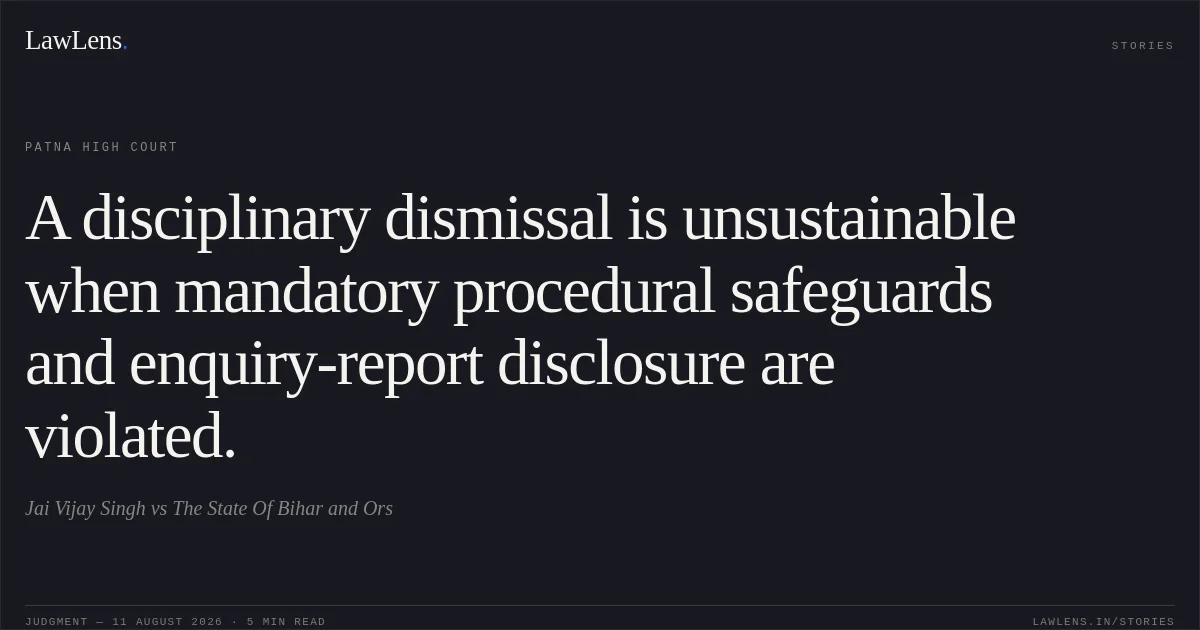
Whether the disciplinary proceedings were vitiated by non-compliance with Rules 17(3)–(6) of the Bihar Civil Services (Classification, Control and Appeal) Rules, 2005, particularly by failure of the disciplinary authority to obtain and consider the petitioner’s written statement of defence before appointing the Enquiry Officer?
Source reference: paras. 26–27Whether the proceedings were vitiated because the enquiry report was not supplied to the petitioner before the disciplinary authority passed the order of punishment?
Source reference: paras. 26–27Whether the disciplinary authority violated Rule 18(4) of the Bihar CCA Rules, 2005 by mechanically rejecting the petitioner’s reply to the second show-cause notice without considering its contents?
Source reference: paras. 26–27Whether the petitioner could be punished on the basis of Rule 76 of the Bihar Service Code when the alleged violation of that provision was not part of the original charge?
Source reference: paras. 26–27Whether dismissal could lawfully be made effective retrospectively from a date prior to the order of dismissal?
Source reference: paras. 16–17, 26Whether dismissal from service was disproportionate to the misconduct alleged, particularly in the absence of corruption, moral turpitude, misappropriation or proved financial loss?
Source reference: paras. 20–22, 26Law Applied
The Court applied Rules 17(3)–(6) of the Bihar CCA Rules, 2005, which require the disciplinary authority to frame and serve the charge, obtain the delinquent employee’s written statement of defence, apply its mind to the defence, and only thereafter decide whether an enquiry is necessary.
Source reference: no citationRule 18(3) requires supply of the enquiry report, while Rule 18(4) mandates consideration of the employee’s representation before imposition of punishment.
Source reference: no citationThe Court relied on Rama Shankar Chaudhary v. State of Bihar, 2018 (1) PLJR 91, and Shweta Mishra v. State of Bihar, 2018 (1) PLJR 784, regarding mandatory procedural safeguards.
Source reference: no citationThe Court relied on State of U.P. v. Saroj Kumar Sinha, (2010) 2 SCC 772, and Roop Singh Negi v. Punjab National Bank, (2009) 2 SCC 570, regarding the Enquiry Officer’s impartiality and the requirement that documentary evidence be properly proved.
Source reference: no citationThe Court relied on State Bank of India v. Kamal Kishore Prasad, 2018 (1) PLJR 893, regarding the impermissibility of retrospective dismissal.
Source reference: no citationThe Court relied on Ravi Oraon v. State of Jharkhand, AIR 2025 SC 5073, regarding punishment based on a charge different from the one notified.
Source reference: no citationKrushankant B. Parmar v. Union of India, (2012) 3 SCC 178, holding that unauthorised absence is not necessarily wilful absence and that wilfulness must be established.
Source reference: no citationThe Court also applied the proportionality principle in disciplinary punishment and relied on Allahabad Bank v. Krishna Narayan Tewary, (2017) 2 SCC 308, permitting the Court, in appropriate cases involving long delay and supervening circumstances, not to remit a procedurally defective enquiry for fresh proceedings.
Source reference: no citationReasoning
The Court found that the disciplinary authority had not first called for and considered the petitioner’s written statement of defence as required by Rules 17(4) and 17(5) of the Bihar CCA Rules, 2005.
Source reference: paras. 26–27Instead, the charge memorandum itself appointed the Enquiry Officer and Presenting Officer, and the Enquiry Officer improperly called upon the petitioner to submit his defence.
Source reference: paras. 26–27The Court further noted that the departmental documents had not been proved through witnesses and that the enquiry report was not supplied to the petitioner before the punishment order, contrary to Rule 18(3).
Source reference: para. 27The punishment order also failed to demonstrate consideration of the petitioner’s reply to the second show-cause notice, thereby violating Rule 18(4).
Source reference: paras. 26–27Further, the disciplinary authority relied on Rule 76 of the Bihar Service Code even though the petitioner had not originally been charged with violation of that provision, resulting in punishment on a ground for which he had not been given an effective opportunity to defend himself.
Source reference: paras. 26–27The Court additionally held that dismissal could not be given retrospective effect from 6 March or 6 September 1996.
Source reference: para. 26Although the Court noted that the petitioner had not produced comprehensive medical records substantiating his alleged ten-year treatment, it found that the proceedings were fundamentally defective.
Source reference: para. 26The alleged misconduct concerned absence from duty and did not involve corruption, moral turpitude, misappropriation, illegal gratification or proved financial loss.
Source reference: para. 26In these circumstances, and considering the petitioner’s long service, the extreme penalty of dismissal was also disproportionate.
Source reference: para. 26In view of the petitioner’s age, his superannuation in 2016, and the prolonged pendency of the litigation, the Court held that remitting the matter for a fresh enquiry would cause undue hardship and was unnecessary.
Source reference: paras. 28–29Holding
The High Court allowed the writ petition and quashed the disciplinary authority’s order dated 29 December 2009 and the appellate authority’s order dated 3 September 2013.
It declined to remit the matter for a fresh disciplinary enquiry because of the substantial delay, the petitioner’s advanced age and the fact that he had already reached the age of superannuation.
Source reference: paras. 28–29The respondents were directed to grant the petitioner all consequential service and retiral benefits.
Source reference: para. 30However, no salary was awarded for the period of absence from 6 September 1996 during which the petitioner claimed to have been under treatment, in the absence of adequate supporting medical records.
Source reference: para. 30The petitioner was awarded 50% salary from 14 December 2006, when he claimed to have submitted his joining, until the date of superannuation, along with pension and other post-retirement benefits.
Source reference: para. 30The directions were to be implemented within four months.
Source reference: para. 31Original Court PDF
Jai Vijay SinghvsThe State Of Bihar and Ors
Click to open original judgment
Original judgment, available to read, download and summarize on LawLens.in