Facts
Rohtash Singh, employed as a conductor with the Delhi Transport Corporation (DTC), was found on 20 December 1988 operating a bus on the Delhi–Faridabad route when four passengers allegedly alighted without tickets after paying ₹16 in aggregate to him. An excess cash amount of approximately ₹29.60/₹29.65 was also allegedly found in his possession.
Source reference: p. 2, paras. 2–3Following a departmental enquiry, the charges were held proved and Singh was removed from service with effect from 5 May 1989. DTC’s application under Section 33(2)(b) of the Industrial Disputes Act, 1947 was allowed after the enquiry was found to comply with natural justice.
Source reference: p. 2, para. 3In the subsequent industrial dispute, however, the Labour Court held that the enquiry was unfair and that the charge of non-issuance of tickets was not proved, principally because the passengers and Shri Khem Chand, who had recorded their statements and checked the cash, were not examined before it. It directed reinstatement with 25% back wages.
Source reference: pp. 2–3, paras. 4–5During the writ proceedings, Singh was taken back into service pursuant to DTC’s statement and received payments under Section 17B of the Industrial Disputes Act.
Source reference: p. 4, para. 9Issues
Whether the Labour Court erred in holding that the departmental enquiry was unfair and improper merely because DTC did not lead fresh evidence before it to establish the validity of the enquiry
Source reference: pp. 5–6, paras. 11–12Whether the Labour Court was justified in holding that the misconduct was not proved because Shri Khem Chand and the passengers were not examined before it
Source reference: pp. 2–3, 6–8, paras. 5, 12–16Whether the findings and relief granted in the impugned award warranted interference in writ jurisdiction
Source reference: pp. 8–9, paras. 17–20Whether amounts paid to the workman under Section 17B of the Industrial Disputes Act were recoverable after the impugned award was set aside
Source reference: p. 9, para. 19Law Applied
In a disciplinary enquiry, misconduct is established on the standard of preponderance of probabilities, not proof beyond reasonable doubt; strict rules of evidence under the Indian Evidence Act do not apply, and logically probative material, including credible hearsay, may be considered, provided the enquiry observes fairness and natural justice.
Source reference: pp. 4–5, para. 11Relying on State of Haryana v. Rattan Singh, (1977) 2 SCC 491, the Court held that the relevant question is whether there was “some evidence” supporting the finding, rather than whether the evidence satisfies the technical standards applicable to criminal trials.
Source reference: p. 5, para. 11Non-examination of passengers does not, by itself, vitiate a departmental enquiry, and a reviewing court cannot reappreciate evidence as an appellate authority.
Source reference: pp. 5, 7–8, paras. 11, 15, 17–18Payments under Section 17B of the Industrial Disputes Act, being in the nature of subsistence payments to an unemployed workman during litigation, are not recoverable merely because the employer ultimately succeeds.
Source reference: p. 9, para. 19Reasoning
The Court found that the Labour Court adopted an erroneous evidentiary standard by treating the non-examination of Shri Khem Chand and the passengers as fatal to DTC’s case.
Source reference: pp. 6–8, paras. 12–15The enquiry record contained the inspection report, the passengers’ statements recorded on the challan and countersigned by Singh, Singh’s admission regarding the excess cash, and the testimony of Shri Niwas, a member of the checking team, who stated that four passengers were found ticketless after claiming to have paid the fare.
Source reference: pp. 6–8, paras. 13–15Singh had received the relevant documents, had an opportunity to reply, participated in the enquiry, and was given the opportunity to examine and cross-examine witnesses; the record also showed that he declined to cross-examine Shri Khem Chand.
Source reference: p. 6, para. 14Applying the preponderance-of-probabilities standard and the “some evidence” test in Rattan Singh, the Court held that the Enquiry Officer could reasonably conclude that the charges were proved. The Labour Court therefore exceeded the permissible limits of judicial scrutiny by reappreciating the evidence and substituting its own conclusions.
Source reference: pp. 7–9, paras. 15–18The Court nevertheless held that payments already made under Section 17B were not recoverable.
Source reference: p. 9, para. 19Holding
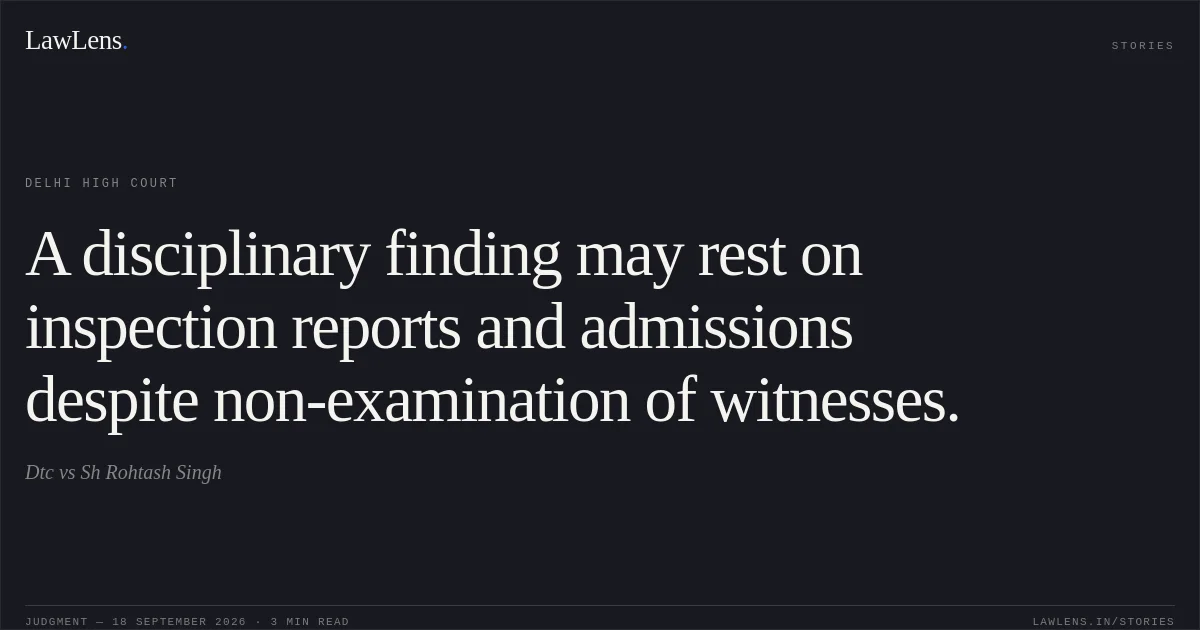
The Court held that the Labour Court had erred in declaring the enquiry unfair and in finding the misconduct unproved. The departmental enquiry was supported by sufficient material and complied with the requirements of natural justice; the Labour Court’s reappreciation of evidence and insistence on examination of the passengers and Shri Khem Chand were legally unsustainable.
Accordingly, the writ petition was allowed, the impugned award directing reinstatement with 25% back wages was set aside, and no recovery was directed in respect of amounts already paid to Singh under Section 17B of the Industrial Disputes Act.
Source reference: p. 9, paras. 19–20Acts & Sections Cited
4 provisions across 1 statute referred to in this judgment. Linked provisions open on LawLens.
Industrial Disputes Act, 19474
Original Court PDF
DtcvsSh Rohtash Singh
Click to open original judgment
Original judgment, available to read, download and summarize on LawLens.in