Facts
Complaints alleged that the respondent Panchayat Development Officers had misappropriated MGNREGA funds by including non-working labourers in the scheme and preparing bogus job cards.
Source reference: p. 4–5, para. 3Following an inquiry, the competent authority imposed a penalty of withholding four annual increments with cumulative effect and deferred promotion by four years.
Source reference: p. 4–5, para. 3The officers challenged the penalty before the Karnataka State Administrative Tribunal (KSAT), which set it aside.
Source reference: p. 5, para. 3The Upa-Lokayukta challenged KSAT’s common order in these connected writ petitions.
Source reference: p. 5, para. 3Issues
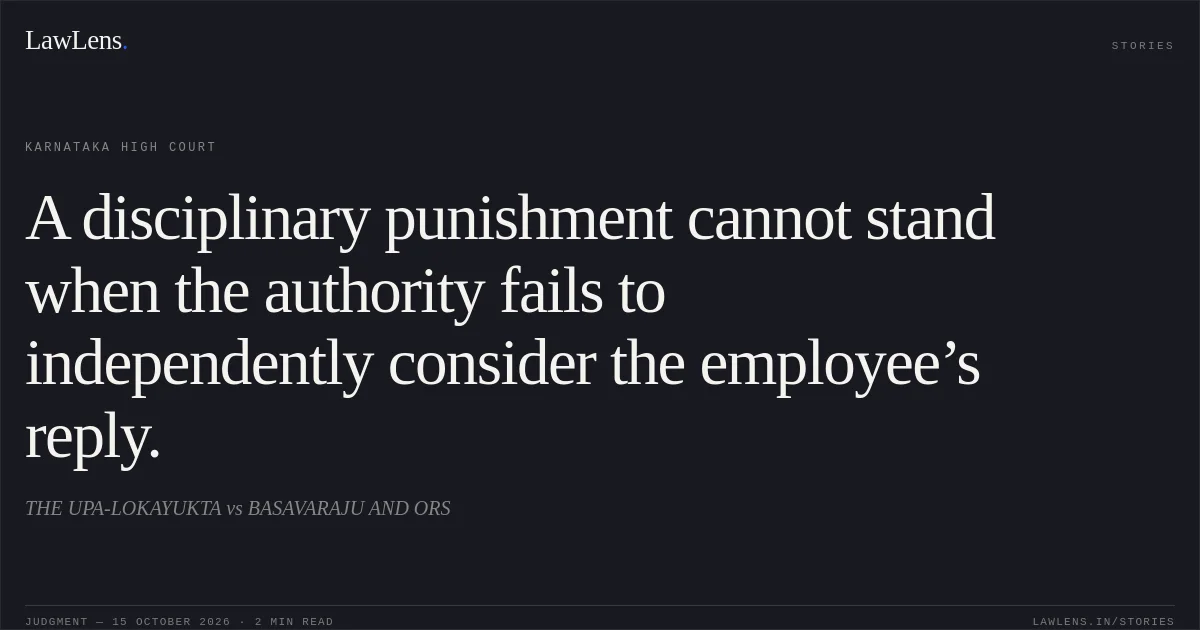
Whether KSAT was justified in setting aside the penalty because the disciplinary authority did not consider the officers’ explanations and did not independently assess the Upa-Lokayukta’s recommendation.
Source reference: p. 8–10, paras. 10–11Whether the High Court should interfere with KSAT’s order in light of the authority’s failure to consider that the complaint named officers by designation, rather than by name.
Source reference: p. 10–11, para. 12Law Applied
Rule 14-A of the Karnataka Civil Services (Classification, Control and Appeal) Rules, 1957, was invoked to entrust the inquiry to the Upa-Lokayukta.
Source reference: p. 5, para. 3; p. 7, para. 8Section 12(3) of the Karnataka Lokayukta Act was the provision under which the Upa-Lokayukta submitted its report to the competent authority.
Source reference: p. 7, para. 8The decision also applied the principles that a disciplinary authority must consider the employee’s material representations and reach its own decision, rather than merely adopt a recommendation; KSAT had relied on *Sri Krishna K.M. v. State of Karnataka*, W.P. No. 47719/2018, decided on 21 June 2021.
Source reference: p. 9, para. 10Reasoning
The High Court noted that the officers’ replies raised material points, including that the complaint was against officers by designation, that the job cards were not issued by them, and that payments were made directly to job-card holders through banks.
Source reference: p. 8–10, paras. 10–11The impugned order did not address those explanations and stated that the penalty was imposed as recommended by the Upa-Lokayukta, indicating that the disciplinary authority had not independently analysed the matter.
Source reference: p. 9–10, paras. 10–11The Court also agreed that the authority had not considered the fact that the complaint was not made against the officers by name.
Source reference: p. 10–11, para. 12It therefore found no error in KSAT’s decision to set aside the penalty.
Source reference: p. 10–11, para. 12Holding
The High Court dismissed both writ petitions and upheld KSAT’s common order setting aside the disciplinary penalties.
Pending applications, if any, were disposed of.
Source reference: p. 11, para. 13Acts & Sections Cited
1 provisions across 1 statute referred to in this judgment. Each provision opens on LawLens.
KARNATAKA LOKAYUKTA ACT, 19841
Original Court PDF
THE UPA-LOKAYUKTAvsBASAVARAJU AND ORS
Click to open original judgment
Original judgment, available to read, download and summarize on LawLens.in