Facts
The petitioner, a District Sub-Registrar, was charged in departmental proceedings after a vigilance case was registered alleging that he possessed assets disproportionate to his known sources of income.
Source reference: pp. 9–10, 12–13The charges concerned the alleged disproportionate assets, discrepancies between declared and recovered assets, and breach of Rule 3(1)(i)–(iii) of the Bihar Government Servants’ Conduct Rules, 1976.
Source reference: pp. 9–10, 12–13The Enquiry Officer deferred findings on the first two charges pending the vigilance investigation but found the conduct-rule charge proved.
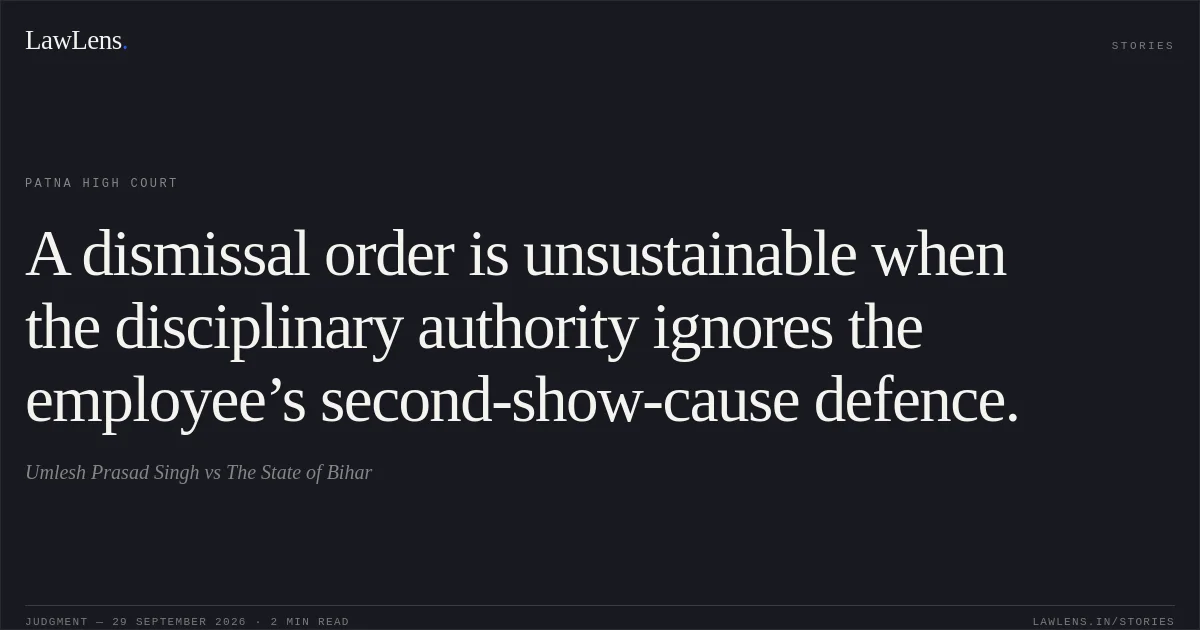
Source reference: pp. 10, 13After receiving the petitioner’s response to the second show-cause notice, the department dismissed him on 23 August 2024. His review application was rejected on 28 January 2025.
Source reference: pp. 4–5, 10–11He challenged both orders, alleging, among other things, that the disciplinary authority had not considered his defence.
Source reference: pp. 5–7Issues
1. Whether the dismissal order was sustainable when it did not address the petitioner’s submissions in response to the second show-cause notice, as required by Rule 18 of the Bihar Government Servants (Classification, Control & Appeal) Rules, 2005.
Source reference: pp. 14–152. Whether the petitioner had established an illegality in the Enquiry Officer’s finding that the charge of violating Rule 3(1)(i)–(iii) of the Conduct Rules was proved.
Source reference: pp. 11–14Law Applied
Rule 18 of the Bihar Government Servants (Classification, Control & Appeal) Rules, 2005 requires the disciplinary authority to consider the delinquent employee’s response to the enquiry report before imposing punishment; failure to address that response may render the punishment order unsustainable.
Source reference: pp. 14–15Rule 3(1)(i)–(iii) of the Bihar Government Servants’ Conduct Rules, 1976 requires a government servant to maintain absolute integrity, devotion to duty, and conduct becoming of a government servant.
Source reference: p. 12The Court noted the petitioner’s reliance on Roop Singh Negi v. Punjab National Bank, Punjab National Bank v. Kunj Behari Misra, and Kranti Associates (P) Ltd. v. Masood Ahmed Khan, but did not separately elaborate their principles.
Source reference: p. 8Reasoning
The Court found that the enquiry report contained a detailed assessment of the evidence and that the petitioner had not demonstrated an error in the finding on the conduct-rule charge; it noted the recovered cash, jewellery, property documents, and bank-account documents, as well as the examination and cross-examination of vigilance witnesses.
Source reference: pp. 13–14However, the dismissal order did not deal with the petitioner’s submissions in his reply to the second show-cause notice.
Source reference: p. 14That omission violated Rule 18 and made the dismissal unsustainable, regardless of the Court’s assessment of the enquiry finding on charge three.
Source reference: pp. 14–15Holding
The Court set aside both the dismissal order dated 23 August 2024 and the review-rejection order dated 28 January 2025.
The respondents may resume the disciplinary process from consideration of the petitioner’s response to the second show-cause notice.
Source reference: pp. 15–16The petitioner is to be reinstated, but paid only subsistence allowance until a final order is passed; the respondents must decide consequential benefits when passing that order, which is to be issued within four months of receipt or production of the judgment.
Source reference: pp. 15–16The writ application was allowed to that extent.
Source reference: p. 16Acts & Sections Cited
1 provisions across 1 statute referred to in this judgment. Each provision opens on LawLens.
Prevention of Corruption Act, 19881
Original Court PDF
Umlesh Prasad SinghvsThe State of Bihar
Click to open original judgment
Original judgment, available to read, download and summarize on LawLens.in