Facts
The Petitioners’ mother was inducted as a tenant in the subject premises by its original owner, Smt. Anila Dasgupta.
Source reference: p. 2The Petitioners claimed that an Agreement to Sell dated 3 October 1985 altered the tenancy, and relied on a pending suit for specific performance; that suit was later dismissed, although an appeal was filed and no stay was brought to the Court’s notice.
Source reference: pp. 2–3, 7–8, 18–19The Respondents claimed through the original owner’s estate and sought eviction under Section 14(1)(e) of the Delhi Rent Control Act, 1958 (DRC Act).
Source reference: pp. 3–5The Rent Controller rejected the Petitioners’ application for leave to defend and ordered eviction.
Source reference: pp. 3–5The Petitioners’ revision challenged the Respondents’ ownership and the landlord–tenant relationship; they did not substantively challenge the findings on bona fide requirement or alternative accommodation.
Source reference: pp. 12–15, 27Issues
1. Whether the Petitioners raised a genuine triable issue that the alleged Agreement to Sell had displaced the admitted landlord–tenant relationship and rendered the Respondents unable to maintain the eviction petition.
Source reference: pp. 15–18, 22–232. Whether the Respondents’ claimed derivative title, the absence of attornment or rent payment, or a third party’s alleged claim under a Will warranted leave to defend.
Source reference: pp. 19–253. Whether the Rent Controller’s refusal of leave to defend disclosed an error warranting interference under the High Court’s revisional jurisdiction under Section 25B(8) of the DRC Act.
Source reference: pp. 9–11, 27–28Law Applied
Under Section 25B(8) of the DRC Act, the High Court exercises limited supervisory and revisional—not appellate—jurisdiction and does not reappreciate evidence unless the Rent Controller’s decision-making process reveals an error apparent, material irregularity, perversity, or manifest illegality; the Court relied on Sarla Ahuja v. United India Insurance Co. Ltd., Hindustan Petroleum Corporation Ltd. v. Dilbahar Singh and Abid-Ul-Islam v. Inder Sain Dua.
Source reference: pp. 9–11For eviction under Section 14(1)(e), the landlord need not prove absolute title against the world, but must show an interest superior to the tenant’s; Shanti Sharma v. Ved Prabha was applied for that principle.
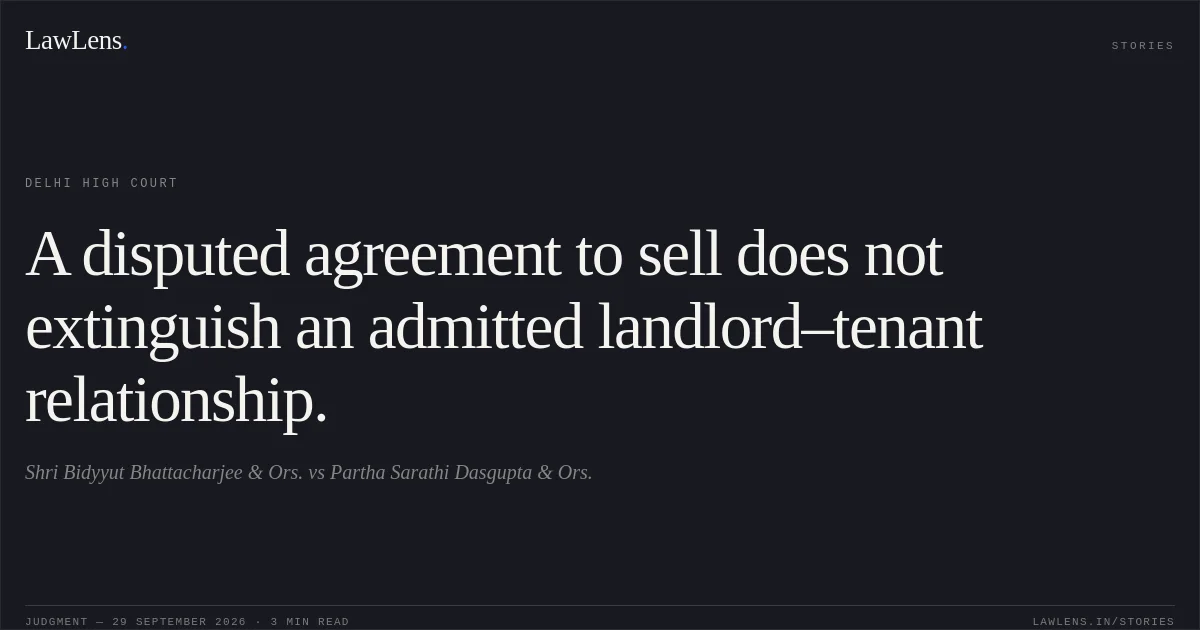
Source reference: pp. 16, 25An agreement to sell does not, by itself, transfer an interest in immovable property, and a disputed agreement cannot alone extinguish an admitted tenancy; the Court also referred to Jivan Das v. Naraian Das.
Source reference: pp. 14, 18–19A tenant’s failure to attorn to a successor landlord or pay rent does not, by itself, terminate the tenancy; the Court relied on Ramesh Chand v. Uganti Devi.
Source reference: p. 21Leave to defend is warranted where the tenant raises a bona fide, material defence which, if proved, could disentitle the landlord to eviction.
Source reference: pp. 22–23Reasoning
The original tenancy was admitted, while the alleged change in status depended on an Agreement to Sell whose existence and effect were disputed by the original owner and were the subject of separate civil proceedings.
Source reference: pp. 16–19The Rent Controller therefore was not required to treat the agreement as having terminated the tenancy, particularly when the original owner had continued to assert her landlord status.
Source reference: pp. 16–19The Respondents claimed through the original owner’s estate, and the Petitioners had themselves treated them as her legal representatives in the specific-performance proceedings; the competing succession and third-party Will claims did not require the Rent Controller to determine absolute title.
Source reference: pp. 19–20, 24–26Neither non-payment of rent nor lack of formal attornment established termination of the tenancy.
Source reference: pp. 21–22The Court found no reviewable error in the Rent Controller’s decision, and noted that the bona fide-requirement findings were not substantively challenged.
Source reference: pp. 27–28Holding
The Court held that the Petitioners had not raised a genuine triable issue concerning the landlord–tenant relationship or the Respondents’ entitlement to maintain the eviction petition.
Finding no jurisdictional error, material irregularity, perversity, or manifest illegality, it dismissed the revision and disposed of the pending applications.
Source reference: pp. 27–29Acts & Sections Cited
3 provisions across 2 statutes referred to in this judgment. Each provision opens on LawLens.
delhi rent control act, 19582
Hindu Succession Act, 19561
Original Court PDF
Shri Bidyyut Bhattacharjee & Ors.vsPartha Sarathi Dasgupta & Ors.
Click to open original judgment
Original judgment, available to read, download and summarize on LawLens.in