Facts
On 9 February 2019, the deceased was found dead in an open field beside his motorcycle.
Source reference: pp. 1–3, 9–14, paras 2–5The prosecution alleged that the appellant had assaulted him at the appellant’s home, relying principally on WhatsApp messages between two witnesses, alleged recoveries of blood-stained soil and weapons, and injuries on the appellant.
Source reference: pp. 1–3, 9–14, paras 2–5The witnesses said to have observed or heard the alleged incident did not support the prosecution at trial; one denied sending the messages, and the blood evidence could not be linked to the deceased.
Source reference: pp. 1–3, 9–14, paras 2–5The Trial Court convicted the appellant under Sections 302 and 201 IPC, and the High Court affirmed. The appellant appealed to the Supreme Court.
Source reference: pp. 1–3, 9–14, paras 2–5Issues
1. Whether the circumstantial evidence, including the WhatsApp messages and alleged recoveries, established the appellant’s guilt beyond reasonable doubt.
Source reference: pp. 20–25, paras 10.2–10.52. Whether the evidence excluded the possibility that the deceased’s injuries resulted from an accident, and whether the appellant’s unexplained injuries supported conviction.
Source reference: pp. 25–26, paras 10.6–10.8Law Applied
In a case based on circumstantial evidence, each circumstance must be fully established, the circumstances must cumulatively form a complete chain pointing unerringly to guilt, and they must exclude every reasonable hypothesis other than guilt; the accused must be shown to “must be,” not merely “may be,” guilty (*Sharad Birdhichand Sarda v. State of Maharashtra*; *Shivaji Sahabrao Bobade v. State of Maharashtra*).
Source reference: p. 20, paras 10–10.1Under Sections 6, 7 and 8 of the Evidence Act, facts forming part of the same transaction, facts connected as cause or effect, and relevant conduct may be admissible, but the court must assess whether the asserted facts satisfy the statutory requirements.
Source reference: pp. 20–23, para 10.3Sections 302 and 201 IPC were the offences for which the appellant had been convicted.
Source reference: pp. 1–2, para 2Reasoning
The prosecution did not establish that the deceased was last seen with the appellant: the relevant witnesses did not support that allegation.
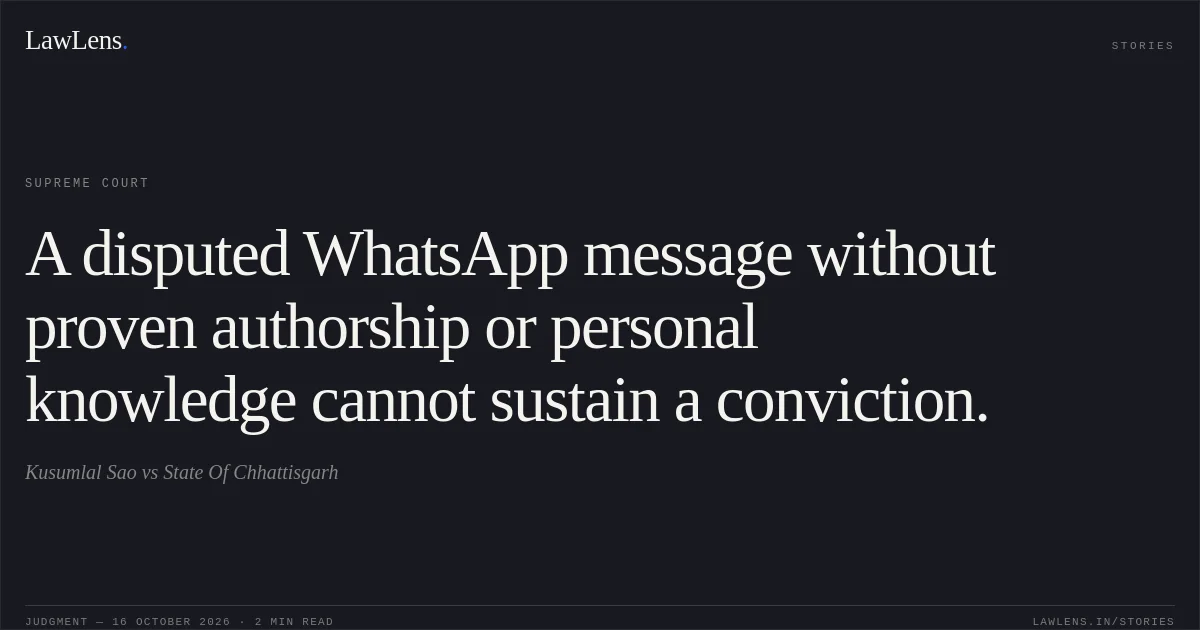
Source reference: p. 20, para 10.2Although the electronic records showed messages had been sent, the witnesses’ evidence did not establish who authored them or whether their contents were based on personal knowledge; the messages therefore raised suspicion but did not prove the alleged assault.
Source reference: pp. 22–23, para 10.3The seizure evidence was inconsistent as to whether blood-stained soil and other articles came from the appellant’s house, and the blood could not be linked to the deceased.
Source reference: pp. 23–25, paras 10.4–10.5The deceased was found beside a motorcycle, and the doctor did not exclude injuries from a fall; the Court considered the accident hypothesis reasonably possible.
Source reference: pp. 25–26, paras 10.6–10.8The appellant’s unexplained injuries could not independently establish guilt in the absence of proof that he had fought with the deceased.
Source reference: pp. 25–26, paras 10.6–10.8Holding
The Court held that the circumstantial evidence did not establish a complete chain proving the appellant’s guilt and allowed the appeal.
It set aside the judgments of the Trial Court and High Court, acquitted the appellant of the charges under Sections 302 and 201 IPC, and directed his release unless required in another case.
Source reference: p. 26, paras 11–13Acts & Sections Cited
4 provisions across 2 statutes referred to in this judgment. Each provision opens on LawLens.
Indian Penal Code, 18603
Code of Criminal Procedure, 19731
Original Court PDF
Kusumlal SaovsState Of Chhattisgarh
Click to open original judgment
Original judgment, available to read, download and summarize on LawLens.in