Facts
The petitioner was engaged as a Consultant (AEE) on a consolidated remuneration of ₹40,000 per month for one year, from 4 August 2022 to 3 August 2023.
Source reference: pp. 2, 6She applied for six months’ maternity leave from 26 December 2022 to 25 June 2023; the request was rejected solely under Condition 5 of her appointment order, which permitted only declared State Government holidays and no additional leave.
Source reference: pp. 2, 5, 7After her legal notice received no response, she filed a writ petition challenging the rejection.
Source reference: p. 2Issues
1. Whether a contractual condition prohibiting additional leave could justify denying the petitioner maternity benefits
Source reference: p. 6, para. 6.22. Whether the petitioner’s contractual status, where the claimed leave fell within her contractual tenure, barred her entitlement to maternity benefits
Source reference: pp. 7, 21–22, paras. 7–7.4Law Applied
Section 5 of the Maternity Benefit Act, 1961 provides maternity benefits subject to statutory eligibility requirements; Section 12 protects entitlement in specified circumstances involving discharge or dismissal, and Section 27 gives the Act overriding effect over inconsistent provisions in an agreement or contract of service.
Source reference: p. 7, para. 6.5Rule 103 of the Rajasthan Service Rules, 1951 provides eligible female government servants maternity leave of up to 180 days.
Source reference: pp. 7–8, para. 6.5In Municipal Corporation of Delhi v. Female Workers (Muster Roll), the Supreme Court held that maternity benefits are not confined to regular employees.
Source reference: pp. 8–10, para. 6.7In Dr. Kavita Yadav v. Secretary, Ministry of Health and Family Welfare, the Court held that, where statutory eligibility is met, maternity benefits may extend beyond the contractual term and cannot be defeated by contractual expiry.
Source reference: pp. 10–15, para. 6.8The Rajasthan High Court authorities cited in the judgment likewise support that contractual status alone is not a ground to deny maternity benefits.
Source reference: pp. 15–20, paras. 6.9–6.10Reasoning
The petitioner sought leave while her contract remained in force, and the full requested period fell within her initial contractual tenure.
Source reference: pp. 6–7, para. 6.3; p. 21, para. 7The respondents’ refusal rested solely on Condition 5, without an independent assessment of her eligibility under the applicable maternity-benefit provisions.
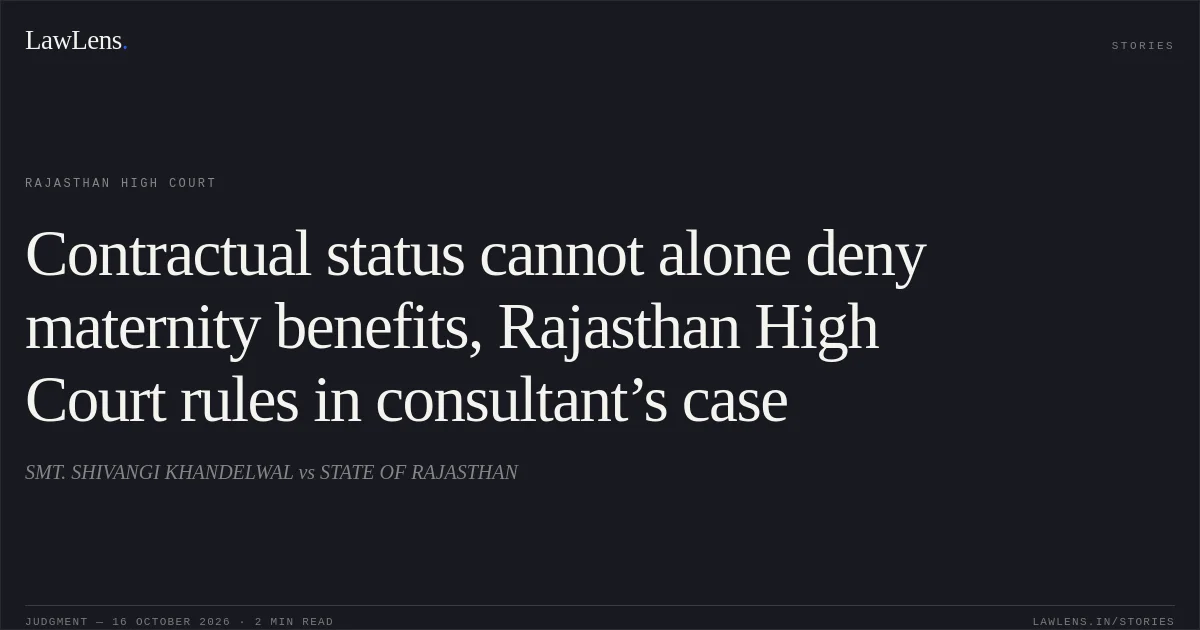
Source reference: p. 22, para. 7.3Applying the statutory scheme and the cited authorities, the Court held that a general contractual restriction on leave could not, by itself, defeat maternity benefits where the statutory requirements were satisfied; the denial was therefore unsustainable.
Source reference: pp. 21–22, paras. 7.2–7.4Holding
The Court allowed the petition and quashed the rejection letter dated 16 December 2022.
It directed the respondents to provide maternity benefits for 180 days from 26 December 2022 and pay the admissible remuneration for that period in accordance with applicable law, completing the exercise within three months of receiving a certified copy of the judgment.
Source reference: pp. 22–23, paras. 8.1, 8.3Acts & Sections Cited
4 provisions across 1 statute referred to in this judgment. Linked provisions open on LawLens.
Maternity Benefit Act, 19614
Original Court PDF
SMT. SHIVANGI KHANDELWALvsSTATE OF RAJASTHAN
Click to open original judgment
Original judgment, available to read, download and summarize on LawLens.in