Facts
The petitioner-father sought a writ of habeas corpus concerning his five-and-a-half-year-old daughter, alleging that she was in the illegal custody of her mother and the mother’s friend.
Source reference: para. 2; p. 1He stated that after returning from work on 1 July 2026, he found the house’s lock broken from outside and could not contact his wife.
Source reference: paras. 2–3; p. 1The Court noted that the petition contained no material comparing the parties’ circumstances or showing that the child’s welfare would be better served by transferring custody to the father.
Source reference: paras. 6, 13; pp. 2, 5It dismissed the petition as unsuitable for determination in habeas corpus proceedings, leaving the parties to pursue their custody claims before the Family Court.
Source reference: paras. 14–15; p. 6Issues
Whether the child’s custody with her mother constituted illegal detention warranting a writ of habeas corpus.
Source reference: paras. 5, 8; pp. 2–3Whether the disputed custody and welfare questions could appropriately be determined in habeas corpus proceedings, or should be left to the Family Court.
Source reference: paras. 6, 12–13; pp. 2, 4–5Law Applied
The Court applied the principle that the child’s welfare is the paramount consideration in custody disputes, overriding the parents’ competing legal claims.
Source reference: paras. 9–10; pp. 3–4Habeas corpus may be available in child-custody matters where a minor is detained by a person not entitled to legal custody, but it is an extraordinary, summary remedy; where a detailed inquiry into welfare is required, parties should ordinarily pursue remedies under the Hindu Minority and Guardianship Act or the Guardians and Wards Act before the competent court.
Source reference: para. 7; pp. 2, 4–5The Court also referred to Rinku Ram v. State of U.P., 2026 SCC OnLine All 2065, for the proposition that maintainability does not foreclose the Court’s discretion to decline habeas corpus relief in the circumstances of a case.
Source reference: para. 11; p. 4Reasoning
The child was with her mother, who had a legal right to custody; the Court therefore found no basis to treat the custody as illegal for purposes of habeas corpus.
Source reference: paras. 5, 8; pp. 2–3It also observed that the petitioner’s account of finding the house locked from outside prima facie suggested that he may himself have been detaining his wife and child, who had escaped.
Source reference: para. 5; p. 2The petition lacked pleadings on the parties’ educational, financial and social circumstances relevant to the child’s welfare, while the competing custody claims raised disputed factual questions requiring evidence.
Source reference: paras. 6, 12–13; pp. 2, 4–5The Family Court was better equipped to conduct that inquiry.
Source reference: paras. 12–13; pp. 4–5Holding
The Court declined to entertain the habeas corpus petition and dismissed it, leaving the parties free to seek determination of their respective custody claims in a suit before the Family Court.
It clarified that it had not considered the merits and that dismissal would not affect the Family Court’s decision on custody.
Source reference: para. 15; p. 6Original Court PDF
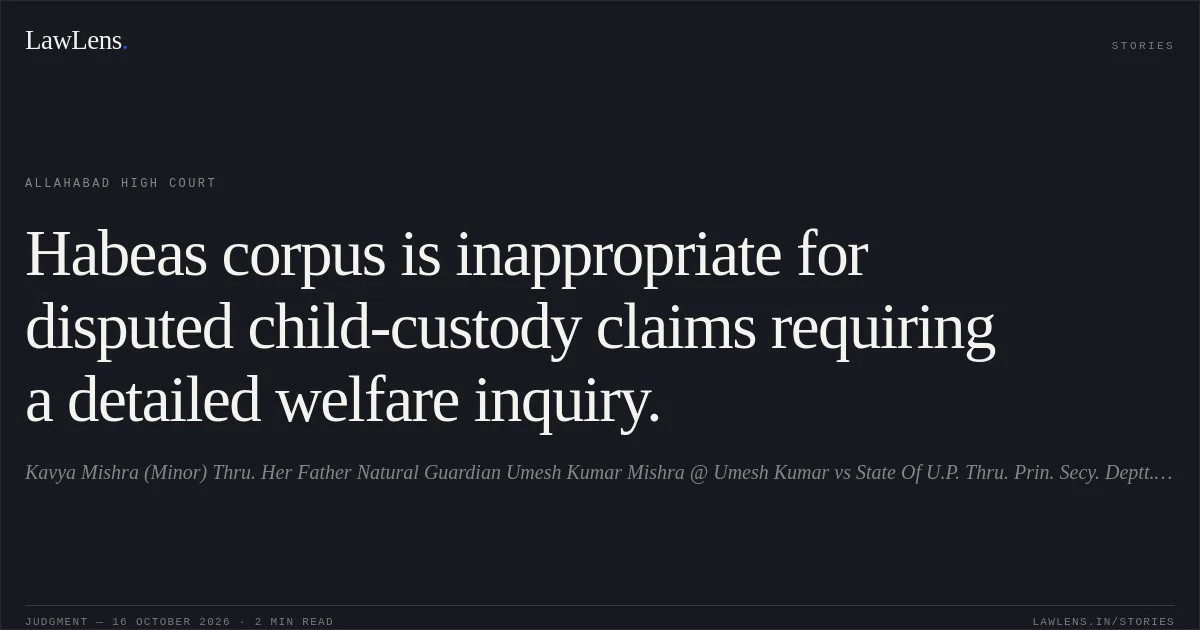
Kavya Mishra (Minor) Thru. Her Father Natural Guardian Umesh Kumar Mishra @ Umesh KumarvsState Of U.P. Thru. Prin. Secy. Deptt. Of Home U.P. Lko. And 3 Others
Click to open original judgment
Original judgment, available to read, download and summarize on LawLens.in