Facts
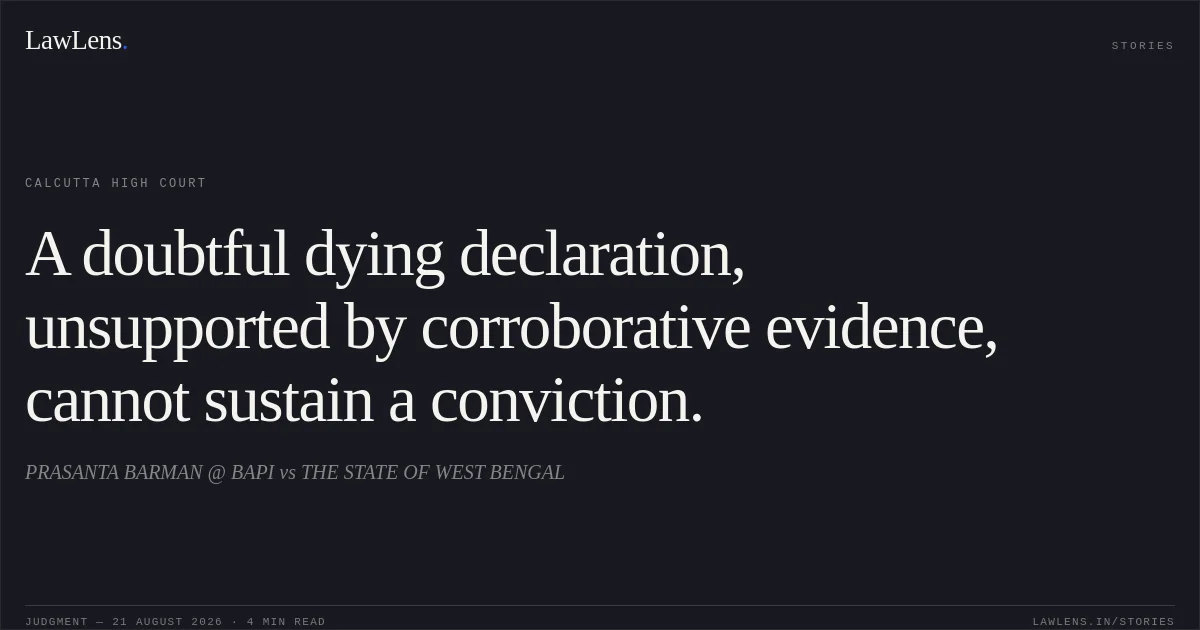
The appellant was prosecuted under Sections 498A and 302 of the Indian Penal Code in connection with Dinhata Police Station Case No. 350 of 2017. The prosecution alleged that, on 29 March 2017, the appellant poured kerosene on his wife and set her on fire at her parental home after a quarrel. She sustained extensive burn injuries, was treated initially at hospital, and later died on 8 July 2017 from septicemia arising from the burn injuries.
Source reference: paras. 2–3; pp. 2–3The prosecution relied principally on two statements attributed to the victim: the history recorded by Dr. Shantanu Pathak at admission and a statement recorded shortly thereafter by Dr. Indrajit Das, described as a dying declaration.
Source reference: paras. 11–12; pp. 8–9However, the victim’s mother, father, elder sister and other witnesses testified that the victim had accidentally caught fire while cooking, and they were not declared hostile.
Source reference: paras. 8, 13, 26; pp. 6–7, 9, 15–16The trial court convicted the appellant under Section 302 IPC and sentenced him to imprisonment for life with a fine of ₹10,000, while acquitting his mother, the co-accused. The appellant challenged the conviction in the present appeal.
Source reference: paras. 1, 3; pp. 1–2Issues
1. Whether the conviction for murder under Section 302 IPC could be sustained solely on the basis of the alleged dying declarations of the deceased.
Source reference: para. 7; p. 62. Whether the dying declarations were voluntary, truthful and made by the deceased while in a fit mental and physical condition to make a reliable statement.
Source reference: paras. 16–20; pp. 10–123. Whether the inconsistencies in the medical records and testimony, the absence of a subsequent statement under Section 161 CrPC, and the evidence of the prosecution witnesses created reasonable doubt regarding the appellant’s involvement.
Source reference: paras. 21–27; pp. 12–16Law Applied
The court applied Sections 498A and 302 IPC concerning cruelty and murder, and Section 32 of the Indian Evidence Act, 1872, under which a statement made by a deceased person relating to the cause or circumstances of death is admissible as a dying declaration.
Source reference: no citationRelying on Atbir v. Government (NCT of Delhi), (2010) 9 SCC 1, the court reiterated that a dying declaration may be the sole basis of conviction if it is voluntary, truthful, made in a fit state of mind, and inspires full confidence; corroboration is a rule of prudence rather than an absolute legal requirement.
Source reference: para. 16; pp. 10–11The court also relied on Irfan @ Naka v. State of Uttar Pradesh, 2023 LiveLaw (SC) 698, for the principle that dying declarations must be scrutinised with great caution in light of the surrounding circumstances, and on Mst. Dalbir Kaur v. State of Punjab, (1976) 4 SCC 1588, concerning factors relevant to assessing their truthfulness.
Source reference: paras. 18–20; pp. 11–12The prosecution was required to establish guilt beyond reasonable doubt, with any reasonable doubt benefiting the accused.
Source reference: para. 20; p. 12Reasoning
The court held that the prosecution case rested substantially, if not exclusively, on the two alleged dying declarations, since the mother, father, elder sister and other material witnesses supported the accidental-burning version and were not declared hostile.
Source reference: paras. 8, 13, 15, 26; pp. 6–7, 9, 10, 15–16Although Dr. Das stated that the victim was mentally and physically alert, the injury report recorded approximately 70% burns, including blisters and loosening of skin, and the doctor acknowledged that a patient with such injuries might be unconscious.
Source reference: para. 11; p. 8The court found several circumstances casting doubt on the declarations: the alleged statement referred to the appellant’s mistreatment of his “son and daughter” although the victim had only male children; the evidence differed as to whether kerosene or coconut oil was mentioned; the second declaration was recorded within approximately ten minutes of admission; the doctors did not promptly inform the police; the mother was not present or shown to have witnessed the declaration; and the police did not record the victim’s statement under Section 161 CrPC even though she survived for approximately four months.
Source reference: paras. 12, 21–23, 26; pp. 9, 12–16The post-mortem established death from septicemia caused by old burn injuries but did not establish the manner in which the injuries were caused.
Source reference: para. 22; pp. 13–14In the absence of reliable corroboration, these inconsistencies and omissions created a serious and reasonable doubt about the authenticity and reliability of the dying declarations.
Source reference: paras. 23–27; pp. 14–16Holding
The High Court allowed the appeal, holding that the alleged dying declarations did not inspire the requisite confidence and could not, in the circumstances, sustain a conviction for murder beyond reasonable doubt.
The judgment and order of conviction dated 27–28 February 2020 were set aside, and the appellant was acquitted and discharged from his bail bond, unless required in connection with another case.
Source reference: paras. 28–29; p. 16The court directed that a copy of the judgment and the trial court record be forwarded to the concerned court for necessary action.
Source reference: para. 30; p. 16Acts & Sections Cited
6 provisions across 2 statutes referred to in this judgment. Each provision opens on LawLens.
Indian Penal Code, 18604
Code of Criminal Procedure, 19732
Original Court PDF
PRASANTA BARMAN @ BAPIvsTHE STATE OF WEST BENGAL
Click to open original judgment
Original judgment, available to read, download and summarize on LawLens.in