Facts
The prosecution alleged that the first appellant repeatedly pressured the minor victim to love and marry him and threatened to kidnap her; it further alleged that, after the victim’s father approached the first appellant’s parents, all six appellants came to the father’s house on 18 September 2016, abused him and threatened him and his family.
Source reference: pp.5–8, paras.7–12The father lodged a complaint on 20 September 2016.
Source reference: pp.5–8, paras.7–12The trial court convicted the appellants under Sections 147, 294(b) and 506(i) of the Indian Penal Code (IPC), and convicted the first appellant under Section 12 of the Protection of Children from Sexual Offences Act, 2012 (POCSO Act), and appellants 2–6 under Sections 12 read with 17 of that Act.
Source reference: pp.2–5, paras.2–5The appellants challenged their convictions and sentences under Section 374(2) of the Code of Criminal Procedure, 1973.
Source reference: p.1; para.1Issues
Whether the trial court’s convictions and sentences were sustainable on the evidence and in law.
Source reference: p.5, para.6Whether the prosecution proved the alleged offences under Sections 294(b) and 506(i) IPC beyond reasonable doubt, having regard to the evidence, the complaint and FIR delays, and the alleged threats.
Source reference: pp.9–16, paras.15–19Whether the evidence and charge supported the POCSO convictions, including whether the alleged conduct was established as an offence under Section 11 of the POCSO Act.
Source reference: p.16, para.20Law Applied
The Court considered Section 294(b) IPC, which criminalises the utterance of obscene words in or near a public place to the annoyance of others, and applied the principle that vulgar or offensive language is not necessarily obscene; obscenity must be assessed in context and must meet the relevant test of tending to deprave or corrupt.
Source reference: pp.10–13, para.16, citing Savarimuthu Nadar & Others v. State, 1994 (1) MLJ (Crl) 154For criminal intimidation under Section 506(i) IPC, the Court relied on the principle that a threat must be real and intended to cause alarm, rather than a mere angry expression, and referred to the evidentiary discussion in Noble Mohandass v. State, (1988) L.W. (Crl.) 178.
Source reference: pp.14–15, para.18The Court also considered Section 11 POCSO, requiring proof of an act specified in its clauses, accompanied by sexual intent, and treated the absence of a clear identification of the applicable clause in the charge as relevant to the accused’s ability to defend themselves.
Source reference: p.16, para.20The appeal was before the Court under Section 374(2) CrPC.
Source reference: p.1Reasoning
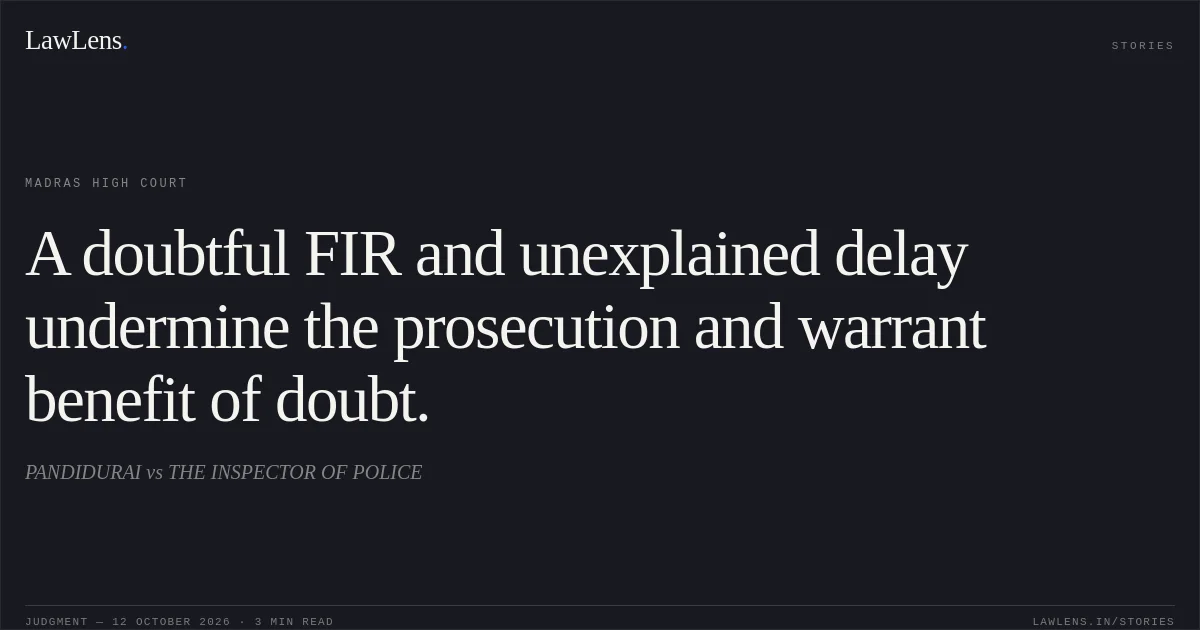
The Court found material weaknesses in the prosecution evidence.
Source reference: no citationOn the alleged abuse, the witnesses did not consistently identify the words used, and the Court held that the language alleged, though vulgar, did not satisfy the applicable test for obscenity.
Source reference: pp.9–13, paras.15–16On intimidation, it noted the two-day interval before the complaint, the unexplained delay in its dispatch to court, and the father’s evidence that he had signed a complaint typed and brought by another person; it considered these matters to cast doubt on the complaint’s origin and the prosecution account.
Source reference: pp.13–15, paras.17–18The Court also found the alleged common threat by all six appellants improbable and concluded that the evidence did not establish a real threat causing alarm.
Source reference: pp.13–15, paras.17–18As to the victim, it considered that the first appellant’s conduct, as described, did not establish criminal intimidation; it also found the POCSO charge insufficiently specific as to the relevant Section 11 clause and noted the doubts surrounding the initial complaint.
Source reference: pp.15–16, paras.19–20Holding
The Court held that the prosecution had not proved the charges beyond reasonable doubt and that the convictions and sentences were unsustainable.
It allowed the appeal, acquitted all six appellants, ordered their bail bonds discharged, and directed that any fine paid be refunded.
Source reference: p.17, para.21Acts & Sections Cited
10 provisions across 3 statutes referred to in this judgment. Each provision opens on LawLens.
Code of Criminal Procedure, 19733
Indian Penal Code, 18604
Protection of Children from Sexual Offences Act, 20123
Original Court PDF
PANDIDURAIvsTHE INSPECTOR OF POLICE
Click to open original judgment
Original judgment, available to read, download and summarize on LawLens.in