Facts
Joginder Singh sustained injuries in a motor vehicle accident on 27 September 2016 while riding his motorcycle, when it was hit head-on by a Santro car driven by Shakti Singh, owned by Anand, possessed by Umesh Gautam, and insured with United India Insurance Company Ltd.
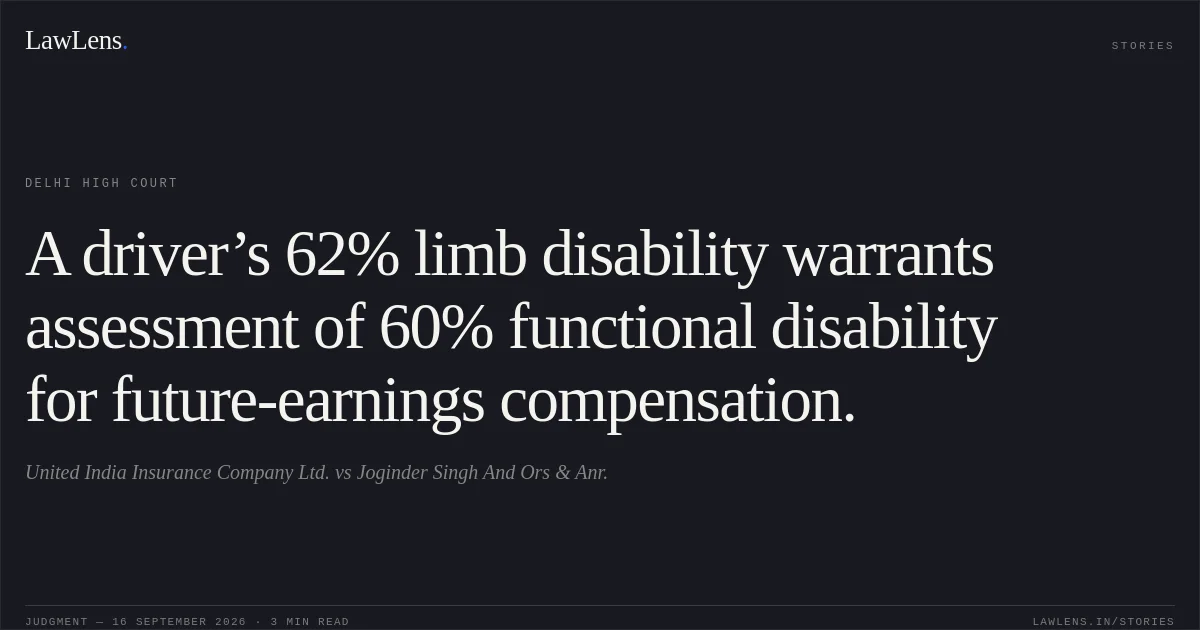
Source reference: p.2, para. 2He suffered 62% permanent disability concerning his right upper and lower limbs.
Source reference: p.2, para. 3Joginder Singh was employed as a driver with the Delhi Transport Corporation and was subsequently declared medically unfit, resulting in compulsory retirement on 28 February 2017.
Source reference: p.2, para. 6; p.3, para. 10The Motor Accident Claims Tribunal, Rohini, awarded compensation of ₹33,04,800 with interest at 9% per annum. The Insurance Company filed an appeal seeking reduction of compensation, while the claimant filed a cross-appeal seeking enhancement.
Source reference: p.2, para. 1Issues
Whether the claimant’s loss of future income was required to be recalculated by applying a multiplier of 11 and future prospects of 15%, considering his age and compulsory retirement?
Source reference: p.3, paras. 10–11Whether the claimant was entitled to compensation for loss of income during the period of unpaid leave?
Source reference: p.3–4, paras. 12–14Whether functional disability should be assessed at 60%, rather than 20%, in view of the claimant’s occupation as a driver and his permanent disability of 62% in the right upper and lower limbs?
Source reference: p.4, paras. 15–16Whether income-tax deductions were required to be made from the claimant’s established income for computing compensation?
Source reference: p.4, para. 17Law Applied
The Court applied the established principles governing compensation under the Motor Vehicles Act, 1988, particularly the assessment of loss of future earning capacity by considering actual income, future prospects, an appropriate age-based multiplier, and the claimant’s functional disability.
Source reference: pp. 3–5, paras. 10–18It distinguished physical or medical disability from functional disability, requiring assessment of the extent to which the injury affects the claimant’s ability to perform his specific occupation.
Source reference: pp. 3–5, paras. 10–18The Court further applied the principle that actual loss of income during a period of unpaid leave may be separately compensated, but the same period cannot be compensated twice through both a separate award and the computation of future income.
Source reference: pp. 3–5, paras. 10–18No specific statutory provision or precedent was expressly cited in the judgment.
Source reference: pp. 3–5, paras. 10–18Reasoning
The Court held that the compensation for loss of future income represented the claimant’s post-retirement earning loss and, since he was 57 years old, a multiplier of 11 was appropriate rather than 9.
Source reference: p.3, para. 10Since the claimant had been compelled to retire approximately three years before his normal superannuation date, the separate award of ₹17,29,476 for that three-year period was deducted to avoid double recovery.
Source reference: p.3, para. 11However, the separate award of ₹2,22,966 for the period of unpaid leave was retained because the claimant’s testimony established that he received substantially reduced or no salary during the relevant months.
Source reference: pp. 3–4, paras. 12–14The Court also found that a 62% permanent disability affecting the claimant’s right upper and lower limbs substantially impaired his ability to work as a commercial or transport driver.
Source reference: p.4, paras. 15–16Nevertheless, taking into account his proximity to retirement, it assessed functional disability at 60%, rather than equating it fully with the medical disability.
Source reference: p.4, paras. 15–16Future prospects of 15% were added to the established monthly income of ₹48,041.
Source reference: p.5, para. 18On the tax issue, the Court accepted the position that, after applicable deductions, the claimant’s income did not fall within the taxable bracket; consequently, no deduction towards income tax was made.
Source reference: p.4, para. 17Holding
The cross-appeals were disposed of by revising the compensation from ₹33,04,800 to ₹49,12,890, inclusive of compensation for medical expenses, conveyance, special diet and attendant charges, loss of income, loss of future earnings, pain and suffering, and loss of amenities.
The Court applied a monthly income of ₹48,041, future prospects of 15%, multiplier of 11, and functional disability of 60%, while retaining ₹2,22,966 for loss of income during unpaid leave.
Source reference: p.5, para. 18The compensation was enhanced by ₹16,08,090, with interest at 9% per annum.
Source reference: p.5, paras. 18–19The enhanced amount, together with accrued interest, was directed to be deposited before the MACT and released to the claimant in a lump sum; the entire compensation and accrued interest were to be released to him.
Source reference: p.5, paras. 20–22The statutory deposit was directed to be refunded to the Insurance Company only upon deposit of the enhanced amount with accrued interest.
Source reference: p.6, para. 25Original Court PDF
United India Insurance Company Ltd.vsJoginder Singh And Ors & Anr.
Click to open original judgment
Original judgment, available to read, download and summarize on LawLens.in