Facts
The appellant was accused of setting fire to a room in Mysuru where he and several hotel workers had previously stayed, causing burn injuries to the occupants.
Source reference: pp. 3–5One occupant, Raju alias Delhi Raju, later died.
Source reference: pp. 3–5The prosecution alleged that the appellant acted out of resentment after a dispute over a mobile phone and a threat made about 15 days earlier.
Source reference: pp. 3–5PW3’s complaint stated that, after the fire began, he saw the appellant leaving; it did not say that PW3 saw him pour fuel or set the fire.
Source reference: pp. 10–14The deceased’s statement, recorded before PW3’s complaint, stated that PW3 had told him that someone had set the fire and fled.
Source reference: pp. 10–14The trial court convicted the appellant under Sections 302, 307, 436 and 449 IPC.
Source reference: pp. 17–19He appealed under Section 374(2) CrPC.
Source reference: pp. 3–5Issues
1. Whether the prosecution proved beyond reasonable doubt that the appellant set fire to the room and was responsible for the resulting death and injuries
Source reference: pp. 14–18, 23–242. Whether the trial court’s convictions under Sections 302, 307, 436 and 449 IPC should be set aside in light of the evidentiary inconsistencies and the deceased’s statement
Source reference: pp. 17–19, 24–25Law Applied
The charges were under Sections 302, 307, 436 and 449 of the Indian Penal Code, concerning murder, attempt to murder, mischief by fire and house-trespass in order to commit an offence punishable with death, respectively; the appeal was brought under Section 374(2) of the Code of Criminal Procedure.
Source reference: pp. 2, 5The prosecution had to establish the charges beyond reasonable doubt.
Source reference: p. 18The Court applied the principle that suspicion, however grave, cannot substitute for proof.
Source reference: p. 18Reasoning
The Court found that neither PW3 nor the other injured occupants had seen the appellant pour fuel or ignite the fire.
Source reference: pp. 10–11, 15–16PW3’s complaint recorded that he saw the appellant leaving after the fire began, while a later statement to the Tahsildar attributed the act of pouring petrol and setting the fire to the appellant; the Court treated that account as an improvement.
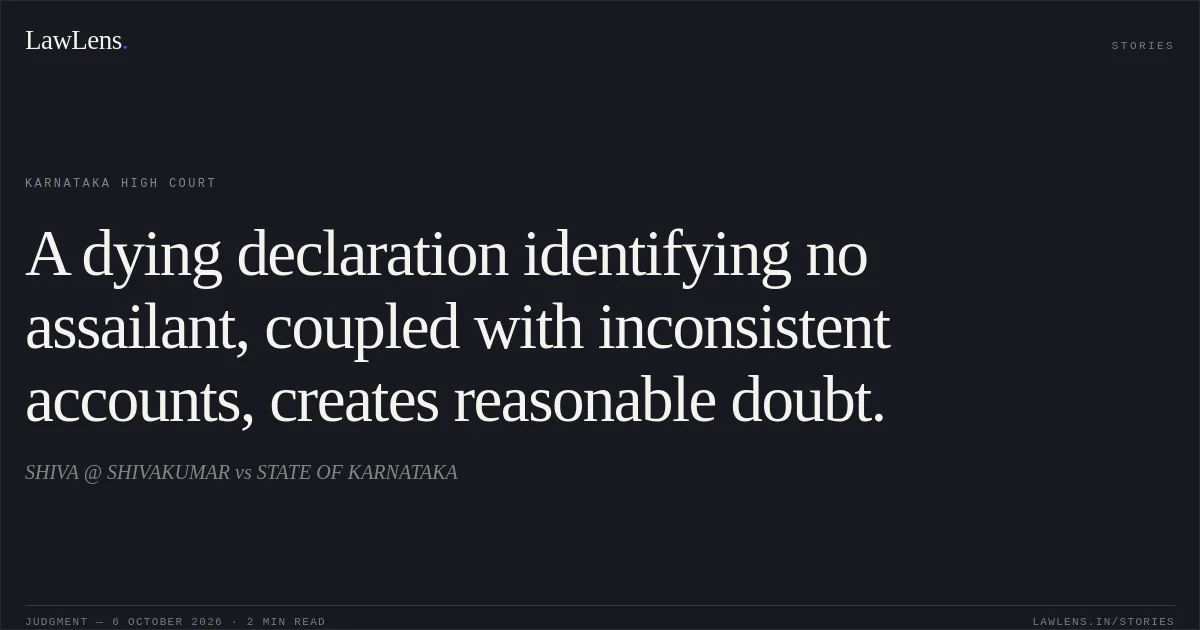
Source reference: pp. 10–11, 15–16The deceased’s earlier statement did not identify the appellant and recorded that PW3 had said only that someone had set the fire and fled, creating doubt about PW3’s claimed identification.
Source reference: pp. 11–12, 17–18The alleged bottle recovered from the appellant tested negative for petrol and kerosene residues.
Source reference: p. 16In the Court’s view, the prior dispute and threat raised suspicion but did not establish the appellant’s guilt beyond reasonable doubt.
Source reference: p. 18Holding
The High Court held that the prosecution had not proved the charges beyond reasonable doubt and allowed the appeal.
It set aside the conviction and sentence and acquitted the appellant of the offences under Sections 302, 307, 436 and 449 IPC.
Source reference: pp. 18–19The Court ordered cancellation of his bail bond and return of any fine amount deposited.
Source reference: pp. 18–19Acts & Sections Cited
5 provisions across 2 statutes referred to in this judgment. Each provision opens on LawLens.
Code of Criminal Procedure, 19731
Indian Penal Code, 18604
Original Court PDF
SHIVA @ SHIVAKUMARvsSTATE OF KARNATAKA
Click to open original judgment
Original judgment, available to read, download and summarize on LawLens.in