Facts
The petitioner, owner of an industrial shed in Howrah, entered into a proposed commercial leave-and-licence arrangement with Opposite Party No. 2 for a plastic-granules manufacturing unit.
Source reference: para. 1–3The parties exchanged funds, including a security deposit of ₹19,25,760 and ₹20 lakh towards electricity requirements; the petitioner also retained an earlier ₹25 lakh electricity-security cheque.
Source reference: para. 1–3The parties disputed whether the premises had been misrepresented as having the required electrical capacity, chimneys and flooring, and whether the petitioner carried out flooring work at the opposite party’s request.
Source reference: para. 1–3After Opposite Party No. 2 demanded a refund by notice dated 11 February 2019, the petitioner presented the ₹25 lakh cheque, which was dishonoured, and commenced proceedings under Section 138 of the Negotiable Instruments Act, 1881.
Source reference: para. 4–6Opposite Party No. 2 then lodged a police complaint alleging offences under Sections 420, 406 and 506 IPC; a charge sheet followed.
Source reference: para. 4–6A civil money suit concerning the transaction was also pending.
Source reference: para. 4–6The petitioner sought quashing of the criminal proceedings under Section 482 CrPC.
Source reference: para. 6Issues
1. Whether the dispute arising from the failed commercial lease was predominantly civil in nature, making the criminal proceedings an abuse of process
Source reference: para. 252. Whether the materials disclosed the ingredients of offences under Sections 420 and 406 IPC, and whether those provisions could both be invoked in respect of the same transaction
Source reference: para. 253. Whether the criminal complaint was a malicious counter-blast to the petitioner’s proceedings under Section 138 of the Negotiable Instruments Act
Source reference: para. 254. Whether the disputed factual claims required a trial or justified quashing under Section 482 CrPC
Source reference: para. 25Law Applied
Section 482 CrPC empowers the High Court to quash proceedings where the allegations do not disclose the ingredients of an offence or where continuation would amount to abuse of process; it is not ordinarily a power to conduct a mini-trial into disputed facts.
Source reference: para. 44–47Under Section 420 IPC, cheating requires dishonest or fraudulent intent at the inception of the transaction; a subsequent contractual breach alone is insufficient.
Source reference: para. 33–35Section 406 IPC requires entrustment of property followed by dishonest misappropriation or conversion.
Source reference: para. 33–35The Court relied on Dalip Kaur v. Jagnar Singh and Sarabjit Kaur v. State of Punjab for the distinction between contractual breach and criminal cheating.
Source reference: para. 30–31The Court relied on Lalit Chaturvedi v. State of U.P. and Delhi Race Club (1940) Ltd. v. State of U.P. for its conclusion that Sections 406 and 420 were inconsistent on the facts alleged.
Source reference: para. 36–38The Court relied on Sunil Kumar v. Escorts Yamaha Motors Ltd., D.P. Gulati v. State of U.P. and Mahmood Ali v. State of U.P. on identifying retaliatory or mala fide criminal proceedings from the surrounding circumstances and chronology.
Source reference: para. 41–42Reasoning
The Court considered the agreement’s “as is where is” and repair-work clauses, Opposite Party No. 2’s notice referring to selection and inspection of the premises, the parties’ competing accounts of the property’s condition, and the pending civil suit.
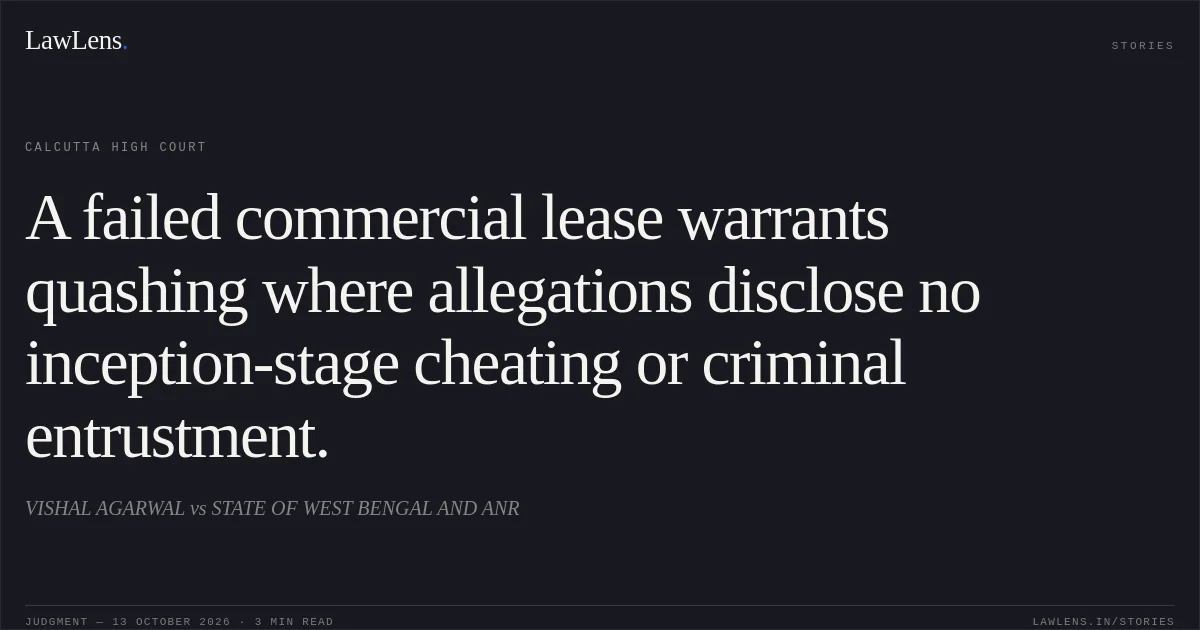
Source reference: para. 27–31It concluded that the dispute principally concerned the breakdown and financial consequences of a commercial arrangement, rather than criminal conduct.
Source reference: para. 27–31It found no prima facie dishonest intent from inception to support Section 420, nor entrustment and subsequent misappropriation to support Section 406; it also treated the two offences as inconsistent in the circumstances of this case.
Source reference: para. 33–38On chronology, it found that the police complaint followed the petitioner’s Section 138 proceedings and inferred that it was a retaliatory counter-blast.
Source reference: para. 39–43Although the parties’ claims about the premises and flooring were disputed, the Court held that those disputes did not require a criminal trial given its conclusions on the civil character of the dispute, the alleged offences and the complaint’s motive.
Source reference: para. 44–47Holding
The Court answered all four issues in favour of the petitioner and allowed the application.
It quashed the proceedings in G.R. Case No. 2138 of 2019, arising from Golabari P.S. Case No. 148 of 2019, including Charge Sheet No. 149 of 2021 and consequential orders.
Source reference: para. 48–50It clarified that its observations would not prejudice the pending civil suit or the Section 138 proceedings, and made no order as to costs.
Source reference: para. 51, 54Acts & Sections Cited
8 provisions across 3 statutes referred to in this judgment. Each provision opens on LawLens.
Code of Criminal Procedure, 19734
Indian Penal Code, 18603
Negotiable Instruments Act, 18811
Original Court PDF
VISHAL AGARWALvsSTATE OF WEST BENGAL AND ANR
Click to open original judgment
Original judgment, available to read, download and summarize on LawLens.in