Facts
The applicant invoked Section 482 of the Code of Criminal Procedure, 1973, seeking quashing of FIR being C.R. No. I-117/2015 registered at Mansa Police Station, Gandhinagar, for offences under Sections 465, 467, 468 and 471 of the Indian Penal Code, 1860.
Source reference: p.1The complainant, the applicant’s brother, alleged that after the death of their father, the applicant falsely represented himself as the sole legal heir, prepared and notarised a false affidavit/pedhinama, and on that basis procured mutation of the father’s property, City Survey No. 1943, in his own name.
Source reference: pp.2–4The applicant contended that the complainant had relinquished his interest in the family properties under a 1999 family arrangement in consideration of Rs.2 lakh, and that the FIR was lodged with mala fide intent to exert pressure in a civil property dispute.
Source reference: p.4The complainant and the State opposed quashing, asserting that the applicant knowingly excluded the complainant and their sister, who were legitimate heirs of the deceased father, from the pedigree document and revenue records.
Source reference: pp.5–6Issues
Whether the allegations that the applicant prepared and used a false affidavit or pedhinama showing himself as the sole heir, and thereby secured mutation of the property, disclose offences under Sections 465, 467, 468 and 471 IPC.
Source reference: pp.6–10Whether the dispute concerning the parties’ respective rights in the property and the effect of the alleged 1999 family arrangement was essentially civil in nature and warranted exercise of the High Court’s inherent jurisdiction under Section 482 CrPC.
Source reference: pp.4, 9–10Law Applied
The Court applied Section 482 CrPC, which empowers the High Court to quash criminal proceedings to prevent abuse of process and secure the ends of justice.
Source reference: no citationIt considered Sections 463 and 464 IPC, under which forgery requires the making of a “false document” with the requisite fraudulent or injurious intent.
Source reference: pp.7–8Section 465 IPC prescribes punishment for forgery; Section 467 applies only where the forged document concerns specified instruments such as a valuable security, will or authority to receive property; Section 468 requires forgery committed for the purpose of cheating; and Section 471 requires use of a forged document as genuine.
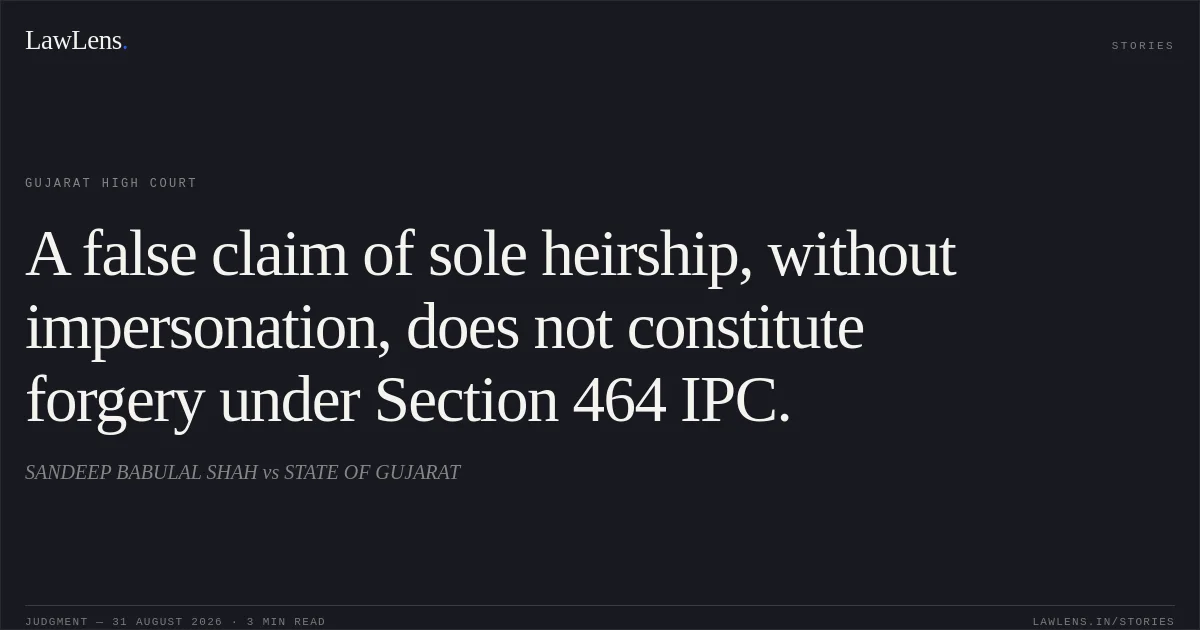
Source reference: pp.7–8Relying on Mohammed Ibrahim v. State of Bihar, (2009) 8 SCC 751, the Court held that a person who executes a document claiming property as his own, even if that claim is ultimately incorrect, does not thereby make a false document unless he impersonates another or falsely claims authority from another person; absent a false document, forgery under Sections 463–464 and the consequential offences under Sections 467 and 471 are not made out.
Source reference: p.8Reasoning
The Court treated the FIR’s essential allegation as being that the applicant made an incorrect or incomplete declaration of heirship by omitting the complainant and their sister from the pedigree document.
Source reference: pp.6–7Applying Mohammed Ibrahim, it held that a wrong statement or claim of exclusive entitlement does not, by itself, satisfy the statutory concept of making a false document under Section 464 IPC.
Source reference: p.8Since the alleged affidavit/pedhinama did not involve impersonation or a false representation of having authority from another person, the foundational element of forgery was absent; consequently, Sections 465, 467, 468 and 471 IPC could not be sustained on the allegations as stated.
Source reference: pp.7–9The competing claims arising from inheritance, the alleged family arrangement, and entitlement to the property were matters for civil adjudication, and the Court expressly refrained from deciding their merits.
Source reference: p.9Holding
The Court held that, even if the FIR were accepted at face value, the allegations did not constitute offences under Sections 465, 467, 468 or 471 IPC.
The application was allowed, and FIR C.R. No. I-117/2015 registered at Mansa Police Station was quashed and set aside.
Source reference: p.9The Court clarified that the order would not affect any civil proceedings concerning the property or the alleged family arrangement, which were to be decided independently on the evidence led by the parties.
Source reference: p.10Acts & Sections Cited
7 provisions across 2 statutes referred to in this judgment. Each provision opens on LawLens.
Code of Criminal Procedure, 19731
Indian Penal Code, 18606
Original Court PDF
SANDEEP BABULAL SHAHvsSTATE OF GUJARAT
Click to open original judgment
Original judgment, available to read, download and summarize on LawLens.in