Facts
On 7 August 2013, a dispute arose between the appellant and the deceased, Subbashetty, over the diversion of water to their adjoining agricultural lands.
Source reference: pp. 2–5The prosecution alleged that the appellant struck the deceased on the head with a spade; the deceased later died from his injuries.
Source reference: pp. 2–5The trial court convicted the appellant under Section 302 IPC and sentenced him to life imprisonment and a fine.
Source reference: pp. 2–5In appeal, the appellant argued that the deceased’s injuries resulted from a fall on a stone and, alternatively, that the incident did not amount to murder.
Source reference: pp. 2–5Issues
Whether the evidence established that the appellant caused the deceased’s fatal head injuries, rather than the injuries resulting from a fall on a stone.
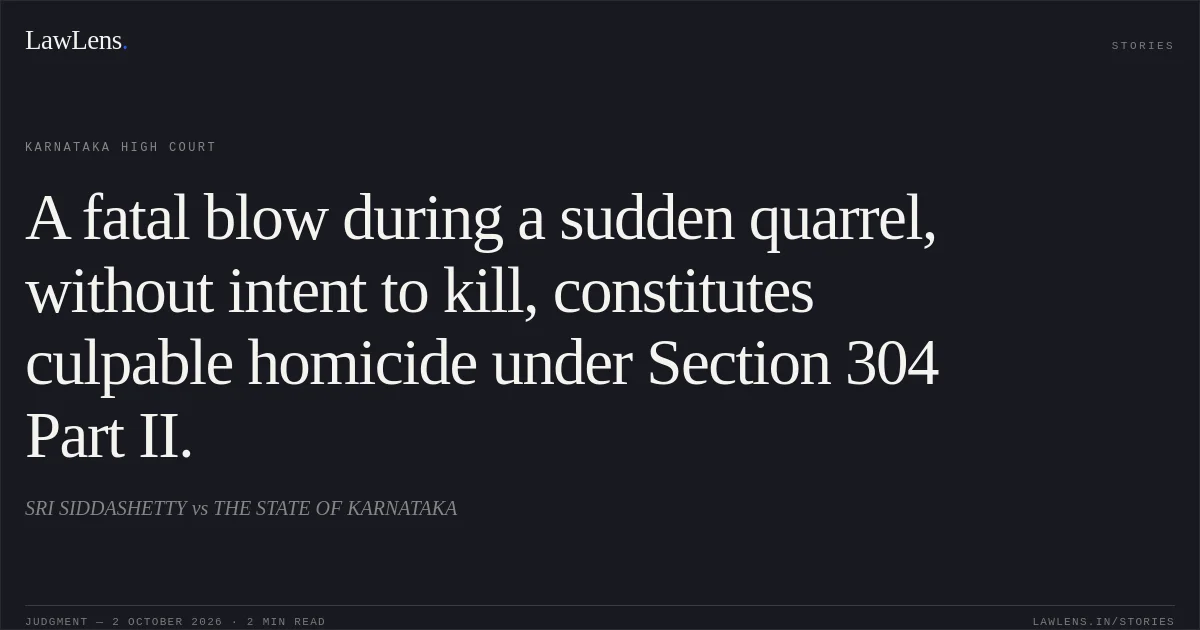
Source reference: pp. 4–5, 8Whether the appellant’s act constituted murder under Section 302 IPC or culpable homicide not amounting to murder under Section 304 Part II IPC.
Source reference: pp. 5, 9–10Law Applied
The court considered Section 302 IPC, under which the appellant had been convicted, and Exception 4 to Section 300 IPC, which it applied to determine whether the homicide amounted to murder or culpable homicide not amounting to murder.
Source reference: pp. 9–10It held that the incident fell within Exception 4 because it arose from a sudden quarrel, was not premeditated, and involved a single blow; the appellant had knowledge that his act could cause death, but the court found no intention to cause death.
Source reference: pp. 9–10The applicable offence was therefore Section 304 Part II IPC.
Source reference: pp. 9–10Reasoning
The court accepted the consistent eyewitness testimony of PWs.1–3 that the appellant struck the deceased with a spade.
Source reference: pp. 6–8The medical evidence established fatal head injuries, and the spade and bloodstained clothing supported the prosecution case; the court rejected the fall-on-stone theory, noting that no bloodstains were found on the stone.
Source reference: pp. 6–8However, the evidence showed that the confrontation arose spontaneously over water diversion, without premeditation, and that the appellant delivered only one blow and did not continue the assault after the deceased fell.
Source reference: pp. 8–10In those circumstances, the court held that Exception 4 to Section 300 applied and that the appellant’s act was punishable under Section 304 Part II, not Section 302 IPC.
Source reference: p. 10Holding
The appeal was allowed in part.
The court set aside the conviction and sentence under Section 302 IPC, convicted the appellant under Section 304 Part II IPC, and sentenced him to the period already undergone.
Source reference: pp. 10–12It also imposed a fine of ₹1,00,000, with one year’s simple imprisonment in default; upon payment or recovery, the fine was to be paid as compensation to the deceased’s wife, PW.3, and deposited before the trial court within 30 days of receipt of the order.
Source reference: pp. 10–12Acts & Sections Cited
4 provisions across 2 statutes referred to in this judgment. Each provision opens on LawLens.
Code of Criminal Procedure, 19731
Indian Penal Code, 18603
Original Court PDF
SRI SIDDASHETTYvsTHE STATE OF KARNATAKA
Click to open original judgment
Original judgment, available to read, download and summarize on LawLens.in