Facts
The appellant and Nandini were married and had two children.
Source reference: no citationThe prosecution alleged that the appellant had harassed her, including by pressuring her to work despite her ill health, and that he assaulted her shortly before her death.
Source reference: no citationOn 1 April 2016, Nandini died after an incident at the couple’s home.
Source reference: no citationThe appellant maintained that she had collapsed because of thyroid and heart-related illness.
Source reference: no citationThe post-mortem examination recorded head injuries and opined that death may have resulted from cardiorespiratory arrest following syncope caused by traumatic impact.
Source reference: p.3–7, 10–12The Sessions Court convicted the appellant under Sections 498A and 302 of the IPC; it rejected the charge under Section 304B.
Source reference: p.8–10The appellant appealed against the conviction and sentence.
Source reference: p.8–10Issues
Whether the prosecution proved that Nandini’s injuries resulted from an assault by the appellant, rather than a fall caused by her medical condition.
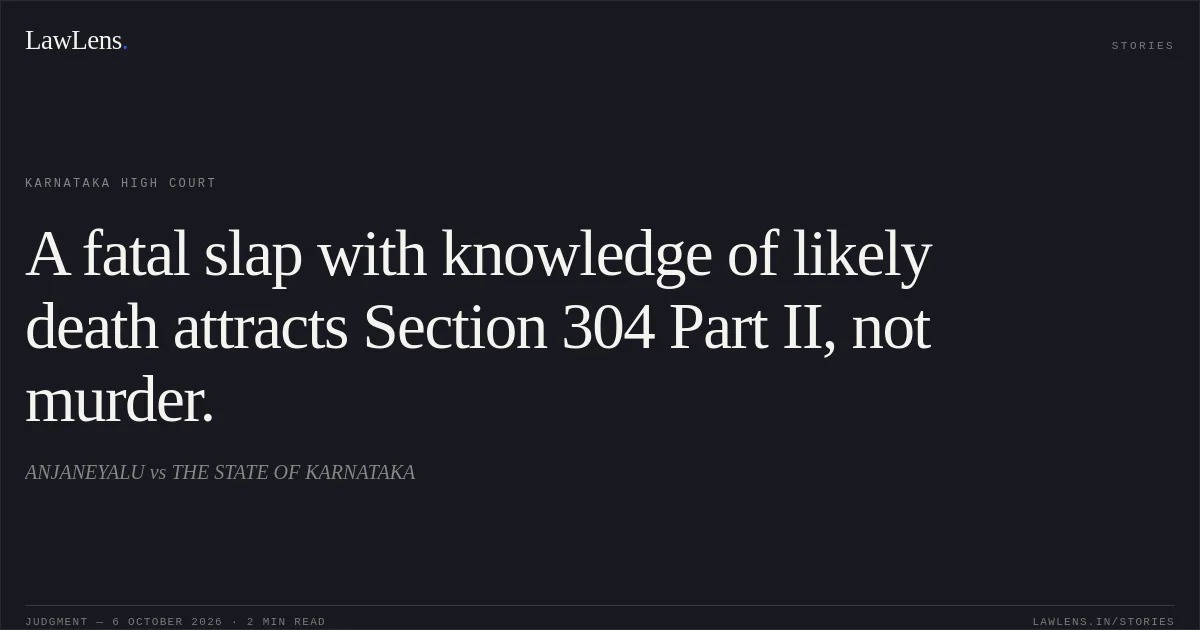
Source reference: p.12–14, 19, 21–23Whether the assault constituted murder under Section 302 IPC or culpable homicide not amounting to murder under Section 304 Part II IPC.
Source reference: p.14–17, 20–24Whether the conviction under Section 498A IPC should be disturbed.
Source reference: p.8–11, 25Law Applied
The Court considered Section 302 IPC, which concerns murder, and Section 304 Part II IPC, which applies where an act causing death is done with knowledge that it is likely to cause death, but without the intention required for murder.
Source reference: p.8–11It also considered Section 498A IPC in relation to cruelty by a husband.
Source reference: p.8–11The Court discussed Section 304B IPC but upheld the trial court’s conclusion that the charge was not established because there were no allegations of dowry harassment.
Source reference: p.8–11It applied Section 428 CrPC in directing set-off of the appellant’s detention.
Source reference: p.19No precedent was cited.
Source reference: no citationReasoning
The Court rejected the defence that Nandini’s illness caused her to fall and sustain the injuries.
Source reference: p.12–14, 19The post-mortem evidence recorded injuries to the head and face, and the doctor’s evidence did not support the proposed fall as an explanation for all the injuries.
Source reference: p.12–14, 19The evidence of PW.2 was that, following a quarrel, the appellant said he had assaulted Nandini and that she had fallen; the Court inferred that he had slapped her, causing her to fall and sustain the head injury.
Source reference: p.15–17However, the medical evidence did not establish that the injury was sufficient in the ordinary course of nature to cause death.
Source reference: p.17The Court therefore found the appellant had the requisite knowledge, but not the basis for sustaining a murder conviction, and classified the offence under Section 304 Part II IPC.
Source reference: p.17It found no reason to disturb the Section 498A conviction, supported by evidence of continuing harassment and cruelty.
Source reference: p.9–10, 18Holding
The appeal was allowed in part.
The conviction under Section 302 IPC was set aside and replaced with a conviction under Section 304 Part II IPC.
Source reference: p.18–19The appellant was sentenced to ten years’ rigorous imprisonment and a fine of ₹10,000, with six months’ simple imprisonment in default.
Source reference: p.18–19The Section 498A conviction was confirmed; the remaining compensation directions were left unchanged.
Source reference: p.18–19The sentences were ordered to run concurrently, with set-off under Section 428 CrPC.
Source reference: p.18–19Acts & Sections Cited
7 provisions across 3 statutes referred to in this judgment. Each provision opens on LawLens.
Indian Penal Code, 18603
Code of Criminal Procedure, 19733
Bharatiya Nagarik Suraksha Sanhita, 20231
Original Court PDF
ANJANEYALUvsTHE STATE OF KARNATAKA
Click to open original judgment
Original judgment, available to read, download and summarize on LawLens.in