Facts
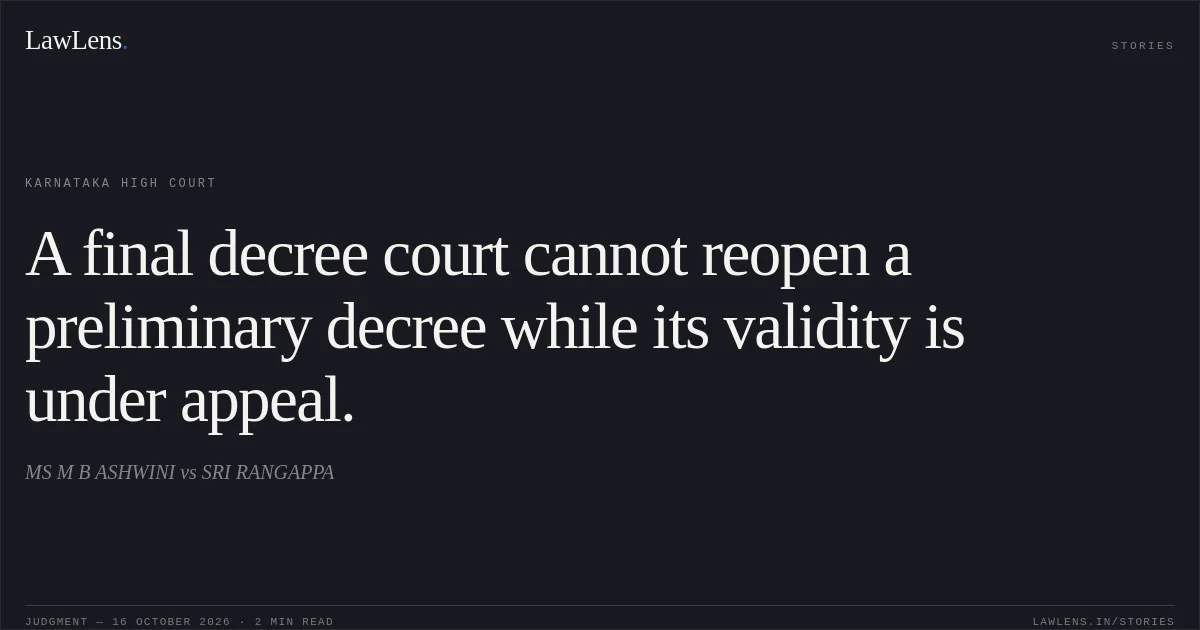
The petitioner, claiming to be a purchaser of suit-schedule property, challenged orders of the Final Decree Court rejecting applications in FDP No. 12/2008 and FDP No. 6/2020.
Source reference: para. 2Both proceedings arose from a preliminary partition decree in O.S. No. 174/2001.
Source reference: para. 2The petitioner contended that the preliminary decree was collusive.
Source reference: para. 2She had separately challenged that decree in O.S. No. 42/2011; the suit was dismissed, and the dismissal was affirmed in R.A. No. 65/2012. Her second appeal, R.S.A. No. 323/2014, had been admitted. The final decree proceedings were stayed pending that appeal.
Source reference: para. 2, 4Issues
1. Whether a transferee of suit-schedule property may seek rejection of final decree proceedings on the ground that the preliminary decree is collusive
Source reference: para. 52. Whether the Final Decree Court’s rejection of the petitioner’s applications warranted interference under Article 227 of the Constitution
Source reference: para. 8–9Law Applied
Under Order XX Rule 18 of the Code of Civil Procedure, 1908, final decree proceedings in a partition suit implement the rights and shares declared by the preliminary decree, including through division of the property by metes and bounds.
Source reference: para. 6A preliminary decree remains operative unless set aside or modified by a competent court; its validity is not ordinarily open to reconsideration in final decree proceedings.
Source reference: para. 6The High Court’s supervisory jurisdiction under Article 227 does not warrant interference absent illegality or infirmity in the impugned orders.
Source reference: para. 8The judgment cited no specific precedent.
Source reference: para. 6, 8Reasoning
The petitioner’s allegation of collusion challenged the validity of the preliminary decree, an issue already raised in her pending second appeal.
Source reference: para. 6–8The Final Decree Court’s role was to give effect to the preliminary decree, not to reconsider its correctness or validity.
Source reference: para. 6–8The pending appeal did not entitle the petitioner to obtain rejection of the final decree proceedings on the same ground.
Source reference: para. 6–8Since those proceedings were already stayed and no illegality or infirmity was shown in the orders rejecting her applications, the Court found no basis for Article 227 intervention.
Source reference: para. 6–8Holding
The Court answered the first issue in the negative and declined to interfere under Article 227.
Both writ petitions were dismissed.
Source reference: para. 8–10The petitioner remained at liberty to pursue her challenge in R.S.A. No. 323/2014, with all contentions in that appeal kept open and the appeal to be decided on its own merits, uninfluenced by the observations in these writ petitions.
Source reference: para. 8–10Original Court PDF
MS M B ASHWINIvsSRI RANGAPPA
Click to open original judgment
Original judgment, available to read, download and summarize on LawLens.in