Facts
The petitioners were appointed following Advertisement No. 1/2015 to various support-staff posts in the Jharkhand Armed Police and related forces.
Source reference: p. 4–6Their services were terminated on 23 June 2016 due to alleged irregularities in the selection process.
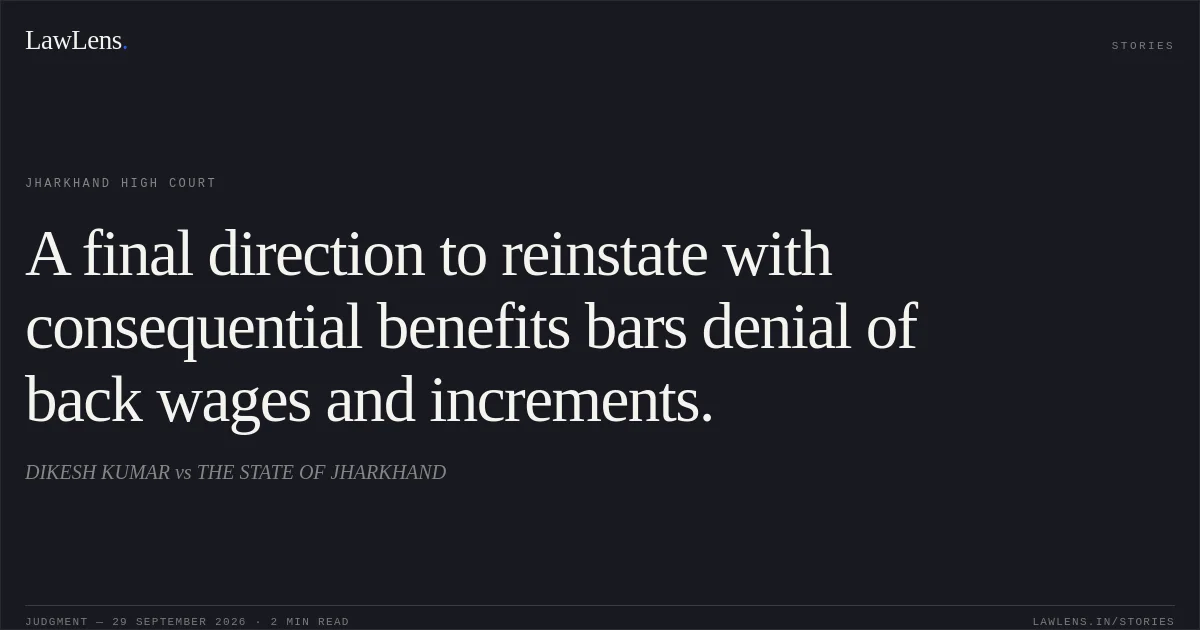
Source reference: p. 4–6In an earlier writ petition, the High Court set aside the termination and directed their reinstatement “with all consequential benefits”; the State did not challenge that order.
Source reference: p. 4–6On 22 January 2021, the State revoked the termination and granted continuity of service, but treated the intervening period as “No Work, No Pay.”
Source reference: p. 4–6The petitioners challenged that condition, seeking back wages, increments and other consequential benefits for the period from 23 June 2016 to 22 January 2021.
Source reference: p. 4–6Issues
1. Whether the State could impose a “No Work, No Pay” condition when implementing the final earlier order directing reinstatement with consequential benefits.
Source reference: p. 5–82. Whether the petitioners were entitled to back wages, increments and other monetary benefits for the intervening period.
Source reference: p. 7–13Law Applied
The Court relied on Rule 97 of the Jharkhand Service Code, 2001, which requires the competent authority, upon reinstatement, to make a specific order concerning pay and allowances for the absence period and whether that period counts as duty; full pay and treatment as duty follow where the employee is fully exonerated.
Source reference: p. 9–10It applied the principle that a final judicial direction to grant “consequential benefits” must be implemented and cannot be diluted by the employer.
Source reference: p. 11–12Relying on *Deepali Gundu Surwase v. Kranti Junior Adhyapak Mahavidyalaya*, the Court noted that reinstatement with continuity and back wages is ordinarily appropriate in wrongful-termination cases, subject to relevant circumstances, and that an employer seeking to deny back wages must plead and prove gainful employment.
Source reference: p. 10–11It also relied on *Commissioner, Karnataka Housing Board v. C. Muddaiah*, *T. Sudhakar v. Union of India* and *Rajendra Prasad Sharma v. State of Jharkhand* for the binding effect of final orders and the inclusion of increments and other monetary benefits within consequential benefits.
Source reference: p. 9–12Reasoning
The earlier order expressly required reinstatement with consequential benefits and had attained finality; the State therefore could not use the 2021 notification to qualify that direction by imposing “No Work, No Pay.”
Source reference: p. 7–8, 12–13The petitioners’ absence resulted from the State’s termination decision, and they asserted that they remained unemployed; the State did not rebut that assertion by showing gainful employment.
Source reference: p. 8The Court held that Rule 97 did not justify withholding benefits in the absence of a finding supporting that result or a specific order consistent with the Rule.
Source reference: p. 9–11It further found that increments were consequential benefits because their denial would adversely affect future pay fixation and service-related benefits.
Source reference: p. 9–11Holding
The Court held that the “No Work, No Pay” condition was legally unsustainable.
It partially quashed and modified Notification No. 351 dated 22 January 2021.
Source reference: p. 13It directed the respondents to grant the petitioners consequential benefits, including back wages and increments, and to issue the necessary orders within eight weeks of receiving or being presented with a copy of the judgment.
Source reference: p. 13The writ petition was allowed on those terms.
Source reference: p. 13Acts & Sections Cited
1 provisions across 1 statute referred to in this judgment. Linked provisions open on LawLens.
Industrial Disputes Act, 19471
Original Court PDF
DIKESH KUMARvsTHE STATE OF JHARKHAND
Click to open original judgment
Original judgment, available to read, download and summarize on LawLens.in