Facts
Mutation No. 488, attested on 7 December 1970, recorded the estate of the petitioner’s father in favour of certain heirs, excluding the petitioner.
Source reference: para. 2–10She claimed that she was a minor when the mutation was attested, had lived outside the Valley, and first learned of it in 2022. In 2023, she challenged the mutation and sought condonation of delay; the Sub-Divisional Magistrate condoned the delay, and the Additional Commissioner upheld that decision.
Source reference: para. 2–10On revision, the Financial Commissioner set aside those orders and upheld the mutation. The petitioner then sought judicial review under Article 226.
Source reference: para. 2–10, 34–40Issues
Whether the Financial Commissioner was justified in setting aside the orders condoning the delay of more than five decades in challenging Mutation No. 488.
Source reference: para. 40Whether the Financial Commissioner’s decision disclosed a ground for interference under Article 226.
Source reference: para. 45, 56Law Applied
Condonation of delay is discretionary and depends on the sufficiency and acceptability of the explanation; courts must distinguish a genuine explanation from a mere excuse, and the length of delay, the party’s conduct, intervening rights, and likely prejudice are relevant considerations (*Sheo Raj Singh v. Union of India*, para. 29, quoted at para. 46).
Source reference: para. 46Limitation must be applied as prescribed and cannot be extended merely on equitable grounds or hardship (*Basawaraj v. Special Land Acquisition Officer*, discussed at paras. 49–50).
Source reference: para. 49–50A party seeking condonation must provide a satisfactory explanation for the relevant period of delay; limitation also serves finality and certainty in legal proceedings.
Source reference: para. 48, 51–52Under Article 226, the High Court may decline interference where the revisional authority has acted within its jurisdiction and committed no manifest error of law.
Source reference: para. 56Reasoning
The Court found that the petitioner’s minority at the time of attestation and residence outside the Valley did not explain her inaction for the entire period between 1970 and the 2023 challenge.
Source reference: para. 42–43, 53–54Even if minority were established, it did not account for the decades after she attained majority; nor was there a cogent explanation for the periods before 1989 and after conditions in the Valley improved.
Source reference: para. 42–43, 53–54The Financial Commissioner had considered the asserted lack of knowledge, residence, prevailing conditions, and the passage of time, and also noted a 2003 transaction that could have created third-party interests.
Source reference: para. 36–39, 44–45Applying the principles on sufficient cause and limitation, the Court concluded that the revisional decision was reasoned and disclosed no jurisdictional or manifest legal error warranting writ intervention.
Source reference: para. 52, 54–56Holding
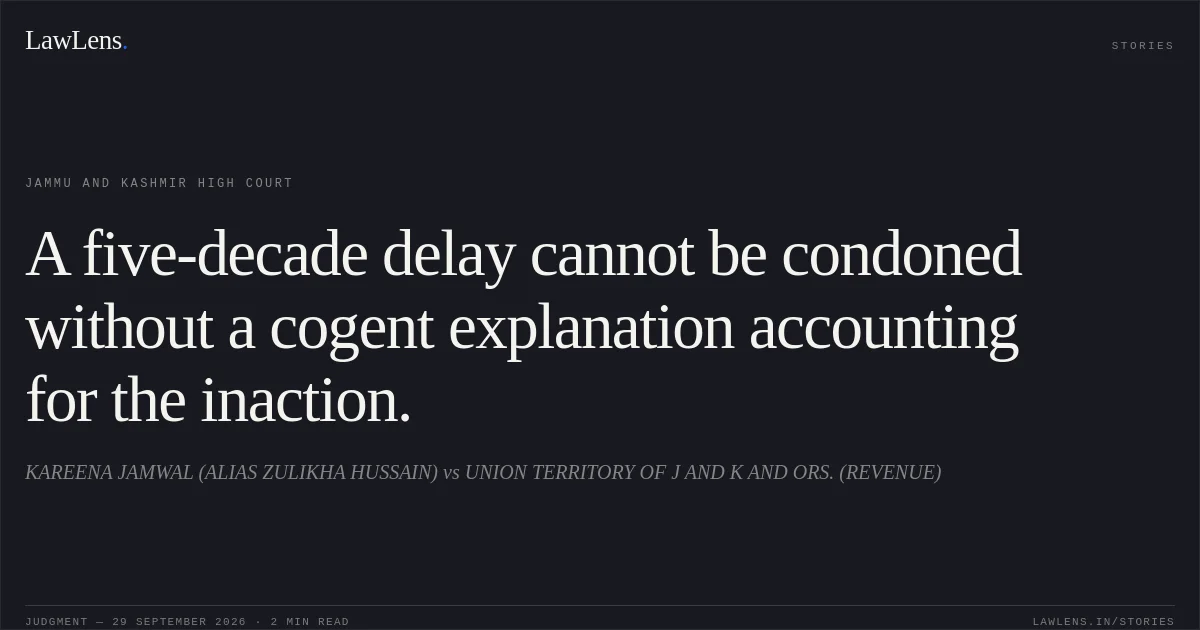
The Court held that the petitioner had not satisfactorily explained the delay of more than five decades and that the Financial Commissioner was justified in setting aside the orders condoning it.
The writ petition was dismissed, and the Financial Commissioner’s order dated 29 August 2025, including its decision to uphold Mutation No. 488, was affirmed.
Source reference: para. 56–57Original Court PDF
KAREENA JAMWAL (ALIAS ZULIKHA HUSSAIN)vsUNION TERRITORY OF J AND K AND ORS. (REVENUE)
Click to open original judgment
Original judgment, available to read, download and summarize on LawLens.in