Facts
The appellant, V.K. Sharma, preferred an appeal under Section 483 of the Companies Act, 1956 against the order dated 1 July 2026 passed by the Company Judge.
Source reference: pp.4–6The impugned order upheld the claims of 14 applicants/buyers, finding that their transactions were bona fide, supported by valuable consideration, and did not amount to fraudulent preference under Section 531 of the Companies Act, 1956.
Source reference: pp.4–6It directed allotment and possession of the relevant plots, relying inter alia on the Official Liquidator’s reports, the SFIO report, and the Official Liquidator’s “no objection”.
Source reference: pp.4–6The respondents raised a preliminary objection that the appeal was not maintainable because the appellant, a former director/ex-management member, had no locus standi to challenge orders concerning creditors and buyers in the winding-up proceedings.
Source reference: pp.6–8They relied on the Division Bench’s earlier order dated 16 November 2018 in V.K. Sharma v. Official Liquidator & Ors., Company Appeal No. 24 of 2018, involving the same parties and circumstances, in which the appellant’s locus was rejected.
Source reference: pp.6–8The appellant contended that Section 483 conferred a statutory right of appeal and relied on Phatu Rochiram Mulchandani v. Karnataka Industrial Areas Development Board, (2015) 5 SCC 244.
Source reference: pp.8–9Issues
1. Whether an erstwhile director/ex-management member, acting in his individual capacity, had the locus standi to maintain an appeal under Section 483 of the Companies Act, 1956 against an order passed in winding-up proceedings concerning claims of creditors and buyers.
Source reference: paras. 2, 7–10; pp.6–92. Whether the appellant could maintain the present appeal when the same issue of his locus standi had already been decided against him by the Division Bench in Company Appeal No. 24 of 2018, and that decision had attained finality.
Source reference: paras. 5, 9–10; pp.7, 93. Whether costs should be imposed for pursuing an appeal found to be obstructive and intended to delay the winding-up proceedings and implementation of the buyers’ rights.
Source reference: paras. 11–15; pp.9–11Law Applied
The Court applied Section 483 of the Companies Act, 1956, which provides for an appeal from an order made by the Company Court in winding-up proceedings, while holding that the statutory remedy presupposes a legally cognisable locus to challenge the order.
Source reference: pp.6–8It relied on the earlier Division Bench decision in V.K. Sharma v. Official Liquidator & Ors., Company Appeal No. 24 of 2018, which held that a former director could not, in his individual capacity, challenge orders dealing with creditors’ claims without demonstrating locus standi.
Source reference: pp.6–8The Court also considered Phatu Rochiram Mulchandani v. Karnataka Industrial Areas Development Board, (2015) 5 SCC 244, where maintainability was prima facie accepted because the appellant had a direct financial interest arising from personal guarantees, but distinguished that principle in light of the binding, final inter partes decision governing the present appellant.
Source reference: p.8–9The Court additionally took note of V.K. Jain v. KSL & Industries Ltd., Criminal Appeal No. 663 of 2016, and the subsequent proceedings referred to by the respondents.
Source reference: p.7Reasoning
The Court held that the earlier order dated 16 November 2018 concerned the same appellant, the Official Liquidator, and the same factual context, and had already rejected the appellant’s attempt to challenge winding-up orders in his individual capacity for want of locus standi.
Source reference: paras. 2, 9–10; pp.6–9Since that determination had attained finality and no distinguishing basis was established, the Court declined to adopt a contrary view merely because the present appeal was framed under Section 483.
Source reference: paras. 9–10; pp.6–9The appellant’s status as a former director, major shareholder, or promoter did not by itself confer a right to obstruct adjudication of creditors’ and buyers’ claims.
Source reference: no citationThe Court also relied on the Company Judge’s findings concerning the appellant’s repeated obstructive conduct and concluded that the appeal had been pursued to delay the winding-up proceedings and prevent the beneficiaries of prior orders from receiving their relief.
Source reference: paras. 10–13; pp.9–10Holding
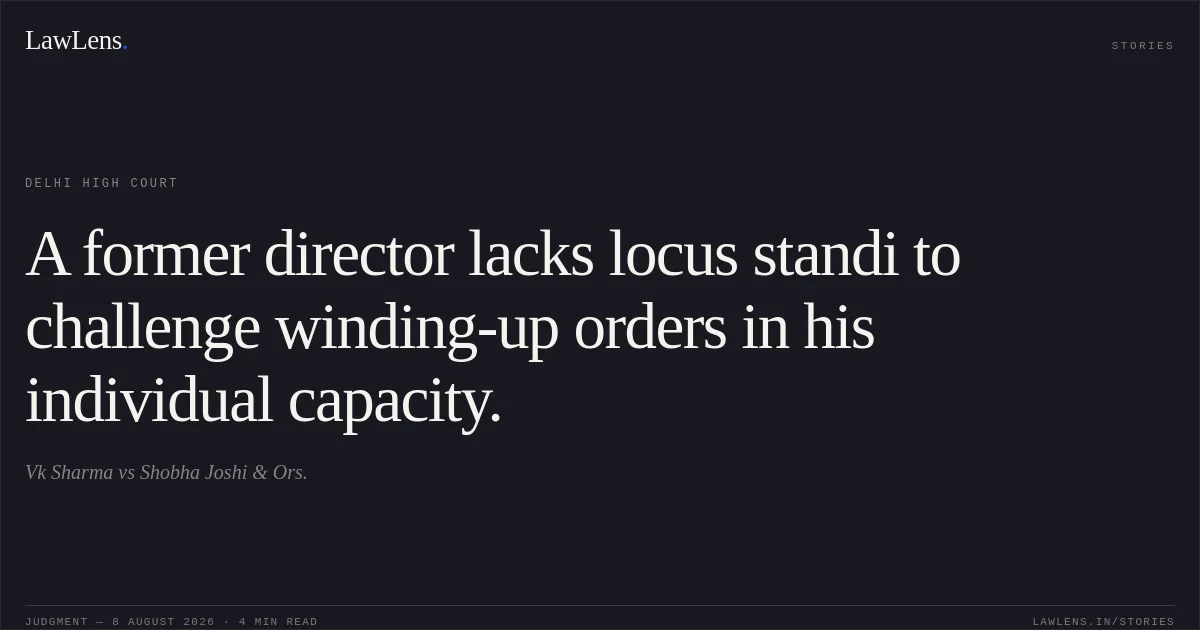
The appeal was held to be not maintainable because the appellant lacked locus standi to challenge the Company Court’s order in his individual capacity, and the issue had already attained finality against him in the earlier proceedings.
The appeal was dismissed, without adjudication of the underlying buyers’ claims on merits.
Source reference: para. 16; p.11Costs of ₹1,00,000 were imposed, payable to the Registry within one month; upon deposit, the amount was directed to be transferred to the Delhi High Court Advocates Welfare Trust.
Source reference: paras. 13–14; p.10In default, the costs were directed to be recovered as land-revenue dues through the concerned Collector.
Source reference: paras. 15–16; pp.10–11Pending applications were also disposed of.
Source reference: para. 17; p.11Acts & Sections Cited
2 provisions across 1 statute referred to in this judgment. Linked provisions open on LawLens.
Companies Act, 19562
Original Court PDF
Vk SharmavsShobha Joshi & Ors.
Click to open original judgment
Original judgment, available to read, download and summarize on LawLens.in