Facts
The appellant’s grandfather became a tenant of the subject premises in 1958; the tenancy devolved upon the appellant’s father, who moved out in 2005.
Source reference: p. 2–3After the premises were notified as a heritage building in 2016, they were sold to private respondents in 2020, demolished in 2021, and replaced by a new structure.
Source reference: p. 2–3The appellant’s father had earlier challenged the construction and ownership, and the appellant later filed a writ petition seeking, among other reliefs, directions to the MCD to book, seal and demolish the new structure.
Source reference: p. 3–4The Single Judge dismissed the petition, holding that the appellant lacked locus standi because he was not directly affected by the alleged unauthorised construction.
Source reference: p. 3–4The appellant challenged that dismissal, relying on asserted subsisting tenancy rights.
Source reference: p. 4–5Issues
1. Whether the appellant had locus standi to maintain a writ petition seeking action against the new structure on the basis of asserted tenancy rights in the demolished premises.
Source reference: p. 5–62. Whether the appellant demonstrated direct injury or prejudice from the construction sufficient to challenge it under Article 226 of the Constitution.
Source reference: p. 6Law Applied
Under Article 226, a person seeking demolition of allegedly unauthorised construction must show that they are directly affected; the Court relied on Tarun Kumar v. Government of NCT of Delhi, 2025 SCC OnLine Del 10623, which it understood to require that the petitioner be an immediate neighbour directly affected by the construction.
Source reference: p. 6The Court also considered that the appellant had placed no determination of his asserted tenancy rights in his favour on the record.
Source reference: p. 6The judgment did not decide the underlying merits of the alleged heritage or building-law violations.
Source reference: no citationReasoning
The appellant had shifted from the premises in 2005, and the premises were demolished in 2021.
Source reference: p. 6His claims that the premises remained locked, that he and his family visited, and that belongings were kept there related to the period before demolition; he produced no material establishing direct injury or prejudice caused by the new construction.
Source reference: p. 6Nor had he placed any determination of tenancy rights in his favour on record.
Source reference: p. 6Applying Tarun Kumar, the Court agreed that the appellant was not directly affected in the manner required to invoke writ jurisdiction for the reliefs sought.
Source reference: p. 6–7Holding
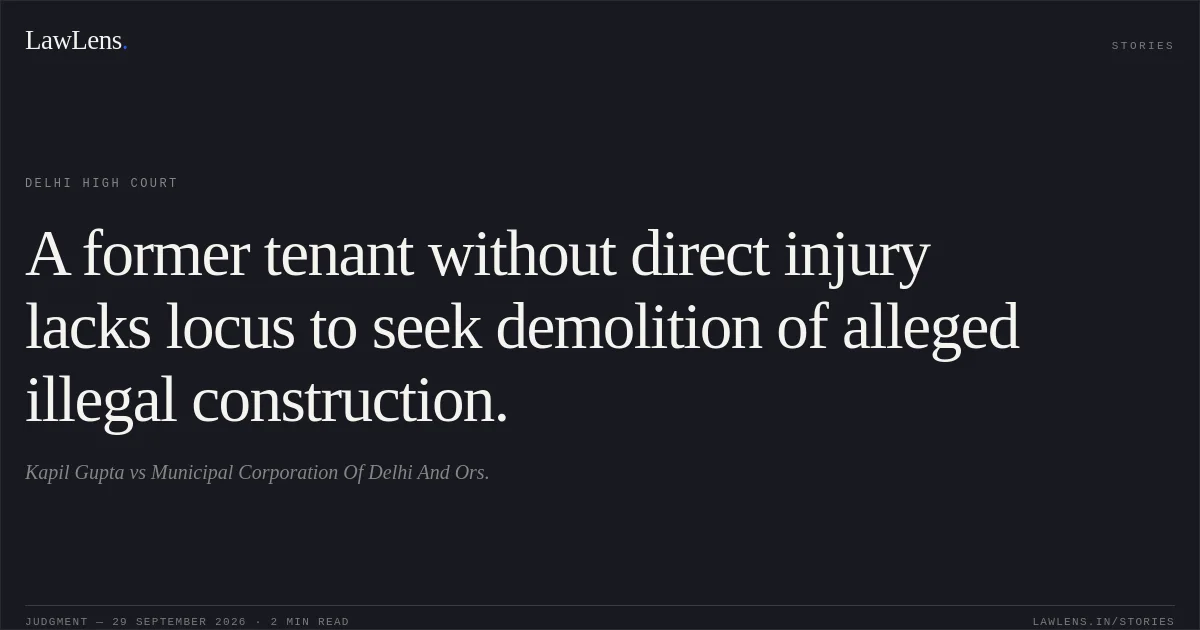
The Court held that the appellant lacked the requisite locus standi to maintain the writ petition and found no infirmity in the Single Judge’s decision.
The appeal was dismissed as devoid of merit; pending applications were disposed of, with no order as to costs.
Source reference: p. 7Acts & Sections Cited
4 provisions across 3 statutes referred to in this judgment. Each provision opens on LawLens.
delhi rent control act, 19581
Code of Criminal Procedure, 19732
Delhi Municipal Corporation Act, 19571
Original Court PDF
Kapil GuptavsMunicipal Corporation Of Delhi And Ors.
Click to open original judgment
Original judgment, available to read, download and summarize on LawLens.in