Facts
The petitioner, a Railway employee, was found in disciplinary proceedings to have obtained employment by submitting a forged ITI marksheet.
Source reference: para. 12–15The disciplinary authority imposed a penalty of reduction of pay to the initial stage for five years; the finding that the marksheet was forged was not challenged
Source reference: para. 12–15The Divisional Railway Manager (DRM) issued a notice proposing revision, but later withdrew it. The General Manager subsequently issued a notice dated 20.10.2021 proposing enhancement of the penalty
Source reference: para. 3, 11The Central Administrative Tribunal dismissed the petitioner’s challenge to the notices, and he challenged that decision before the High Court
Source reference: para. 1, 4Issues
1. Whether the General Manager could initiate revision and issue a notice proposing enhancement of the penalty beyond six months from the disciplinary order, under Rule 25(5) of the Railway Servants (Discipline & Appeal) Rules, 1968
Source reference: para. 8–11, 162. Whether the General Manager’s exercise of revisional power approximately two years after the disciplinary order was unreasonable or otherwise invalid
Source reference: para. 16–22Law Applied
Rule 25(5) of the Railway Servants (Discipline & Appeal) Rules, 1968 generally bars specified authorities from initiating revision after six months where an adverse modification or enhancement of penalty is proposed.
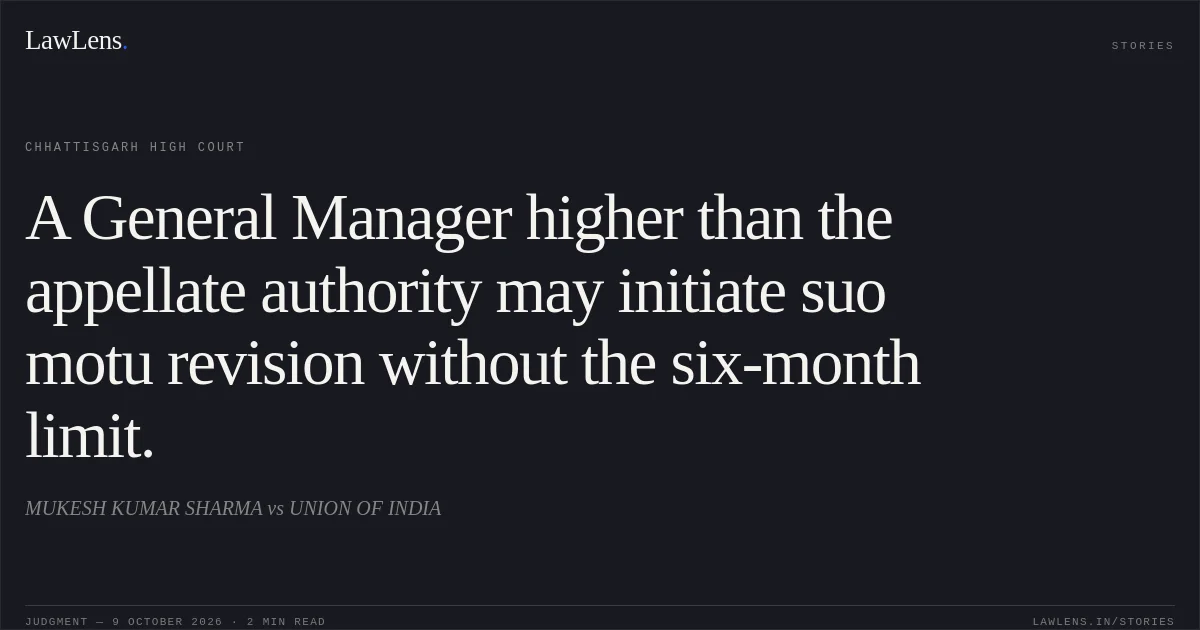
Source reference: para. 8Its proviso permits the Railway Board, a Zonal Railway General Manager, or an authority of equivalent status—when higher than the appellate authority—to undertake revision without a time limit.
Source reference: para. 8The Court also applied the principle that, where a statute does not prescribe a time limit, revisional power must be exercised within a reasonable time, assessed in light of the circumstances.
Source reference: para. 17–20It referred to *Santosh Kumar Shivgonda Patil v. Balasaheb Tukaram Shevale*, (2009) 9 SCC 359, and *Ibrahimpatnam Taluk Vyavasaya Coolie Sangham v. Suresh Reddy*, (2003) 7 SCC 667, on reasonable time and the circumstances in which revisional power may be exercised
Source reference: para. 17–20Reasoning
The Court accepted that the DRM’s notice had been withdrawn after the DRM’s six-month limitation was considered, but held that the General Manager was a higher authority than the appellate authority and fell within the express proviso to Rule 25(5); therefore, the six-month restriction did not bar the General Manager’s notice
Source reference: para. 10–11It further concluded that the approximately two-year interval was not inordinate in the circumstances, particularly because the disciplinary finding was that the petitioner had secured employment through a forged marksheet for a qualification he did not possess, and that finding had not been challenged
Source reference: para. 13–15, 21–22Holding
The High Court held that the General Manager could initiate revision under the proviso to Rule 25(5), and that the timing of the proposed revision was not unreasonable on the facts.
Finding no error in the Tribunal’s decision, it dismissed the writ petition
Source reference: para. 22–23Original Court PDF
MUKESH KUMAR SHARMAvsUNION OF INDIA
Click to open original judgment
Original judgment, available to read, download and summarize on LawLens.in